

Request a demo specialized to your need.
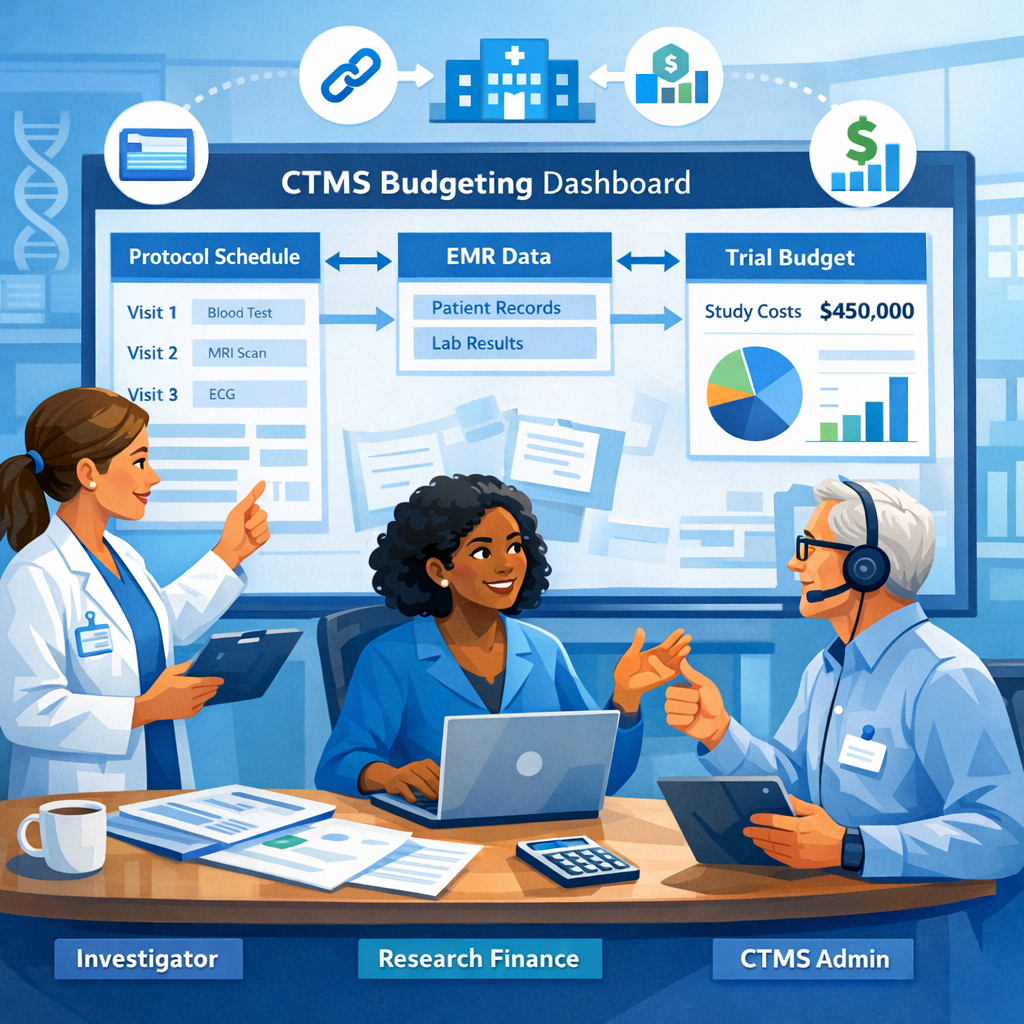
How academic medical centers can use CTMS-based budgeting to align investigators, finance, and compliance teams.
Why Hospital Trial Budgets Need a CTMS Backbone
Academic medical centers and hospital-based research institutes sit at the sharp end of clinical trial budgeting. They must reconcile sponsor expectations, internal coverage-analysis rules, complex care delivery costs, and the realities of investigator and coordinator time, often across dozens or hundreds of concurrent studies.
Too often, the result is a patchwork of spreadsheets, manually maintained trackers, and after-the-fact reconciliations that leave both researchers and finance teams frustrated. A CTMS-based budgeting model offers a way out of this trap.
From Documents to Operations: What CTMS-Based Budgeting Actually Means
Instead of treating budgets as documents that live apart from operations, hospitals can use Cloudbyz CTMS and Clinical Trial Financial Management (CTFM) to make budgets explicit reflections of how work actually gets done:
- Which visits and procedures occur
- Who performs them
- What they cost at institutional research rates
- How they map to contracts and billing rules
Academic CTMS implementations described in the literature show how powerful an integrated approach can be when EMR, IRB, ERP, and CTMS are wired together. For Cloudbyz customers, the same principles apply on a Salesforce-native platform.
The starting point is a shared understanding among investigators, research finance, and compliance teams of what a "good" budget looks like: protocol-driven, tied to clearly defined visit and procedure templates, explicit about which services are billable to payers versus the sponsor, and realistic about coordinator and investigator effort.
Instead of asking PIs to fill in line-item spreadsheets, hospitals can configure CTMS to present protocol-linked visit calendars and standard cost libraries, then let CTFM assemble budgets from those building blocks.
Serving Three Masters at Once
Crucially, CTMS-based budgeting must serve three constituencies simultaneously:
- Investigators need clarity about how many patients they can enroll and what resources they will have.
- Finance teams need reliable forecasts of cash inflows and costs over time.
- Compliance teams need assurance that research-only services are not leaking into routine billing, and that coverage-analysis decisions are being executed consistently.
When Cloudbyz becomes the shared surface where all three perspectives meet, budgeting shifts from a one-time negotiation to an ongoing, data-driven dialogue.
Designing Workflows That Connect Protocol, EMR, and Budget
With a clear picture of where money is really spent, the next step is designing CTMS workflows that connect protocol, EMR, and budget in ways that work for investigators and hospital finance alike. Academic medical centers have two structural advantages: deep expertise in clinical workflows and rich EMR data. A Cloudbyz-based model should exploit both.
Start at Protocol Review
When a new trial is proposed, a multidisciplinary team including the PI, sub-investigators, CRCs, research billing, radiology and lab representatives, and finance should walk through the schedule of assessments and map each planned visit and procedure to three things:
- A CTMS visit or procedure template
- A billing designation (standard of care vs. research)
- A rate source (internal research rate, sponsor contract tariff, or external vendor schedule)
Standard cost categories can be encoded as reusable rate cards and templates rather than ad hoc spreadsheets, replacing one-off work with institutional knowledge that compounds over time.
CTMS as Operational Checklist
Once templates and designations are set, CTMS serves as the operational checklist. Each subject's visit calendar, drawn from the protocol, shows exactly which items are expected, and EMR integrations can pre-populate many data points (labs, imaging, ancillary services) onto the CTMS record.
Research billing teams can then use Cloudbyz views to confirm that services marked as research in coverage analysis are being captured consistently, while services billed to payers match institutional policy. Discrepancies become visible early, before they spiral into denials or compliance issues.
Finance-Side Benefits
On the finance side, Cloudbyz CTFM uses the same CTMS events to drive budget drafts and revisions. Site budgets are built as combinations of rateable units:
- Per-subject visit bundles
- Per-procedure tariffs
- Startup and closeout packs
- Fixed fees for data management or pharmacy
As the trial runs, CTFM compares actual CTMS volumes (visits completed, packs delivered, deviations requiring extra work) to budgeted assumptions, giving both investigators and finance a shared view of burn and margin. Because all of this logic lives inside the Salesforce-native platform, it can be audited and adjusted centrally rather than rediscovered for every new study.
Building a Roadmap: From Pilots to a Hospital-Wide Backbone
Moving from pilot projects to a hospital-wide CTMS budgeting backbone requires sustained governance and change management, but the rewards go beyond cleaner spreadsheets. When academic medical centers can show that CTMS-based budgets are grounded in EMR and operational data, they gain credibility with sponsors, reduce internal friction, and strengthen their regulatory posture.
A practical roadmap typically unfolds in three waves.
Wave 1 - Prove the Model
Select a handful of high-impact studies, often large oncology or cardiovascular trials, to run on the full Cloudbyz stack: CTMS visit and milestone dictionaries, EMR integrations for key procedures, CTFM-driven site budgets, and dashboards for enrollment, burn, and billing compliance. The goal is to prove that investigators, CRCs, and billing teams can work from the same screens without slowing recruitment or overloading staff.
Wave 2 - Codify and Scale
Patterns from those pilots are codified into institutional templates and policies. Standard visit and procedure dictionaries are published; coverage-analysis outputs are fed directly into CTMS; budgeting and billing workflows in Cloudbyz become the default for all new industry-sponsored trials above a certain size.
Training at this stage focuses not just on which buttons to click, but on why the new model matters: fewer surprises for investigators, clearer justifications for sponsors, and fewer red flags in internal audits and external inspections.
Wave 3 - Extend the Backbone
The backbone expands beyond industry-sponsored work. Investigator-initiated trials, cooperative group studies, and even some grant-funded projects use the same CTMS structures, perhaps with simplified rate cards, to achieve better resource planning and compliance.
Over time, hospital leadership gains a portfolio-level view of trial economics: which service lines are subsidizing research, where bottlenecks in pharmacy or imaging are constraining growth, and how protocol design choices affect margin.
Conclusion
Surveys of CTMS adoption in academic settings consistently highlight common pitfalls: underinvestment in integration, poor user interfaces, and a lack of linkage between CTMS and budgeting. Cloudbyz gives academic medical centers a systematic way to address those gaps.
By treating CTMS-based budgeting as a shared backbone and not just a finance tool, hospitals can run more trials, with better oversight, on a financial footing that faculty, sponsors, and regulators can all understand. The technology is ready. The question is whether institutions are willing to commit to the governance and cultural change that makes it stick.
Subscribe to our Newsletter
