

Request a demo specialized to your need.
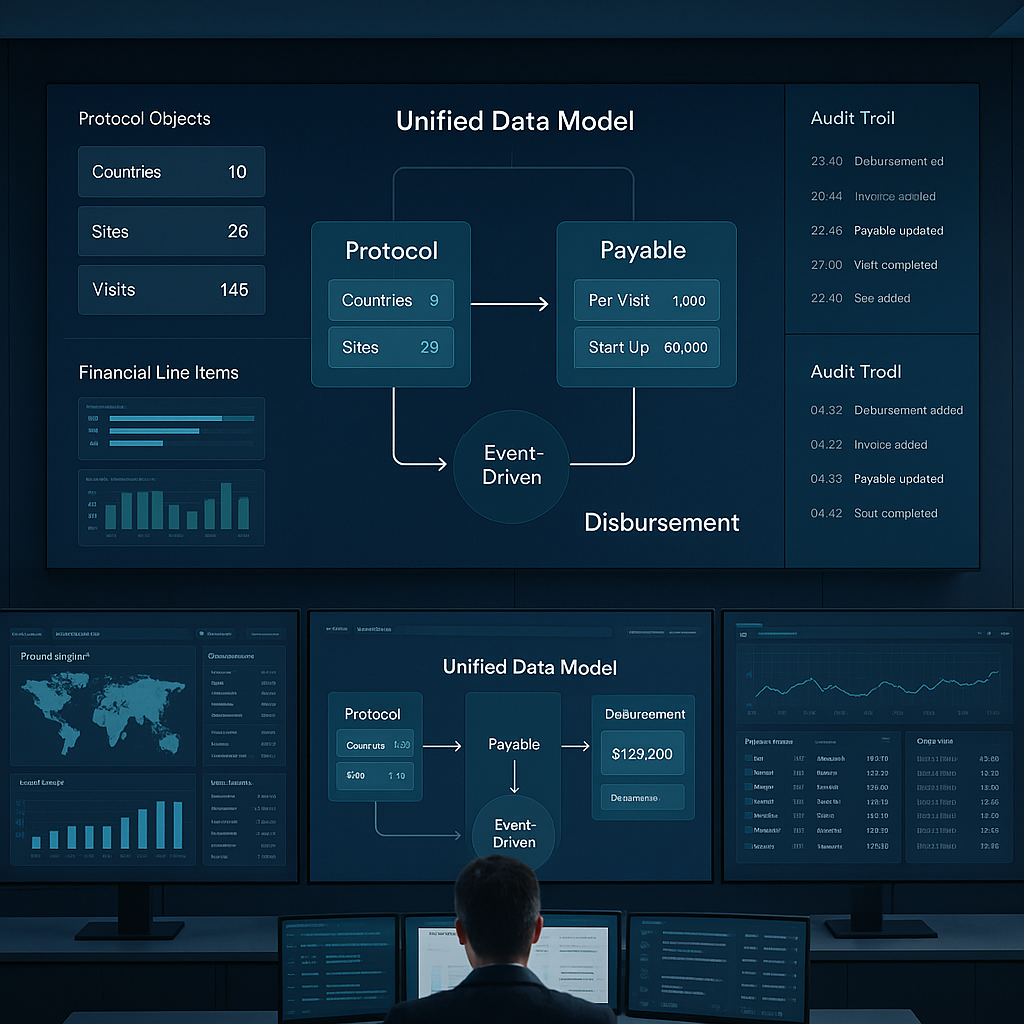
Design a unified, auditable data model that turns protocol events into payables.
From Protocol to Payment: Why a Shared Semantic Layer Is the Backbone of Modern CTFM
Clinical trial finance breaks down when protocol intent, operational execution, and financial outcomes speak different languages. Budgets are negotiated in one system, visits are tracked in another, evidence lives in documents, and finance is left reconciling the gaps. The result is predictable: ambiguous invoices, delayed payments, and audit stress.
A durable Clinical Trial Financial Management (CTFM) practice starts with a shared semantic layer—a common language that connects protocol design to financial reality across systems, studies, and countries.
Designing a Shared Semantic Layer from Protocol to Finance
The semantic layer begins by normalizing the core operational objects that define a study: studies, countries, sites, visits, procedures, and milestones. These objects must map cleanly to the cost model—investigator grants, pass-throughs, start-up fees, vendor services, and closeout activities—so every budget line has a clear operational meaning.
Each financial obligation should trace directly to a verifiable trigger. A per-visit payment must tie to the subject’s actual visit status in CTMS or EDC. An activation milestone must reference documented prerequisites such as regulatory approval, executed contracts, and essential documents finalized in eTMF. This traceability eliminates interpretive invoices and enables automated reconciliation instead of manual debate.
Master data discipline is essential. Site codes, country packs (banking formats, tax forms, withholding rules), rate cards, and currency preferences should be defined early and governed centrally. Fair-market-value references and approval thresholds must be versioned so changes are attributable and auditable. Consistent naming conventions and metadata for cost categories and modifiers—screen failures, early terminations, re-consents—allow teams to compare like-for-like across sites and protocol amendments.
Equally important is ownership. Who maintains the visit schedule? Who updates banking and tax documentation? Who approves rate card changes? Without explicit accountability for data quality, even the best model erodes over time.
Data lineage completes the foundation. Organizations should document how CTMS events flow into the finance layer, how evidence is attached—monitoring logs, EDC visit counts, correspondence—and how journal entries are generated. Regulators expect electronic systems supporting these workflows to be validated, secure, and traceable, as outlined in guidance on computerized systems used in clinical trials from the U.S. Food and Drug Administration.
Automating Event-Driven Payables, Matching, and Accruals
With a shared semantic layer in place, finance can move beyond invoice-centric processes to event-driven execution. Operational milestones should automatically create pre-validated payable candidates: site activation triggers start-up fees, verified subject visits trigger per-visit payments, and documented closeout tasks trigger final disbursements.
Three-way matching—contract terms, operational evidence, and invoice lines—becomes the default, minimizing approval effort and accelerating cycle times. For pass-through costs such as translations, imaging reads, or courier reshipments, standard evidence requirements should link to cataloged price formulas so outcomes are explainable and consistent.
Foreign exchange and taxation must be policy-driven, not improvised. Organizations should define how FX rates are selected (spot versus rolling average), who bears conversion costs, and where gains or losses are recognized. Country-specific tax packs—W-8/W-9 equivalents, beneficial ownership attestations, withholding tables—must be standardized and kept current to avoid downstream surprises.
Participant reimbursements require particular care. Ethics guidance on payments and reimbursements to research subjects, such as that published by the U.S. Food and Drug Administration, should anchor policy. In the United States, finance teams must also consider tax reporting thresholds and interpretations issued by the Internal Revenue Service when determining 1099-MISC treatment for research participants.
Accrual logic should mirror cost behavior. Visit-based costs belong in unit-of-service models. Long-running services fit percentage-of-completion. Phase-level fees often require straight-line treatment. Publishing assumptions, data sources, and approval histories for each method ensures results are reproducible for finance leaders and auditors alike. Role-based dashboards that surface pending payables, holds, and exceptions allow clinical and finance teams to collaborate without endless email chains.
Sustaining Audit-Ready Operations with Dashboards and KPIs
Inspection-grade operations are not achieved through last-minute preparation; they are sustained through continuous visibility and governance. Leading organizations track cycle times from operational event to disbursement, monitor exception categories and aging, and enforce service-level targets for approvals and document resolution.
An auditable chain from contract to payment is non-negotiable: versioned budgets, executed agreements, linked evidence, approvals, and bank confirmations must be readily accessible. Living inspection-readiness narratives should connect SOPs, validation summaries, configuration logs, and sample transaction trails so auditors can follow the story without interpretation.
Finance KPIs deserve the same visibility as operational metrics. Auto-match rates, on-time disbursement ratios, FX variance, withholding accuracy, and accrual error versus actuals provide leaders with a complete view of trial health. Quarterly retrospectives comparing baseline to current budgets surface root causes—protocol changes, documentation gaps, onboarding delays—and feed lessons back into start-up templates and country packs.
Practical perspectives from academic sponsored-projects offices and regulator FAQs reinforce invoicing discipline and electronic records expectations. For example, invoicing guidance from the University of Houston illustrates how clear rules and documentation standards support both compliance and efficiency.
Unifying Protocol, Operations, and Finance
When protocol design, operational execution, and financial controls are unified through a shared semantic layer—especially within a Salesforce-native environment—CTFM shifts from reactive clean-up to predictable execution. Payments accelerate, audits become routine, and trust improves across sponsors, CROs, and sites.
In an era of global, data-intensive trials, a shared language is not a technical detail. It is the operating system for scalable, compliant clinical research finance.
Subscribe to our Newsletter
