

Request a demo specialized to your need.
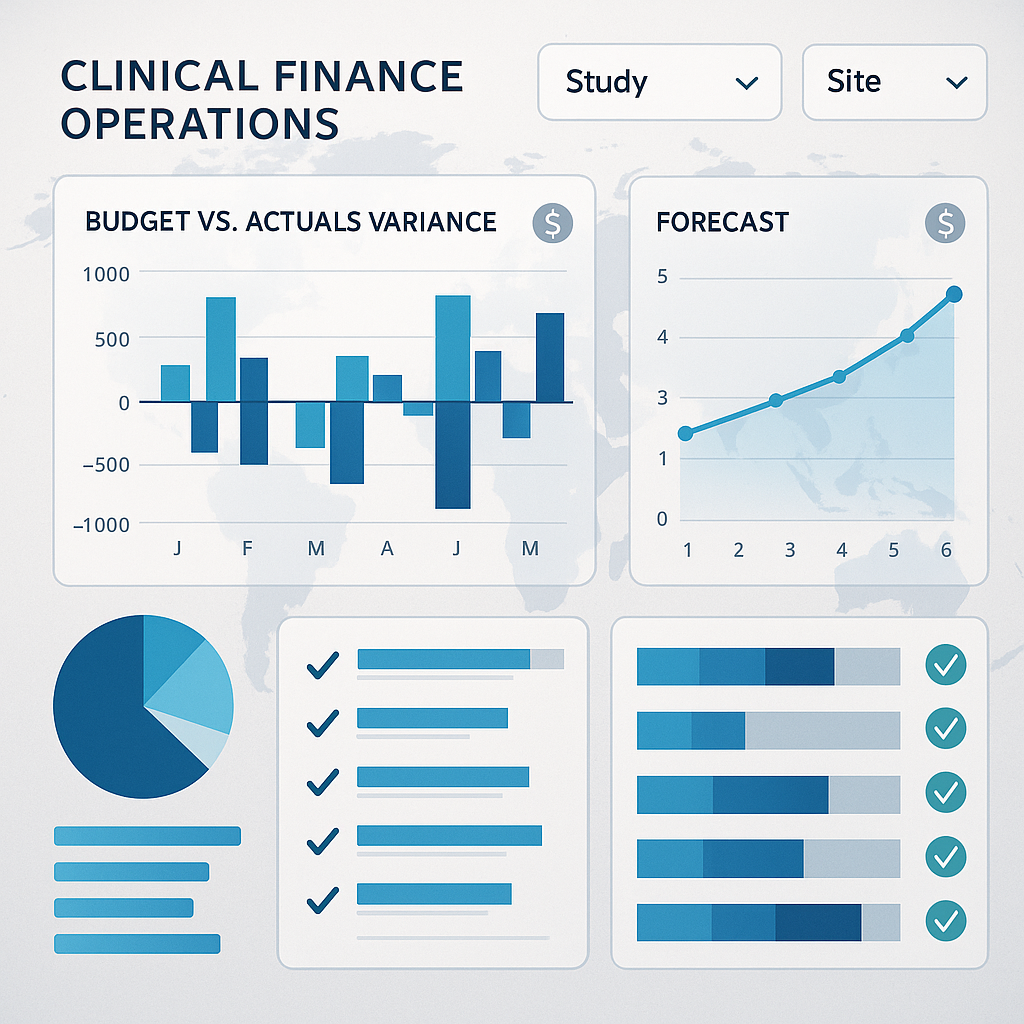
A framework to analyze variances, improve forecasts, and govern CTFM with audit-ready evidence.
Building Variance-Ready Budgets and Baselines
How Explicit Financial Design Turns Clinical Trial Financial Management into a Predictable Discipline
Clinical Trial Financial Management (CTFM) becomes predictable only when the baseline is explicit, testable, and governed. Too often, budgets are treated as static spreadsheets while trials are living systems. The result is variance that reflects noise rather than insight—masking real operational change and eroding confidence across finance, clinical operations, and quality teams.
Leading sponsors and CROs are shifting from reactive reconciliation to variance-ready design. The goal is simple: ensure every dollar has a verifiable operational trigger, every assumption is documented, and every variance can be explained the same way every month.
Designing Explicit, Testable Baselines
A variance-ready budget begins with translating protocol design into a clear financial structure that mirrors how work actually occurs. Costs should be separated into start-up, conduct, and closeout phases, with each line item mapped to a specific, auditable operational trigger.
Investigator grants align to subject visits and procedures. Milestone fees—such as site activation, first patient in, or database lock—map to gated readiness criteria in CTMS and eTMF. Pass-throughs, including translations, imaging reads, and courier resupplies, are tied to cataloged events with defined evidence standards. When every cost is anchored to proof of work, ambiguity disappears.
This structure must be locked as a version-controlled baseline with effective dates and rationale. Variance should always be measured against a known state, not a moving target. Historical baselines remain accessible so changes introduced by amendments, re-negotiations, or scope shifts are explainable months—or years—later.
Master data discipline is equally critical. Rate cards with modifiers (screen failures, early terminations), country “packs” for tax, banking, and withholding, currency preferences, and approval thresholds should exist as first-class records with clear ownership and version history. Participant payments require particular care. Reimbursements—repayment of documented out-of-pocket costs—must be distinguished from compensation or stipends for time and burden, which are often taxable. IRB or EC-approved materials should align precisely with operational practice. Ethical and regulatory expectations around participant payments are reinforced in guidance from the FDA.
Finally, document how operational systems feed finance. Declare which CTMS events are “finance-eligible” and what evidence is authoritative—such as EDC visits with no open critical queries or complete eTMF document packets for activation. Establish and codify your foreign-exchange policy: spot versus averaged rates, booking windows, and variance thresholds. Apply it deterministically so outcomes are reproducible. For cross-border disbursements, validating IBAN and SWIFT/BIC formats before payment reduces rejects; conventions summarized by the European Payments Council are a practical reference.
With baselines and policies explicit, variances reflect real operational change—not spreadsheet noise.
Diagnosing Variance with Repeatable Analytics
Once the baseline is sound, variance explanation should be treated like a product: standardized, repeatable, and evidence-driven. High-performing organizations classify variance into a small, durable set of drivers and measure them the same way every period.
Common drivers include volume (actual visits versus plan), rate (contracted price changes or FMV updates), mix (procedure or site cohort shifts), timing (late invoices or approval delays), FX (rate movements versus policy), and policy exceptions (withholding changes or documentation holds). Each driver is tied to specific evidence. CTMS and EDC visit logs support volume analysis. Executed change orders and revised rate cards explain rate effects. Protocol amendments and cohort definitions clarify mix. Approval timestamps and audit trails reveal timing impacts.
Instrumentation matters. For visit-driven lines, price-volume-mix analysis should be calculated like-for-like, separating the effect of more visits from the effect of different visit types. For vendor services, percentage-of-completion should be measured against statements of work and acceptance records. For FX, every conversion should record the rate source and timestamp so “expected” outcomes under policy can be reconciled to actuals.
A disciplined monthly reconciliation pack brings this together: baseline and current plan snapshots with effective dates, a waterfall that bridges plan to actuals by driver, and a variance dictionary with drill-through links to evidence. When teams cite policies and proof consistently, conversations converge on facts rather than opinions. In U.S. contexts, treatment considerations for participant payments can be grounded in guidance from the Internal Revenue Service, further reducing debate.
Forecasting and Governance with Inspection-Grade Evidence
Forecasting should be a controlled extension of variance management—not a separate art. Start with transparent accrual methods: unit-of-service for visit-based costs, percentage-of-completion for long-running vendor work, and straight-line recognition for phase-level fees. Then layer leading indicators that anticipate change, such as enrollment velocity, site activation cadence, query aging, monitoring backlog, and protocol amendments.
Convert these signals into short-horizon projections with confidence bands, not single-point estimates. If machine learning is used, models should be interpretable, with documented feature importance so stakeholders understand what is moving the forecast. Governance is essential. Data cuts, assumptions, and models must be versioned and approved, with a clear audit trail tying every change to rationale and evidence.
These controls should align with modern GCP quality principles so finance signals reinforce patient safety and data reliability priorities. The finalized guidance from ICH E6(R3) provides a shared vocabulary for this risk-proportionate approach.
The final step is learning. Regular retrospectives reconcile forecasts to actuals, attribute deltas to known drivers, and feed lessons back into budgets, rate cards, and country packs. Over a few cycles, explicit baselines, explainable variance, and governed forecasting transform CTFM from reactive clean-up into predictable execution—building confidence across finance, clinical operations, and quality teams alike.
Subscribe to our Newsletter
