

Request a demo specialized to your need.
Under US GAAP, clinical trial costs fall under ASC 730, which requires research and development costs to be expensed as they are incurred, not when they are invoiced or paid. That makes accruals, the estimate of work done but not yet invoiced, a monthly necessity, and for pre-revenue biotechs they are often identified by auditors as a critical audit matter (G-Squared CFO). The audit firm BDO notes that sponsors need their own independent understanding of trial expenses, a step that is most often handled on spreadsheets (BDO).
Spreadsheets were never built for this. A portfolio of studies can mean thousands of visits, invoices and payments a month, across sites, payees and vendors. Every month-end, someone exports data, merges files, fixes formulas and sends a report that is out of date by the time it is read. And when that person is away, the report waits.
Why these reports matter
- Financial statements. Accruals feed the R&D expense line, so they must be complete, consistent and supportable for auditors.
- Sponsor oversight. ICH E6(R3) expects the financial aspects of a trial to be documented in an agreement (ICH E6(R3), EMA Step 5), and sponsors working through CROs need to see spend against those agreements.
- Transparency reporting. In the US, research payments to physicians and teaching hospitals are reportable under Open Payments, so payment records need to be accurate at payee level.
- Site relationships. Outstanding and ageing payments are what sites notice first.
The reports senior management and sponsors need
|
Report |
Question it answers |
Main audience |
|---|---|---|
|
Payments |
What has been paid, to whom, and when? |
Finance, sponsors |
|
Paid versus unpaid |
What is earned but not yet paid? |
Finance, CTMs |
|
Accruals |
What work has been done but not yet invoiced this period? |
Finance leadership, auditors |
|
Outstanding and ageing |
Which invoices and payments are overdue, and by how long? |
Finance, site relationships |
|
Portfolio summary |
Where does each study stand against budget and forecast? |
Senior management, boards |
What spreadsheets cost you
- Time: exporting, merging and checking thousands of rows every period.
- Accuracy: broken formulas, copy errors and conflicting versions.
- Dependency: reports wait for the one person who knows the file.
- Audit trail: no record of who changed a number, or why.
What one dashboard changes
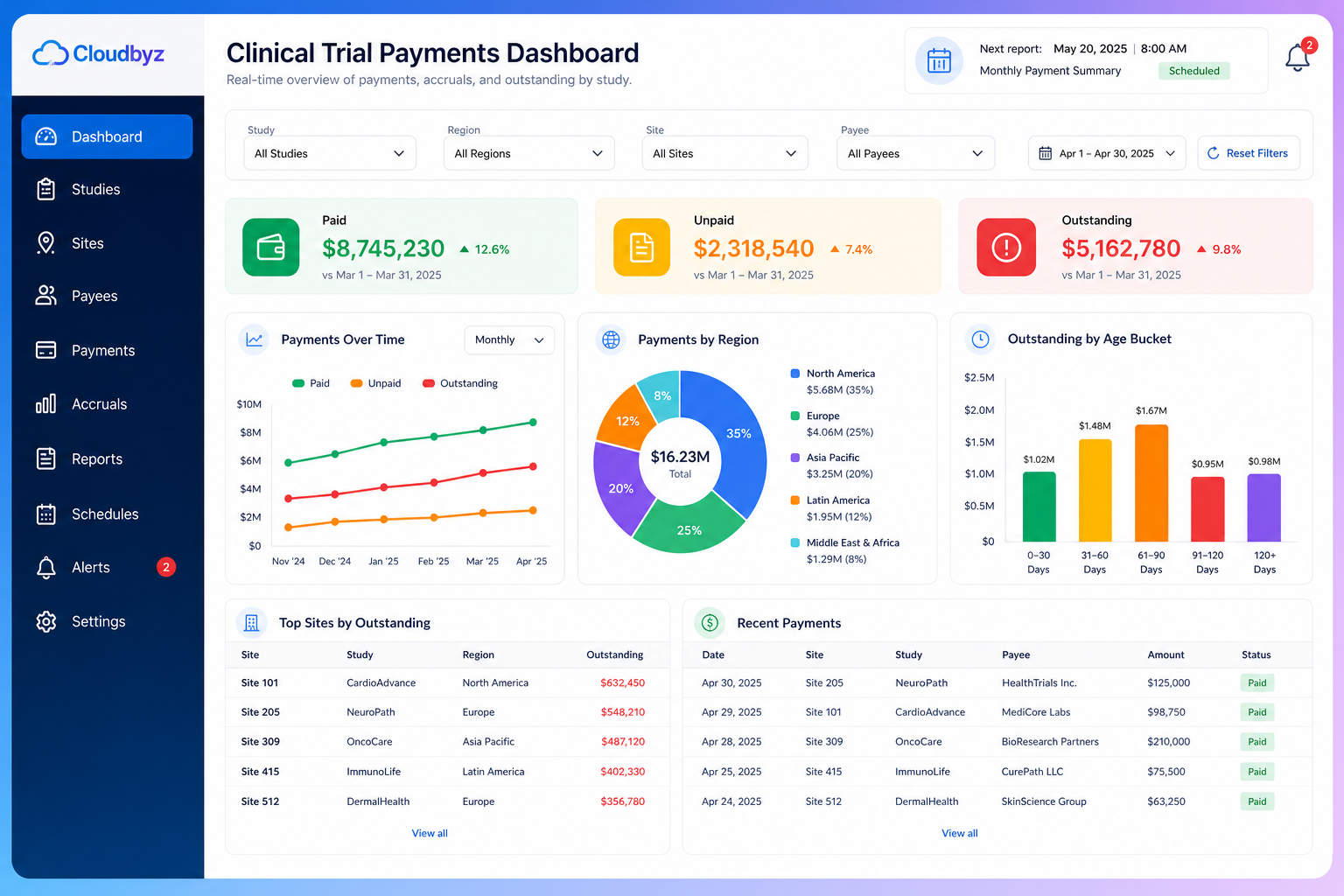
- Payments, paid, unpaid, accrual and outstanding views in one place
- Portfolio view, with drill-down to study, region, site and payee
- Accruals generated from completed visits and milestones, not estimates
- Reports delivered on a schedule to everyone who needs them
- One audit trail behind every number
What this means by role
- Senior management and finance leadership: a current portfolio view without waiting for a pack.
- Study finance teams: month-end becomes review, not assembly.
- Sponsors working with CROs: the same numbers the CRO uses, on a schedule.
- Auditors: accruals traceable to the work behind them.
How Cloudbyz CTFM does this
Cloudbyz Clinical Trial Financial Management (CTFM), built natively on Salesforce with Cloudbyz CTMS and EDC, brings payment, paid, unpaid, accrual and outstanding reports together in one dashboard at portfolio level, with drill-down to study, region, site and payee. Accruals are generated from completed visits and milestones already recorded on the platform. Users can subscribe to reports and receive them on a schedule, so periodic reporting does not depend on anyone preparing spreadsheets, and every figure is backed by the platform's audit trail. Which reports and subscriptions each role sees depends on configuration and access.
See the portfolio dashboard
Book a demo or visit cloudbyz.com.
Subscribe to our Newsletter
