

Request a demo specialized to your need.
A survey by the Clinical Trials Transformation Initiative found that nearly 40% of sites reported stopping participation in clinical trials because of payment delays (ACRP). Many of those delays come not from visit fees, which follow the schedule, but from everything else: travel, stipends, unscheduled visits and other costs that do not map neatly to a procedure.
These non-procedure costs are where disputes start. The site expects to be reimbursed. The sponsor wants to know the cost is allowed and within limits. If the limits live in a contract PDF rather than in the payment system, every claim is checked by hand.
Common non-procedure costs
|
Cost |
Typical unit |
Example of a limit |
|---|---|---|
|
Participant travel |
Per trip |
Up to a set number of trips per visit |
|
Participant stipend |
Per visit |
One stipend per completed visit |
|
Meals or overnight stay |
Per night |
Up to a set number of nights per participant |
|
Caregiver travel |
Per trip |
Only for paediatric participants |
|
Unscheduled visits |
Per visit |
Up to a set number per participant |
|
Screen failures |
Per participant |
Up to a ratio of enrolled participants |
|
Shipping and storage |
Per shipment or month |
Up to a set number per site |
|
Re-consent or extra IRB review |
Per event |
Only after an approved amendment |
The limits shown are examples. Each study sets its own, based on the protocol and agreements.
1. Define each cost with a unit
Every non-procedure cost is defined with its unit, such as per trip, per visit, per participant, per night or per month, so the budget knows how to count it.
2. Set the maximum quantity allowed
For each cost and unit, the study sets the maximum quantity allowed, for example a limit on unscheduled visits per participant or on screen failures per site. The limit reflects what the protocol and agreements allow.
3. Claims are checked against the limit
When a site claims a cost, the quantity is checked against the limit. Claims within the limit can move to payment. Claims above it are flagged for review, rather than paid or rejected without a conversation.
4. Limits differ by study, and by site where needed
One study may reimburse overnight stays and another may not. One region may have different travel rules. Setting limits per study, and per site where agreements differ, keeps payments consistent with what was agreed.
5. Non-procedure costs stay visible in the forecast
Because each cost has a unit and a limit, its expected total can be forecast alongside visit fees, rather than appearing as a surprise on site invoices.
Non-procedure cost checklist
- List every non-procedure cost the study will reimburse
- Define the unit for each cost
- Set the maximum quantity allowed, based on protocol and agreements
- Flag claims above the limit for review
- Set different limits per site where agreements differ
- Include non-procedure costs in the forecast
What this means by role
- Study finance leads: limits are applied by the system, not checked by hand on every claim.
- CTMs and clinical operations managers: fewer disputes with sites over what is reimbursable.
- Site finance teams and CRCs: clear rules on what will be paid, and how much.
- Participants: reimbursements that are agreed in advance are easier to pay on time.
How Cloudbyz CTFM does this
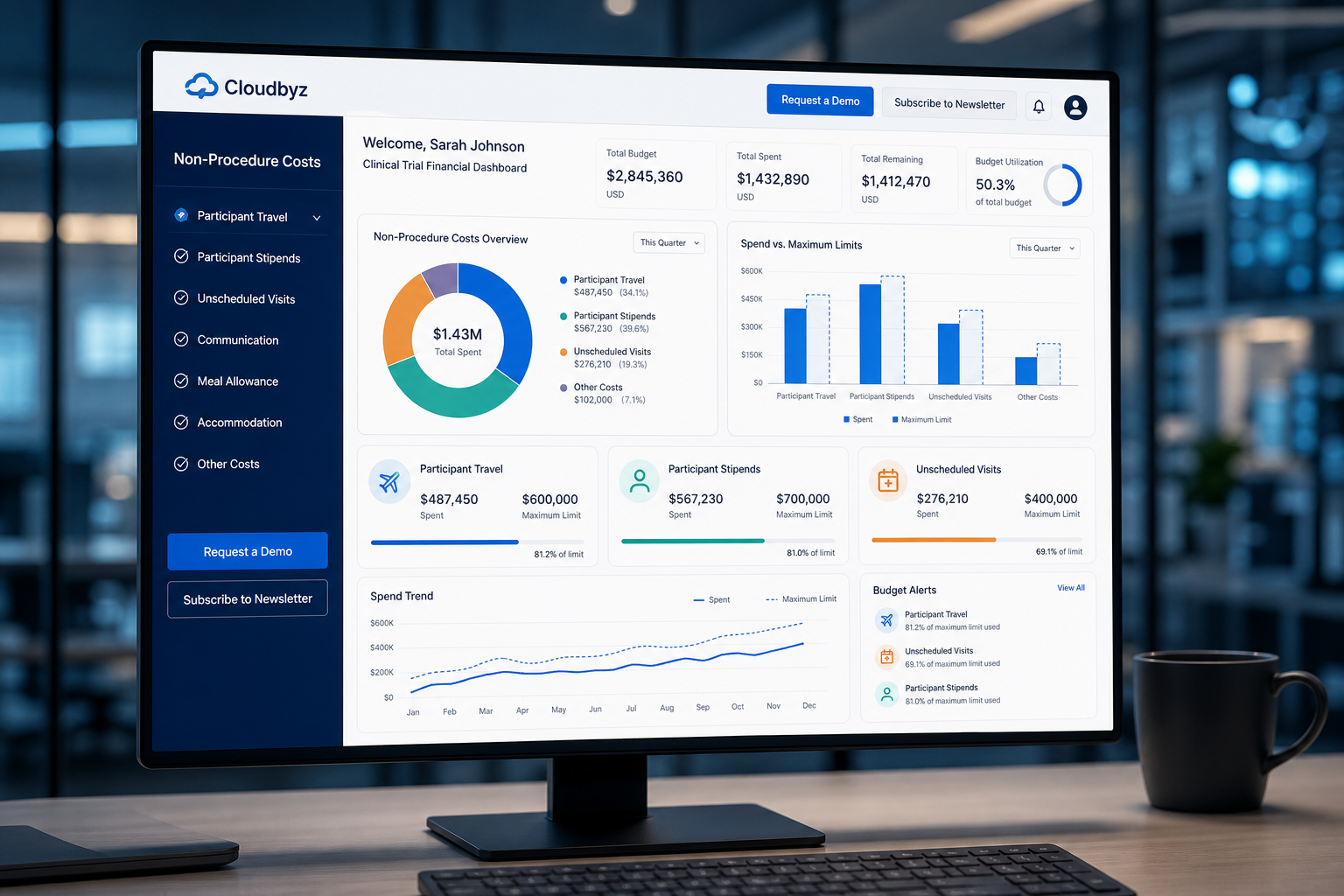
Cloudbyz Clinical Trial Financial Management (CTFM), built natively on Salesforce with Cloudbyz CTMS and EDC, supports non-procedure costs alongside visit and procedure fees. Study teams can set the maximum quantity allowed per unit for each cost, depending on study requirements, and different arrangements per site where agreements differ. Costs are forecast with the rest of the budget, and the Invoice Reconciliation.
See non-procedure costs in CTFM
The Cloudbyz team can walk through setting up non-procedure costs and limits for a sample study. Book a demo or visit cloudbyz.com.
Subscribe to our Newsletter
