

Request a demo specialized to your need.
In a Tufts CSDD study of 257 sponsors and CROs, companies used an average of six applications to support each clinical study, and 77% reported difficulty loading data into their primary EDC system because of compatibility and integration challenges (Tufts CSDD via GlobeNewswire). Budget software and CTMS are two of those applications, and the connection between them decides whether finance sees what operations sees.
Most budget tools claim to integrate with a CTMS. The useful question is what that integration actually carries, how often, and who has to maintain it.
What a budget tool needs from the CTMS
|
Data from CTMS |
Why the budget needs it |
|---|---|
|
Study, sites and site status |
Who can be paid, and whether payments should continue |
|
Visit plan and schedule of assessments |
What each visit should cost |
|
Subject visits completed |
What has been earned |
|
Milestones |
When start-up fees, milestone payments and holdbacks are due |
|
Contacts and payees |
Who receives payments and notices |
|
Protocol amendment versions |
Which fees apply from which date |
Native versus connected
|
Question |
Connected through an interface |
Native on one platform |
|---|---|---|
|
How data moves |
Synced on a schedule or by API |
Shared records, no transfer |
|
How current it is |
As of the last sync |
Real time |
|
What breaks it |
Upgrades on either side, mapping changes |
Nothing between modules |
|
Who maintains it |
IT or the vendor, for each interface |
No interface to maintain |
|
Validation |
Interface validated and re-tested |
One platform validated together |
|
Audit trail |
One per system |
One across both |
Connected integrations can work well, especially when a sponsor already has a CTMS it wants to keep. But every interface is something to build, map, validate and monitor, and the budget can only be as current as the last sync.
Five questions to ask about any CTMS integration
- When a visit is completed in CTMS, how soon does the earned amount appear in the budget?
- When a milestone is marked complete, does the related payment follow without a manual step?
- When a protocol amendment changes the visit plan, which budgets update, and how?
- Are site, contact and payee records shared, or copied?
- What has to be re-tested when either system is upgraded?
What this means by role
- Clinical operations directors: the integration decides whether spend and progress can be seen together.
- Study finance leads: sync delays become payment delays.
- IT and validation teams: every interface adds maintenance and re-testing.
- CTMs and CTAs: shared records mean data is entered once, not reconciled later.
How Cloudbyz CTFM and CTMS work together
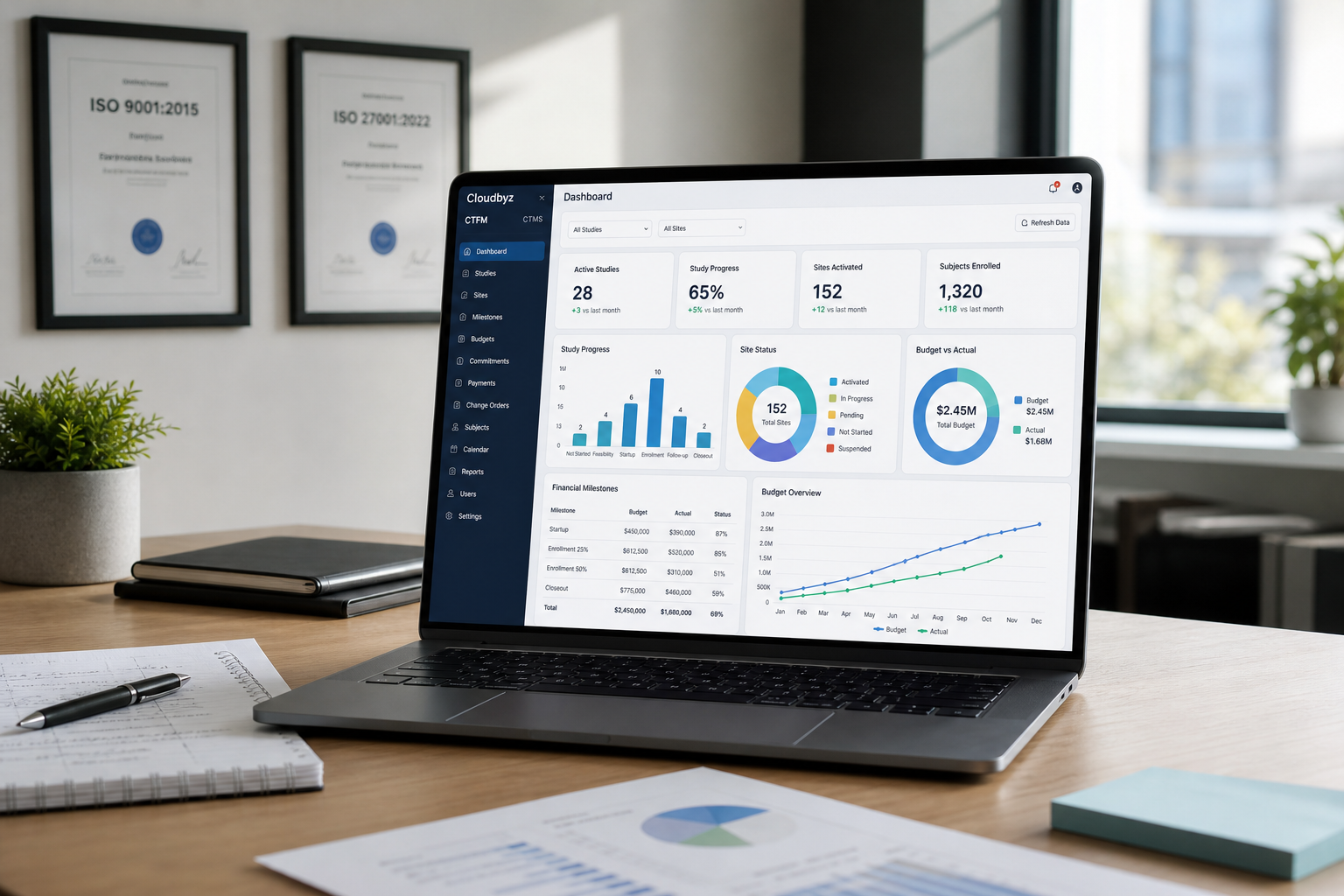
Cloudbyz CTFM and Cloudbyz CTMS are built natively on Salesforce as one platform, so they do not need an integration between them. Studies, sites and site status, visit plans, subject visits, milestones, contacts, payee details and amendments are shared records that both modules use. A visit completed in CTMS creates the earned amount in CTFM, milestones drive the payments they relate to, and amendments are applied to the affected visits and procedures. Finance and operations work from the same data, in real time, with one audit trail. Cloudbyz also offers integrations with external systems, such as ERP, where a study needs them.
See CTFM and CTMS together
The Cloudbyz team can show a visit, a milestone and an amendment moving from CTMS to CTFM in real time. Book a demo or visit cloudbyz.com.
Subscribe to our Newsletter
