
Request a demo specialized to your need.
We launched the Cloudbyz AI eTMF Agent last week. Since then, the conversations with prospects have been energizing — but one theme keeps coming up above everything else. Not "can the AI classify documents correctly?" but "how do we know when to trust it?"
That's the right question. And it's exactly what we designed around.
The trap nobody warns you about
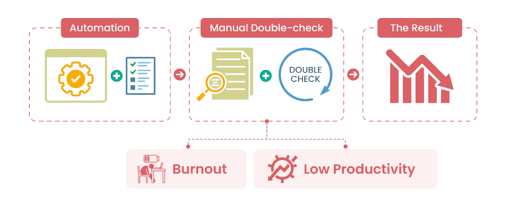
Here's a pattern we've seen play out too many times. A team adopts an AI tool. Reviewers aren't sure when to trust it, so they keep checking everything manually anyway. Now they're running two processes — the AI and the manual work it was supposed to replace. Nothing got faster. The anxiety just moved.
Industry benchmarks put a number to this: up to 50% of automation gains are lost to manual double-checking and low trust in outputs. That's not a technology failure. That's a design failure.
The problem was never whether AI could classify a monitoring visit report correctly. The problem was whether a TMF lead could know, in any given moment, whether to trust what it did — and act on that without second-guessing themselves
Making AI visible
When people say they don't trust an AI system, they rarely mean it's wrong too often. They mean they can't tell when it's wrong. That uncertainty is what drives the double-checking.
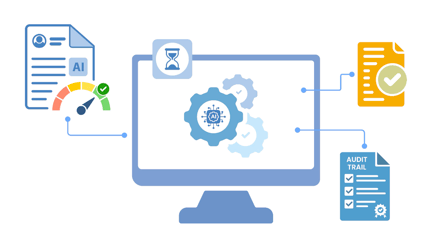
So we built every classification in the AI eTMF Agent to come with a confidence score — not a general model accuracy buried in a settings dashboard, but a per-document number, right there in the interface. A 94% on a site initiation visit report means the model is very sure. A 71% on an ambiguous document means it's flagging its own uncertainty before you have to discover it the hard way.
Visible reasoning is the foundation of trust. Once teams know the AI will always tell them when it isn't confident, they can stop worrying about the cases where it is.
The confidence threshold: a rule, not a feeling
Knowing the AI's confidence is useful. But trusting AI at scale requires something more — a clear rule about what happens as a result. Without that rule, every document still triggers a judgment call. With it, the system becomes predictable. And predictability is what makes the double-checking stop.
The confidence threshold is that rule. Your organization sets it. Documents above it are auto-approved and filed, with a full audit trail. Documents below it go to your review queue, with the AI's suggested classification already surfaced. Same rule, every document, every time.
In practice, that means:
- PHI is scanned and flagged before classification even begins
- Every document gets classified and metadata-extracted in seconds, with a confidence score attached
- High-confidence documents are approved and filed automatically — no human needed
- Lower-confidence documents land in the review queue, pre-annotated with the AI's reasoning
- Every decision — AI and human — is logged, timestamped, and traceable
The threshold can be turned off entirely for teams who want the AI as a support layer rather than an automated one. The control stays with you.
It gets better as it goes
Every time a reviewer corrects the AI, that's a training signal. The model learns your organization's specific document patterns — your CROs' file naming, your sites' templates, your therapeutic area's edge cases. Over time, the confidence distribution shifts upward. The auto-approval rate climbs. The review queue shrinks. And because the accuracy metrics are visible on your dashboard, teams can see the AI becoming more reliable — which builds trust faster than any demo ever could.
Why regulators actually like this design
A common misconception is that regulators are wary of AI in GxP environments. The more accurate picture is that they're wary of unaccountable automation — systems where decisions happen invisibly and nobody can explain why.
A confidence threshold with a full audit trail is the opposite of that. It doesn't claim the AI is infallible. It defines exactly where it defers to humans. It records everything, including the cases where a human disagreed with it. That's a more defensible inspection position than any fully automated system.
Closing Thoughts
We didn't build the AI eTMF Agent to replace human judgment. We built it to make human judgment unnecessary for the 85–90% of documents that don't need it — and to make the remaining 10–15% easier to review than ever before.
When teams know exactly which documents the AI handled, exactly which ones it flagged, and exactly why — there's nothing left to double-check. The system already did that work. And it left a paper trail proving it.
Subscribe to our Newsletter
