

Request a demo specialized to your need.
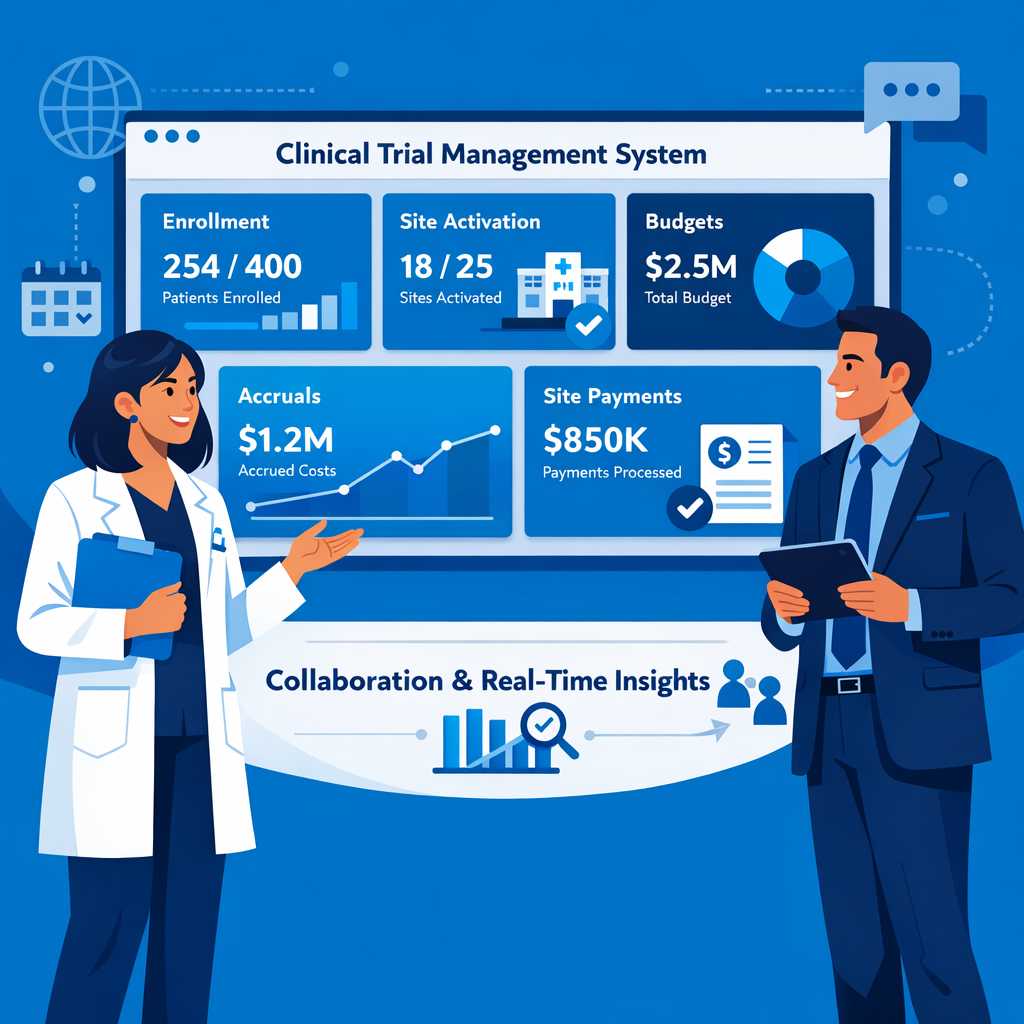
Explores the essential capabilities of modern CTMS platforms, with a focus on aligning clinical operations and financial management on Cloudbyz.
Why Your CTMS Must Be Both an Operational Hub and a Financial Data Spine
Clinical trials have never been more complex or more expensive. As studies grow more global, more intricate, and more capital-intensive, the tools organizations rely on to manage them must evolve accordingly. For many sponsors, CROs, and sites, that means fundamentally rethinking the role of the Clinical Trial Management System (CTMS).
From Record-Keeper to Control Plane
For years, CTMS platforms were treated as operational utilities: systems to track studies, sites, subjects, visits, and documents, primarily for the benefit of project teams and auditors. That narrow definition no longer serves the industry.
Today's trials demand a system that doesn't just capture what happened, but explains what it means financially, operationally, and strategically. Modern CTMS platforms are increasingly described as a "control plane" for clinical operations and financials, not a point solution buried inside a single department.
This shift reflects a straightforward reality: the same events a CTMS tracks, such as site activations, subject visits, milestone completions, and protocol amendments, are the exact events that drive budgets, accruals, and payments to sites and vendors. When a CTMS is designed to expose those events cleanly and consistently, an integrated financial layer can convert them into real-time financial signals without spreadsheets acting as a bridge.
The result is a single, trusted picture that clinical and finance leaders can work from together, rather than reconciling conflicting reports at quarter-end.
The Capabilities That Unlock Financial Visibility
Conversations about CTMS maturity often stall at feature checklists: Does the system handle visit tracking? Monitoring reports? Document storage? For organizations trying to align operations and trial financials, the more meaningful question is whether CTMS capabilities make both clinical and financial work more accurate, more efficient, and more transparent.
Richer Study and Site Records
A financially aware CTMS starts with richer data structures. Study and program hierarchies should carry not only scientific and operational attributes, but also cost-relevant metadata: region, site tier, expected enrollment profile, planned visit mix, and start-up and close-out patterns.
Site records should go beyond feasibility and recruitment metrics to include contract status, banking and tax information, payment terms, and performance history. This blend of operational and financial context forms the foundation for everything that follows.
Structured Visits, Milestones, and Procedures
Visit templates, procedure bundles, and milestone packs should be treated as reusable building blocks with consistent identifiers, not free-text entries that vary by study. When each element carries a stable identity, it can be linked to rate cards and eligibility rules in an integrated financial layer.
The downstream effect is significant: when a CTMS records that a visit is completed and verified, or that a start-up pack has moved to "ready," the system can automatically trigger accruals and payment proposals with no manual handoff required.
Deviations and Data Quality as Financial Triggers
Protocol deviations, query trends, and data-quality flags should be first-class objects in a CTMS, not afterthoughts. When these signals are structured and consistently captured, they can influence financial logic directly, enabling holdbacks, escalation workflows, or payment adjustments to fire without anyone leaving the system.
Site-Payment Performance as a Dashboard Metric
A mature CTMS should make site-payment performance visible and predictable. Key metrics such as event-to-payable cycle time, payable-to-cash cycle time, the share of payments processed under standard rules versus exceptions, and outstanding balances can all be surfaced through CTMS dashboards when financial data is wired back into the platform.
Combined with clinical KPIs like enrollment pace, monitoring coverage, and deviation rates, these metrics help leaders identify which sites and regions are both clinically and financially healthy.
A Shared Canvas for Clinical, Finance, and Executives
When CTMS capabilities are designed with financial outcomes in mind, they reshape how organizations govern portfolios, conduct reviews, and report to stakeholders.
The Study-Level Oversight Canvas
Rather than assembling separate operational and financial decks each month, sponsors and CROs can maintain a standard oversight canvas that clinical operations, finance, and executives all use simultaneously.
At the study level, that canvas might include tiles for:
- Startup readiness: where sites stand in the activation process
- Enrollment vs. plan: pacing relative to projections
- Verified-visit coverage: completeness of monitored visit records
- Deviation and query trends: signals of protocol and data integrity
- Budget burn: actual spend against approved budgets
- Accrual coverage: financial liabilities properly recognized
- Site-payment SLAs: how quickly payments are reaching sites
Each tile is powered by the same CTMS events and the same eligibility and rate logic defined in the financial layer. When something turns amber or red, teams can drill from portfolio to program to site to individual visits, all within one system, without debating which spreadsheet is correct.
Portfolio-Level Capital and Risk Management
At scale, a CTMS designed this way enables more disciplined capital allocation. Consistent metrics across studies and partners surface patterns that would otherwise remain hidden: geographies where start-up or payment processes routinely lag, trial designs that generate repeated protocol amendments or unscheduled visits, or site tiers that deliver strong recruitment but fragile economics.
CTMS-driven rolling forecasts and scenario models turn these patterns into concrete decisions: where to add or remove sites, which programs to accelerate or slow, and how to balance decentralized trial elements against cost and operational risk.
The Organizational Payoff
Over time, treating CTMS as the operational and financial backbone creates a virtuous cycle across the organization.
Study managers see how clean, timely CTMS updates reduce friction in budget reviews and site payments, making their own work easier, not just finance's.
Finance teams gain confidence that their numbers are anchored in the same events that operations teams discuss every day, eliminating the trust gap that makes reconciliation so painful.
Boards and partners hear consistent, CTMS-driven narratives about why R&D spend moved in a given quarter or why a portfolio decision was made, narratives that are traceable and defensible.
The Right Question for Organizations Evaluating CTMS
When assessing or modernizing a CTMS, the most important question is not "Which system has the most features?" It is this:
"Can our CTMS, together with our financial management layer, give us a single, trusted view of how clinical decisions translate into money?"
If the answer is yes, the CTMS is no longer just an operations tool. It is the control plane for the entire business of clinical development, the system of record that connects scientific decisions to financial realities, and operational events to strategic outcomes.
That is the standard modern clinical development organizations should hold their CTMS to.
Subscribe to our Newsletter
