

Request a demo specialized to your need.
 Explains what clinical trial financial management software is, why it matters, and how to choose and deploy it alongside CTMS.
Clinical Trial Financial Management Software: The Financial Intelligence Layer Modern Trials Need
Clinical development leaders increasingly recognize that spreadsheets and generic ERP modules cannot keep up with the financial reality of modern trials. Multi-country portfolios, complex visit schedules, decentralized components, and performance-based contracts create a web of obligations that demands software purpose-built for the job. That is precisely where clinical trial financial management (CTFM) software earns its place.
What CTFM Software Actually Does
CTFM is not a generic accounting add-on. It is a specialized financial intelligence layer that understands the language of clinical operations — countries, sites, protocols, visits, milestones — and translates that activity into budgets, payments, accruals, and forecasts.
For sponsors, CROs, and academic research centers, CTFM provides a single, connected view of study economics. It centralizes budgeting, contract terms, site and vendor payments, and revenue or expense recognition, so clinical and finance teams are no longer working from different versions of the truth. When CTMS records that a complex visit has been completed and verified, CTFM immediately values that work, updates forecasts, and schedules payment — rather than waiting for manual reconciliation.
This level of integration is what separates modern CTFM from the fragmented processes it replaces. Manual, disconnected systems create compliance risk, overwhelm finance teams, and make realistic scenario planning across portfolios nearly impossible.
Core Capabilities of a Mature CTFM Platform
Modern CTFM software goes far beyond digitizing a tracker. At its best, it becomes the financial control plane for studies — connecting protocol design, CTMS events, contracts, and payments in one auditable environment. The core capabilities of a mature platform cluster into five areas.
Budgeting and scenario planning. Instead of building static spreadsheets, teams configure study budgets from protocol-driven templates, rate cards, and country- or site-tier assumptions. Those budgets can be versioned, compared, and re-forecast as the study design evolves.
Contracting and amendment management. CTFM links contracts to the same event model used in CTMS, so a change in visit schedule or procedure mix automatically updates the financial picture rather than requiring a manual clean-up at quarter-end.
Site and vendor payment automation. Payments are calculated and triggered when visits are verified in CTMS, milestones are met, or data is cleaned — not when someone updates a spreadsheet or forwards an invoice. Global currencies and tax rules are handled automatically, producing faster and more transparent payments for sites worldwide.
Accruals, forecasting, and revenue recognition. Because the software understands both contracts and completed CTMS events, it can estimate earned-but-unbilled revenue and future cash needs in real time, eliminating the weeks-long accrual process many finance teams endure at quarter-end.
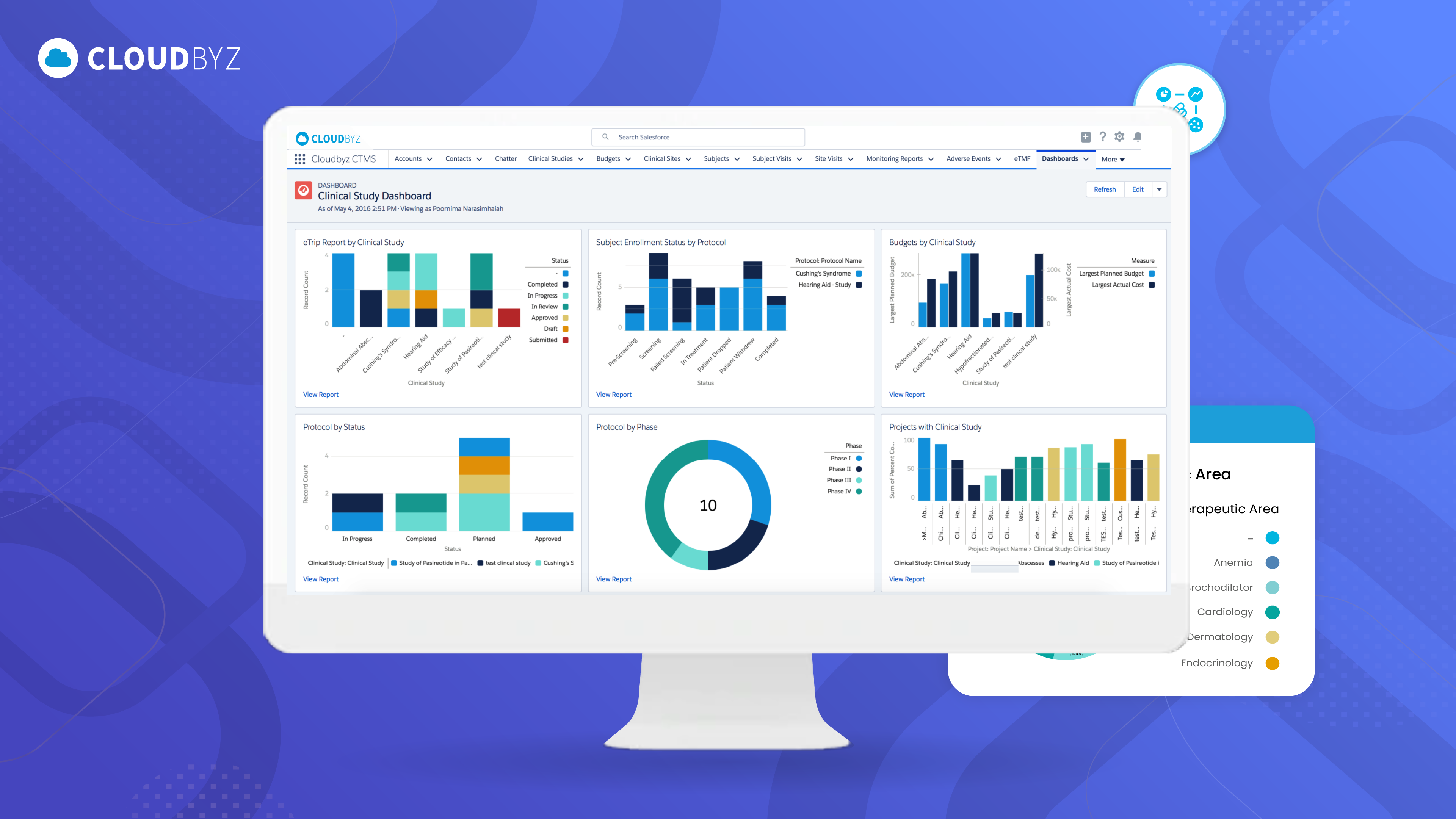
Analytics and reporting. All of this operational and financial history flows into dashboards for clinical operations, finance, and leadership — so they can see study health and financial health side by side, not in separate systems reviewed at separate times.
Integration and Configurability: What Separates Good from Great
The breadth of features matters, but the degree of integration and configurability is what distinguishes robust CTFM systems. Platforms that integrate tightly with CTMS, EDC, eTMF, ERP, and safety tools reduce reconciliation work and make it far easier to stay audit-ready.
Organizations that rely on separate point solutions and spreadsheets consistently struggle to produce a consolidated view of spend. Those that adopt unified financial platforms — where CTMS events, site contracts, and payment runs share a common data layer — see better control, fewer surprises, and faster decision cycles across their portfolio.
Cloudbyz CTFM, built natively on Salesforce alongside CTMS and the broader eClinical stack, reflects this architecture. The shared data model means operational and financial truth are always aligned, and ERP integrations keep corporate books in sync without duplicating general-ledger logic.
Choosing and Deploying CTFM Successfully
Selecting and deploying CTFM is as much an operating-model decision as a technology decision. The organizations that realize the most value typically start from three questions:
- What problems are we trying to solve?
- How will the software interact with our existing CTMS and ERP?
- Who needs to change how they work for this to succeed?
Common pain points — slow and error-prone site payments, limited visibility into trial cash flow, and accruals that take weeks to assemble — provide the clearest guardrails for evaluating platforms and measuring impact after go-live.
Integration strategy follows directly from those pain points. CTFM should sit close to CTMS to read visit and milestone events directly, and close to ERP to post summarized entries without duplicating ledger logic. The same principle that governs CTMS implementation applies here: build solid data flows and governance first, then layer in automation and AI features once the foundation is stable.
Governance and change management are what ultimately turn software into a new way of working. Finance, clinical operations, data management, and IT should define shared KPIs — such as event-to-cash cycle time, quality of accruals, and on-time payment rates — and use CTFM dashboards as the primary lens for operational and financial reviews. Once those routines are established, more advanced capabilities such as AI-based forecast adjustments and anomaly detection in payments can be introduced without overwhelming users.
The Strategic Case
Clinical trial financial management software should ultimately help sponsors and CROs spend money more deliberately: aligning budgets with scientific priorities, paying sites and vendors fairly and on time, and making portfolio-level decisions with clear visibility into trade-offs.
For organizations already running a CTMS, adding or expanding CTFM is the natural next step toward a unified operating model — one where trial execution and trial economics are guided by the same data, the same workflows, and the same source of truth.
Subscribe to our Newsletter
