

Request a demo specialized to your need.
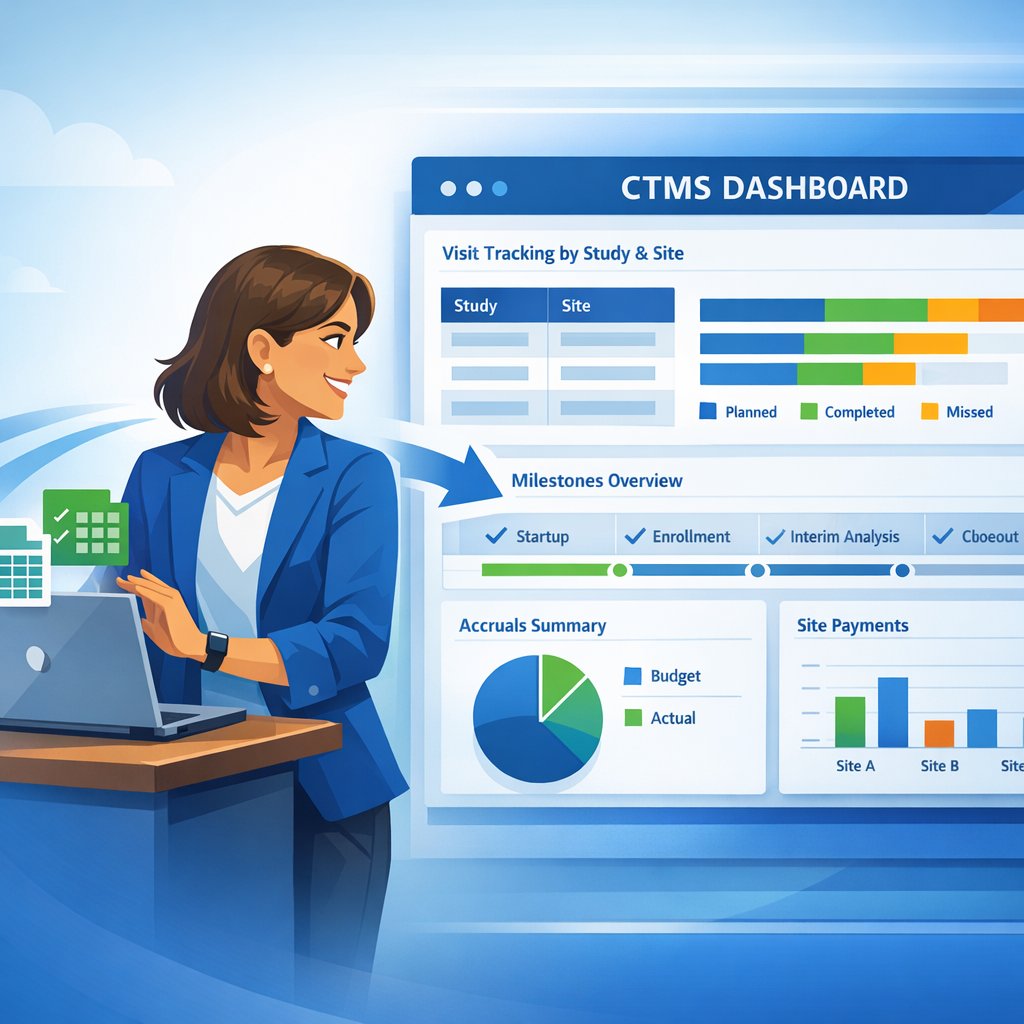
How to redesign clinical trial accounting so CTMS and CTFM, not spreadsheets, become the primary evidence for budgets, accruals, and audits.
From Spreadsheets to Systems: How CTMS-First Accounting Transforms Clinical Trial Finance
Introduction
In many organizations, clinical trial accounting still begins and ends in Excel. Monthly activity summaries flow in from CTMS, CRO trackers arrive as spreadsheets or PDFs, and finance analysts rebuild the entire picture in workbooks, allocating costs by phase, estimating accruals, and rolling everything up into project and portfolio views. These spreadsheets then become the de facto system of record for investors, auditors, and boards, while CTMS is quietly sidelined as a secondary source.
The result is a brittle foundation. Logic is hard to audit, handoffs are opaque, and small errors in formulas or manual entries can produce large swings in reported R&D spend.
A CTMS-first approach changes the question entirely, from "What do our spreadsheets say about this trial?" to "What does CTMS say actually happened, and how does our financial system interpret those events?"
Part 1: Why Spreadsheet-First Accounting Breaks
The Problem with the Current Model
The spreadsheet-first model creates several compounding risks:
- Auditability gaps. When logic lives in hidden formula tabs and ad hoc workbooks, tracing a number back to its source becomes a manual forensic exercise.
- Opaque handoffs. As data moves from CTMS exports to analyst workbooks to finance systems, each transfer is a potential point of error or misinterpretation.
- Fragile reconciliation. Accruals tied to invoice dates rather than to patient visits or site activity systematically distort the timing of R&D spend.
- Slow response to change. When enrollment shifts or country mix changes, analysts must rebuild workbooks from scratch rather than simply updating driver assumptions.
The CTMS-First Alternative
A CTMS-first model treats the clinical operations platform as the operational backbone and the authoritative record of everything that drives cost. This includes:
- When countries and sites became active
- When subjects were screened, enrolled, and completed visits
- When visits were verified and deviations logged
- When startup and closeout packs crossed readiness thresholds
Cloudbyz CTMS records these operational events. Cloudbyz CTFM (Clinical Trial Financial Management) hosts the financial rules, including rate cards, eligibility logic, tax and FX policies, holdbacks, and milestones, that translate those events into budgets, accruals, and payments. ERP and FP&A systems then consume CTFM outputs rather than raw spreadsheets, so that actuals, forecasts, and scenario models all trace back to the same operational story.
This is not about abandoning spreadsheets. They remain useful for exploration and ad hoc analysis. It is about being deliberate about where official logic lives.
Part 2: Designing Data, Workflows, and Controls Accountants Can Trust
Translating Clinical Events into Financial Signals
Once CTMS and CTFM hold the right data in the right shapes, the challenge becomes expressing accounting logic in a way that reliably consumes those signals.
For site grants and pass-throughs, the engine needs to understand which visits, procedures, and service codes in CTMS drive which cost buckets in the P&L. In practice, this means:
- Building a table of rate rules in CTFM keyed by visit template, mode, geography, and site tier
- Creating mapping tables that translate CTMS procedure and pass-through codes into ERP accounts and cost centers
For CRO and vendor work, the engine needs to know how milestone-based contracts should be decomposed into service phases such as startup, enrollment and conduct, and closeout, and which CTMS states serve as evidence of progress in each phase.
Running Reliable Accrual and Recognition Engines
With rules and mappings configured, accrual and recognition engines can run in predictable cycles. At period end, Cloudbyz CTFM:
- Queries CTMS for finance-eligible visits and milestones
- Applies the appropriate rates, tax rules, and FX policies
- Produces a proposed accrual set for each study, vendor, and GL account
For prepayments, the engine amortizes balances based on CTMS evidence rather than flat timelines. As work units are consumed, prepaids are drawn down; where units lag, balances remain. For revenue recognition on reimbursed costs or collaboration agreements, CTFM tracks billable units separately from cost units, enabling clean margin analysis without double-counting events.
Over time, as variances between accruals and actual invoices shrink, organizations can migrate more flows from "review-then-post" toward "post-then-sample," freeing finance capacity for analysis rather than mechanical reconciliation.
Simplifying Budgeting and Forecasting
A CTMS-first model transforms planning as much as it transforms close. Because planners express assumptions in the same CTMS units that drive actuals, such as subjects, visit templates, startup packs, and vendor events, models naturally reconcile to reality. When enrollment, visit intensity, or country mix shifts, forecast updates become a matter of changing driver expectations, not rebuilding workbooks from scratch.
Part 3: Building CTMS-Centric Routines for Close, Reporting, and Audit
Resequencing the Monthly Close
The most practical change organizations can make is introducing a "clinical close" that precedes financial close by a few days:
- Days 1-3 (Clinical Close): Study teams and CRAs bring key CTMS fields current, including visit statuses, startup and closeout milestones, eligibility overrides, and serious deviations. CTFM teams validate rate cards and rules.
- Days 4+ (Financial Close): Only once the operational picture is stable do finance teams run accrual engines and generate proposed journal entries.
This sequencing establishes a norm that the ledger reflects CTMS reality, not the other way around.
Changing How Teams Respond to Scrutiny
Audit and investor interactions should follow the same logic:
- When auditors ask how an accrual was calculated, walk them through CTMS events and CTFM rules, not a spreadsheet macro.
- When boards or due-diligence teams question spend or margin on a pivotal program, use Cloudbyz dashboards to decompose variances into volume, rate, mix, timing, and FX/tax, with each factor anchored in visible CTMS evidence.
These experiences build confidence not only in the numbers, but in the systems and people behind them. They also create natural pressure to maintain configuration quality and data discipline: when everyone knows that period-end narratives and external defenses will be built from CTMS and CTFM, shortcuts lose their appeal.
Investing in Cross-Functional Enablement
The cultural shift requires deliberate investment in people:
- Finance partners should spend time in CTMS screens and study dashboards, learning to interpret operational signals
- Clinical leaders should sit in on accrual and forecast reviews to see how their teams' behavior surfaces in P&Ls and cash curves
- Short playbooks should document common patterns, such as how to explain a variance, trace a payment dispute, or test a new eligibility rule, using Cloudbyz objects and reports
The guiding question in every investigation should become: "What does CTMS say?" before anyone opens a legacy tracker.
Conclusion
The shift to CTMS-first accounting is not primarily a technology change. It is a change in where an organization looks for truth. When CTMS and CTFM become the first place teams turn, for close support, for audit defense, for investor diligence, for forecasting, the entire finance function becomes more reliable, more efficient, and more credible.
Spreadsheets remain part of the toolkit. But the center of gravity moves permanently: away from ad hoc workbooks and toward an integrated stack where operational evidence and financial logic are inseparable by design.
Subscribe to our Newsletter
