

Request a demo specialized to your need.
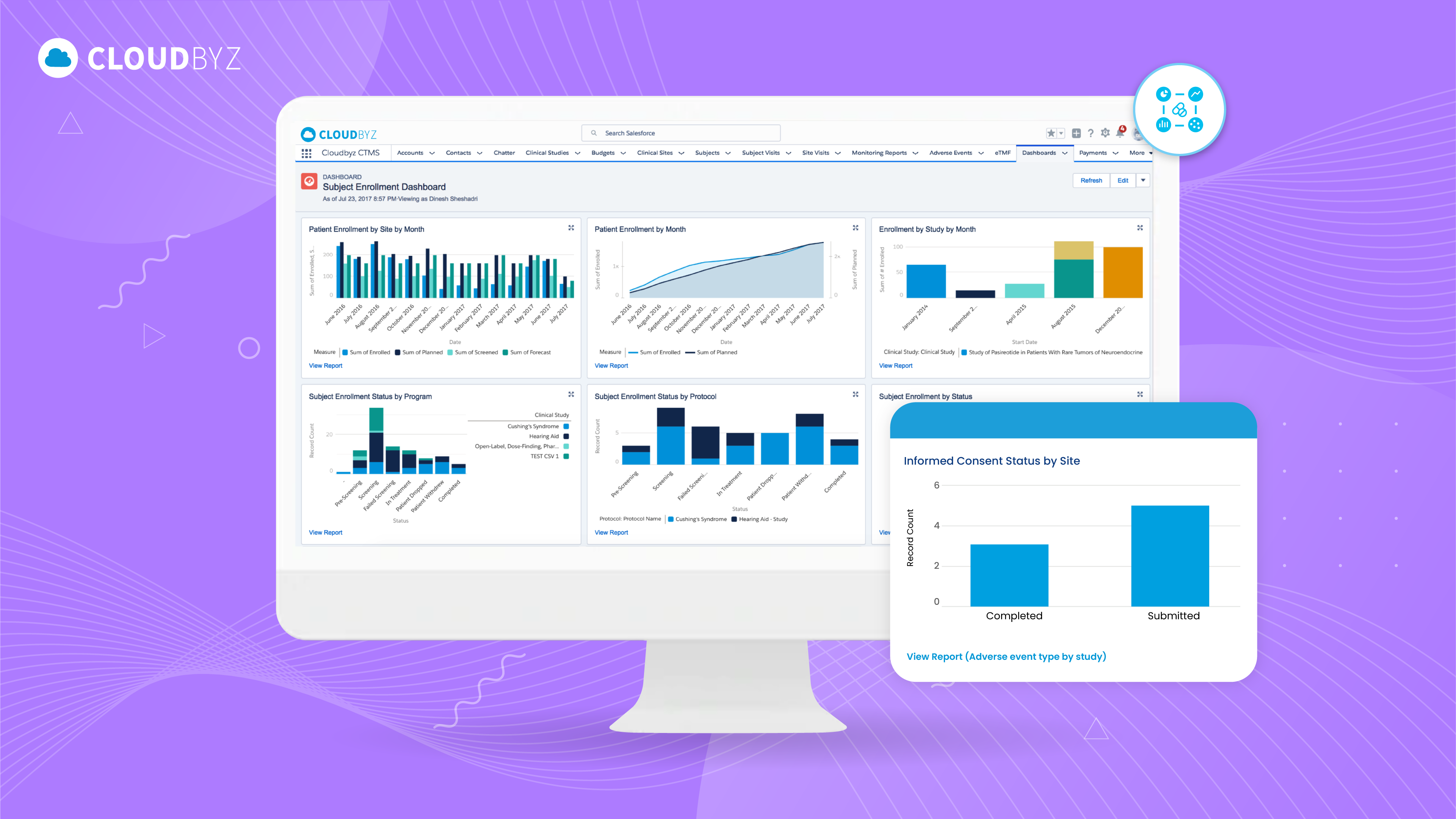
How mid-size CROs can build a repeatable CTMS-led financial operating model.
CTMS as the Operational Ledger for a CRO's Financial Model
Mid-size CROs occupy an increasingly squeezed position in the clinical development ecosystem. Sponsors expect the sophistication and responsiveness of large global providers, but at pricing that leaves little room for financial error. At the same time, portfolios are growing more complex: more decentralized elements, more countries per study, and a heavier mix of specialist vendors. In this environment, a Clinical Trial Management System cannot simply track visits and milestones. It has to be the backbone of a repeatable financial operating model.
Many CROs still run their trial economics on spreadsheets and point solutions even after implementing CTMS. Project teams maintain separate trackers for site payments and monitoring visits; finance teams reconstruct activity each month to prepare invoices and accruals; and leadership receives a fragmented view of margins by study or client. Cloudbyz CTMS and Clinical Trial Financial Management (CTFM) are designed to break this pattern by turning CTMS data into the primary driver of budgets, site payments, sponsor invoicing, and forecasts.
From Passive Tracker to Financial Backbone
The shift begins with a mindset change: treating CTMS as an operational ledger that finance can rely on. Rather than assuming that "real" financials live in offline models, mid-size CROs that configure Cloudbyz correctly capture site activations, subject visits, monitoring trips, and closeout events as standard, well-governed records. CTFM then interprets those records financially, using rate cards and contracts to value work in both local and reporting currencies.
This integrated approach turns operational events into a continuous feed for budgets and payment workflows. Organizations that align operational and financial systems gain faster visibility into overruns, reduce manual reconciliation, and support more accurate scenario planning. For mid-size CROs, the benefits are especially acute. A CTMS-led financial model helps protect margins on fixed-fee or risk-sharing contracts, makes it easier to explain invoices to sponsors, and provides the evidence needed to negotiate change orders when protocols or enrollment patterns shift.
Designing Data, Workflows, and Roles for Financial Control
For a CTMS-led financial operating model to work, the system must be configured around clear roles and workflows that reflect how teams actually deliver studies and manage money.
Mapping CTMS events to financial responsibilities
The first design task is aligning CTMS events to the accountability of each function. Project managers and clinical team leads own the schedule of assessments, country and site mix, and visit plans. In Cloudbyz CTMS, this translates into standardized study and visit templates that define which visits exist, how often they occur, and which procedures are attached. Finance business partners and pricing teams own rate cards, fee schedules, and margin expectations, with their work living primarily in CTFM, where each visit and milestone type is valued based on operational effort and commercial terms. Site payment specialists, vendor managers, and accounts receivable teams rely on CTMS and CTFM to know when to pay, when to bill, and when to escalate exceptions.
Building finance-eligible workflows
A robust operating model encodes these responsibilities into workflows. A visit becomes finance-eligible only when the project team has marked it complete in CTMS, required data is present, and any critical queries are resolved. At that point, CTFM values the visit using the correct rate card, adds the amount to site and sponsor-facing ledgers, and surfaces it to payment and billing queues. A closeout milestone becomes eligible once database lock and required reconciliations have been confirmed. A central visit-to-cash view then connects these operational events to both outgoing site payments and incoming sponsor invoices.
Sustaining the model at scale
To sustain this design, mid-size CROs should invest in clear RACI matrices for CTMS and CTFM fields, role-based page layouts in Cloudbyz so users see only the data they are accountable for, and automation that surfaces alerts when events are stuck between operational and financial states. Over time, this reduces dependence on offline trackers and makes CTMS the shared lens through which both delivery and finance teams view study performance.
Operational Rituals That Keep the Model Working
Even the best-designed CTMS financial operating model will fail without everyday habits that keep data and workflows aligned. Mid-size CROs often run lean; they cannot afford separate teams to correct data after the fact. Instead, they need operational rituals that make CTMS the default place where financial truth is created and maintained.
Joint clinical-finance reviews anchored in CTMS
On a monthly cadence, study leaders and finance partners should review the same Cloudbyz views for each key trial: enrollment versus plan, visit volumes, deviation and query trends, site payment status, and sponsor billing pipelines. When numbers do not reconcile, the conversation starts by inspecting CTMS events and statuses, not by building new spreadsheets. Accruals are most defensible when tied to real activity data rather than flat percentages or late invoices. Anchoring reviews in CTMS data operationalizes that principle.
Routine data quality checks tied to financial fields
CROs can configure daily or weekly dashboards in Cloudbyz that highlight visits stuck in incomplete or unverified states, sites with mismatched activation or closeout dates, and subjects whose visit histories do not align with the schedule of assessments. A small set of targeted checks can protect both budgets and forecasts by preventing inaccurate data from flowing into CTFM before it affects accruals or payments.
Role-integrated training and onboarding
New project managers, CRAs, and finance analysts should learn CTMS and CTFM together, understanding how their updates in the system affect not just study dashboards but also site payments and sponsor invoices. Role-based labs and scenario-driven micro-learning sessions are more effective than generic navigation tours because they make the financial consequences of data quality visible to every user.
The Competitive Advantage for Mid-Size CROs
When these rituals are in place, CTMS ceases to be a passive tracker and becomes the control center of the CRO financial operating model. Study teams understand that clean, timely data in CTMS directly supports strong margins, predictable cash flow, and stronger client relationships.
For mid-size CROs competing against larger players, this operational discipline is not a back-office improvement. It is a differentiator. Sponsors notice when invoices are accurate, change orders are well-supported, and financial reporting is consistent. CROs that build their financial model on a properly governed CTMS are better positioned to win complex programs, defend margins under pressure, and scale without adding proportional overhead. That is the case for treating CTMS not as a system of record, but as an operational ledger the entire business runs on.
Subscribe to our Newsletter
