

Request a demo specialized to your need.
Most eTMF comparisons focus on folder structure, storage capacity, and a general completeness dashboard surface-level attributes that nearly every platform can claim. The comparison that actually predicts real-world fit for a sponsor looks at something different: whether the platform demonstrably reduces inspection risk, not just whether it stores documents in an organized way.
What actually separates eTMF platforms for sponsors
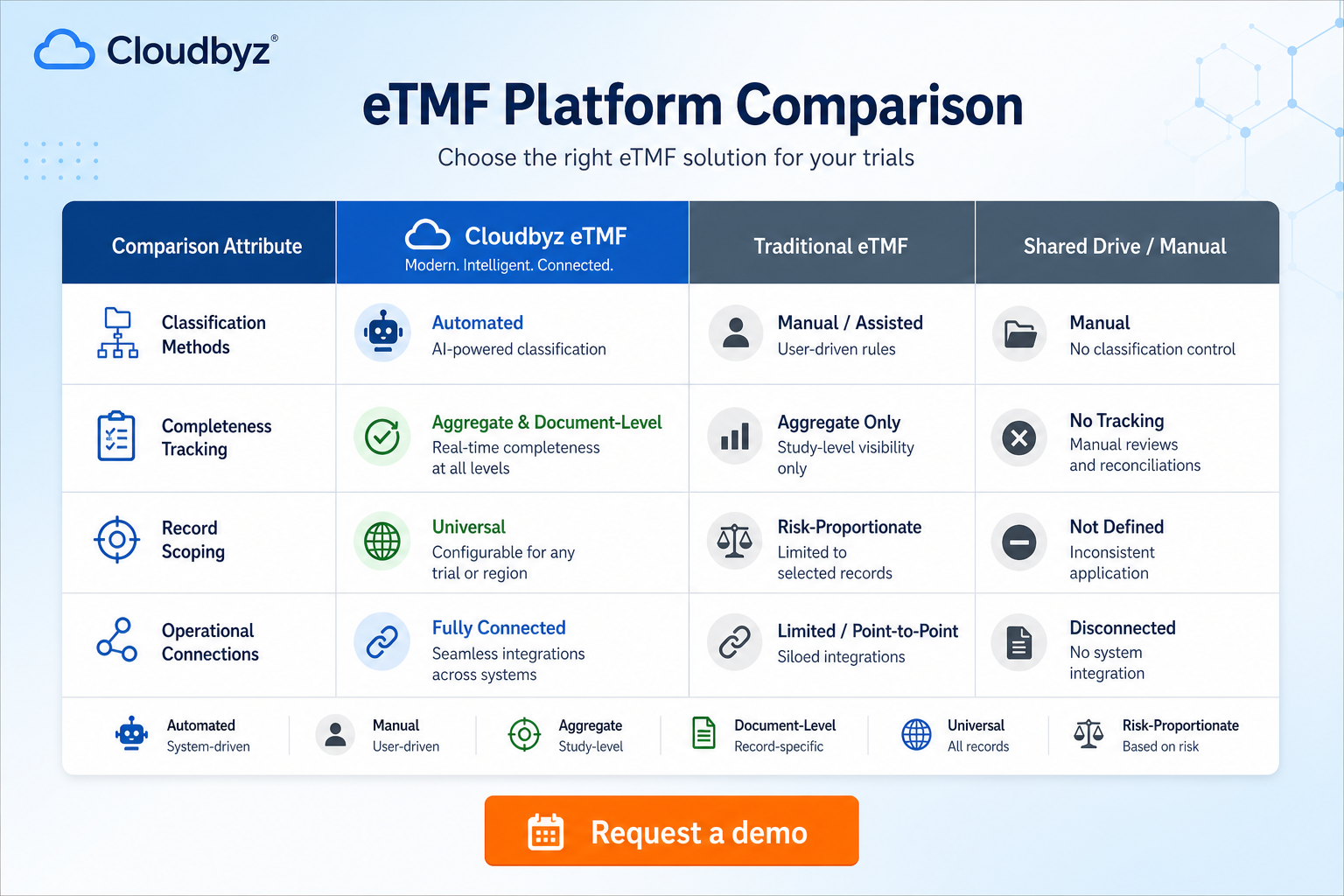
Does classification happen automatically with confidence scoring, or manually by whoever uploads? Automated classification with a confidence score, flagging uncertain cases for human review, keeps document types consistent across a portfolio. Manual classification drifts as different people apply their own judgment.
Is completeness tracked at the document level, or only as an aggregate percentage? A single completeness number can hide exactly which documents are missing or incomplete. Document-level tracking tells a sponsor precisely what's outstanding, not just how close to "done" the TMF looks in aggregate.
Does the platform support risk-proportionate record scoping, or force a single universal template? ICH E6(R3) Appendix C expects essential records to reflect trial-specific risk and design. A platform locked into one standard template across every study doesn't support this proportionality expectation well.
Is the audit trail connected to actual operational data, or does it live in isolation? When the eTMF sits on the same platform as CTMS, document expectations and completeness can reflect real study milestones. An isolated eTMF requires manual reconciliation to keep documentation aligned with what's actually happening operationally.
Can the platform demonstrate a defensible proportionality rationale, or just show a completed folder? Being able to explain why a given record set was scoped the way it was matters as much as having the documents themselves a distinction that becomes more important as risk-based approaches to essential records become standard practice.
A sharper eTMF comparison framework
| Question | Surface-Level Answer | Substantive Answer |
|---|---|---|
| Classification | Manual, varies by uploader | Automated with confidence scoring |
| Completeness | Single aggregate percentage | Document-level tracking |
| Record scoping | One universal template | Risk-proportionate, study-specific |
| Operational connection | Isolated document store | Connected to actual study milestones |
| Proportionality rationale | Not addressed | Demonstrable and documented |
Why this comparison matters more than folder structure
An inspector examining a TMF isn't primarily checking whether the folder structure follows a recognized reference model — that's largely assumed at this point. The real scrutiny falls on whether documentation reflects actual study conduct and whether gaps or inconsistencies were caught proactively rather than discovered during the inspection itself.
How Cloudbyz's eTMF Agent performs against this comparison
Documents are classified automatically with confidence scoring at intake, and completeness is tracked at the document level rather than as a single aggregate figure. Because the eTMF Agent shares a platform with CTMS, document expectations are positioned to reflect actual operational milestones.
See how Cloudbyz's eTMF Agent performs against this evaluation lens — book a demo
Subscribe to our Newsletter
