
Request a demo specialized to your need.
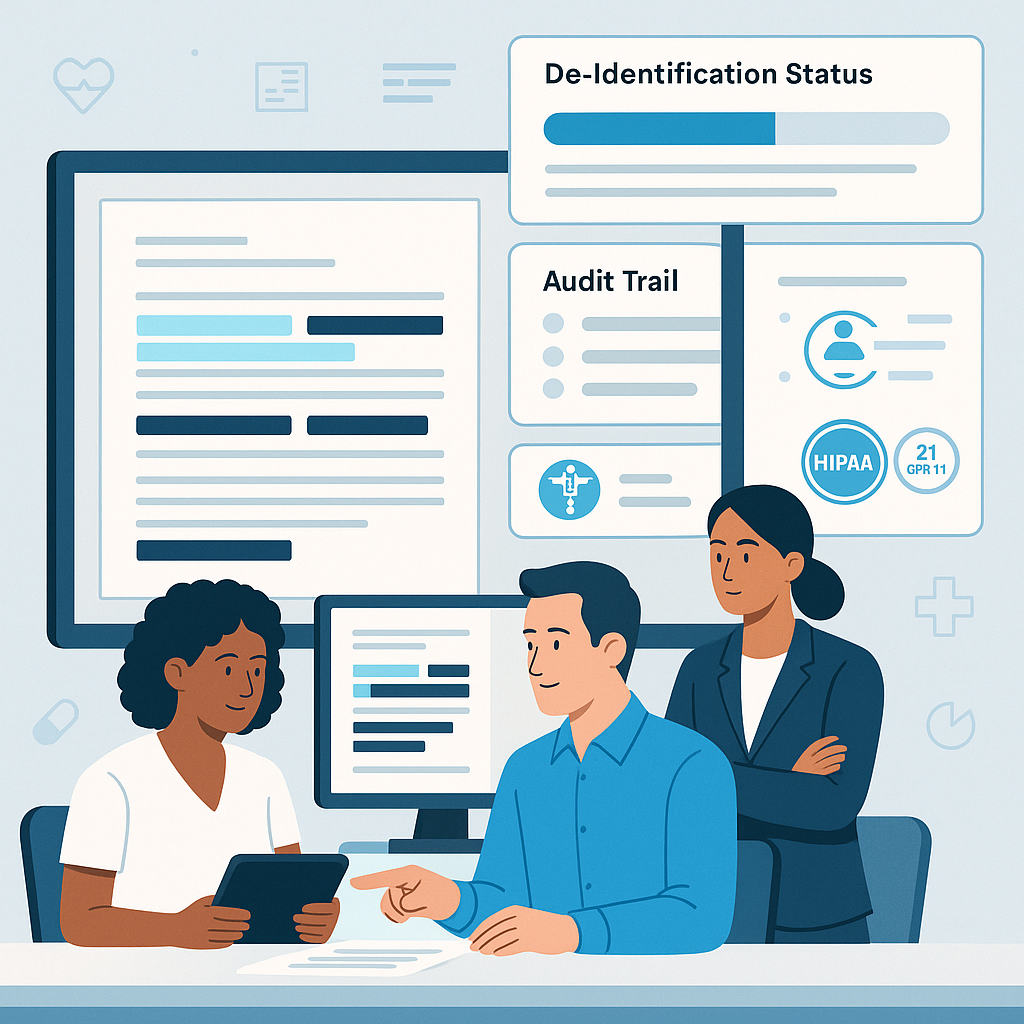
How AI streamlines PHI/PII redaction and proves eTMF privacy.
The privacy crisis hiding inside the eTMF
For years, the industry treated privacy breaches in the Trial Master File (TMF) as operational annoyances rather than systemic risk. A scanned consent with a visible patient name. A monitoring report containing unredacted medical record numbers. A vendor upload with site staff email addresses exposed beyond role-based access. These were “fix it later” issues—caught during QC, cleaned before submission, rarely escalated.
That complacency is no longer viable.
Modern eTMFs sit at the intersection of regulatory inspection readiness, data protection law, and cross-border digital collaboration. They contain personal data, sensitive health information, investigator identifiers, and increasingly, vendor-supplied artifacts generated outside sponsor control. As trials decentralize and data flows multiply, the privacy attack surface of the eTMF has expanded dramatically—while most controls remain manual, brittle, and reactive.
The consequences are not hypothetical. Under the EU’s General Data Protection Regulation (GDPR), administrative fines can reach up to 4% of global annual turnover or €20 million, whichever is higher. European Union regulators have repeatedly emphasized that life sciences companies are not exempt simply because data is used for research. At the same time, clinical inspections increasingly examine how documents are handled, not just whether they exist. Privacy violations now straddle two enforcement regimes: data protection authorities and health regulators.
The uncomfortable truth is this: most eTMFs are inspection-ready on content, but non-compliant on privacy. And as AI enters regulated operations, the tolerance for uncontrolled exposure is shrinking even further.
Evidence the industry can no longer ignore
Several data points illustrate why privacy in eTMF has become a board-level issue:
-
Human redaction does not scale
Independent studies across regulated industries consistently show that manual redaction accuracy drops below 80% when document volumes exceed a few hundred pages, with error rates increasing sharply under time pressure. In clinical trials, where single studies can generate tens of thousands of pages, this is a structural failure—not a training problem. -
Privacy violations are among the most expensive compliance failures
Public GDPR enforcement data shows that cumulative fines now exceed €4 billion since enforcement began, with healthcare and life sciences consistently among the top affected sectors. These penalties often stem from process failures, not malicious intent. -
Inspections increasingly scrutinize data handling controls
GCP inspection findings frequently reference inadequate controls around personal data handling, inappropriate access, and uncontrolled sharing of subject information—especially in outsourced and decentralized trial models. -
Decentralized and hybrid trials amplify risk
Remote monitoring, eConsent, eSource, and third-party vendors dramatically increase the number of documents entering the TMF from outside sponsor systems, often in inconsistent formats with embedded identifiers.
The conclusion is unavoidable: privacy risk in the eTMF is no longer edge-case risk. It is core operational risk.
The broken best practice: “Redact at the end”
The most common industry “best practice” is also its most dangerous:
“Redact during QC, just before final filing or inspection.”
This approach assumes:
-
documents remain internal until late stages,
-
privacy exposure is temporary,
-
and QC has enough time to catch everything.
All three assumptions are false.
In modern trials, documents are shared continuously across sponsors, CROs, sites, monitors, and auditors—often immediately after upload. Waiting to redact means privacy exposure already occurred. Worse, downstream redaction creates version chaos: multiple copies, unclear provenance, and weakened audit trails. Inspectors increasingly question whether redacted documents are faithful representations of originals, especially when redaction is performed manually without validated controls.
Here is the contrarian truth:
Late-stage redaction does not reduce privacy risk. It concentrates it.
By the time QC intervenes, the damage—regulatory, reputational, or legal—may already be done.
Why AI changes the equation—but only if used correctly
AI-powered redaction is often marketed as “faster black boxes.” That framing undersells the real opportunity and masks serious governance risks. In regulated environments, AI must do more than detect names—it must prove control.
When properly designed, AI transforms privacy management across three dimensions:
1. From keyword masking to contextual privacy intelligence
Traditional redaction relies on pattern matching: names, dates, numbers. AI goes further by understanding context:
-
distinguishing patient identifiers from investigator names,
-
recognizing embedded identifiers in free-text narratives,
-
detecting indirect identifiers that create re-identification risk when combined.
This is essential for compliance with GDPR principles of data minimization and privacy by design.
2. From document-level redaction to policy-driven privacy controls
Not all users should see the same data. AI enables role-aware redaction, where visibility depends on:
-
user role (CRA vs auditor vs vendor),
-
geography and jurisdiction,
-
study phase and purpose of access.
This moves privacy from static document alteration to dynamic access control.
3. From one-time cleanup to continuous enforcement
AI can enforce privacy at ingestion—before documents are shared—rather than relying on downstream cleanup. This is the single biggest shift in risk posture.
A practical framework: the “PRECISE” model for AI-driven eTMF privacy
To move from reactive redaction to defensible privacy control, organizations need a structured operating model. The PRECISE framework provides one.
P — Prevent exposure at ingestion
All documents entering the eTMF—uploads, email ingestion, integrations—must pass through an AI privacy gateway. The goal is simple: no unreviewed PII enters the shared workspace.
AI detects and flags identifiers immediately, before access is granted.
R — Recognize context, not just patterns
Detection models must classify:
-
direct identifiers (names, MRNs, addresses),
-
quasi-identifiers (dates, locations, rare conditions),
-
role-dependent identifiers (acceptable for some users, restricted for others).
This avoids over-redaction that destroys document utility.
E — Enforce jurisdiction-aware rules
Privacy rules differ across regions. AI systems must apply:
-
GDPR-aligned controls in the EU,
-
HIPAA-aligned controls in the US,
-
country-specific requirements elsewhere.
Rule engines—not ad hoc decisions—ensure consistency and defensibility.
C — Control visibility dynamically
Instead of creating multiple document versions, AI should render user-specific views:
-
full context for authorized clinical staff,
-
privacy-minimized views for auditors or external vendors.
This preserves a single source of truth while respecting least-privilege access.
I — Instrument every action for audit
Every detection, redaction, override, and approval must be logged:
-
what was detected,
-
why it was redacted,
-
who approved visibility,
-
and when access occurred.
Inspectors do not just ask what you did—they ask how you know it worked.
S — Support human-in-the-loop governance
AI flags. Humans decide. Critical or ambiguous cases route to privacy officers or TMF leads with full context and rationale capture. This is essential for regulatory trust.
E — Evolve with continuous learning
New document types, new vendors, new trial designs introduce new privacy risks. Models must be monitored, re-trained, and validated—not treated as static utilities.
Addressing the elephant in the room: validation and trust
AI in privacy controls raises legitimate concerns: model drift, false negatives, and regulatory acceptance. The answer is not avoidance—it is engineering discipline.
Validated AI redaction systems should include:
-
documented training data and performance metrics,
-
ongoing accuracy monitoring,
-
confidence thresholds triggering human review,
-
and clear SOPs defining responsibility.
Regulators do not expect perfection. They expect control, transparency, and continuous improvement.
The strategic payoff: privacy as inspection readiness
The most forward-looking organizations are reframing privacy controls as part of inspection readiness, not IT hygiene. Why?
Because uncontrolled personal data:
-
undermines subject protection,
-
weakens data integrity narratives,
-
and exposes organizations to parallel enforcement actions.
AI-powered privacy controls allow sponsors and CROs to demonstrate that:
-
sensitive data is identified proactively,
-
access is intentional and justified,
-
and exposure risk is continuously managed.
This is not just about avoiding fines. It is about preserving trust—with regulators, sites, partners, and ultimately, patients.
Privacy failure will outpace data integrity failure
For decades, data integrity was the dominant compliance concern in clinical trials. That era is shifting. As digital collaboration accelerates, privacy failures will become the fastest path to serious enforcement action.
Organizations that still rely on manual redaction and late-stage QC are betting their regulatory standing on human endurance. That is not a strategy.
AI-powered redaction and privacy controls—implemented early, governed rigorously, and audited continuously—represent the next maturity curve for eTMF. Not because AI is fashionable, but because the scale and complexity of modern trials leave no alternative.
In the coming years, the question inspectors will implicitly ask is simple:
Did you know where personal data was—and did you control it?
If your eTMF cannot answer that confidently, no completeness dashboard will save you.
Subscribe to our Newsletter
