
Request a demo specialized to your need.
Why Traditional Approaches Fall Short
Clinical trial teams still spend significant time managing documents in their eTMF. Documents arrive from sites and vendors and are first uploaded into the TMF by a CRA or study team member. Later eTMF specialist must revisit those same files to complete or correct metadata. QC teams then conduct additional reviews to validate classification and completeness, often returning to the same documents multiple times and even across different studies.
As document volumes increase and studies become more geographically dispersed, maintaining these manual, sequential workflows becomes increasingly unsustainable.
Scaling Clinical Trials Requires a Different Approach
This is where technology must play a different role not to replace clinical teams, but to eliminate repetitive effort and help workflows move faster and more consistently.
Today, the same documents still pass through multiple manual handoffs, creating duplicate work, missed or delayed milestones, and increasing operational friction. This pattern is familiar to many clinical organizations.
For years, the response has been to add more eTMF features, more folder structures, more rules, and more validation layers. Each addition aimed to strengthen control, but in practice often made manual processes more complex. The fundamental challenge is not missing functionality. It is the absence of intelligence at the point of document intake.
The Case for Intelligent Classification, Metadata, and Document Intake
Every document should be classified, enriched with accurate metadata, and quality-checked at the moment of upload, before it advances in the workflow. When this does not occur, each downstream step becomes slower, more resource-intensive, and more vulnerable to inconsistency.
This is precisely the gap the Cloudbyz eTMF AI Agent is designed to address.
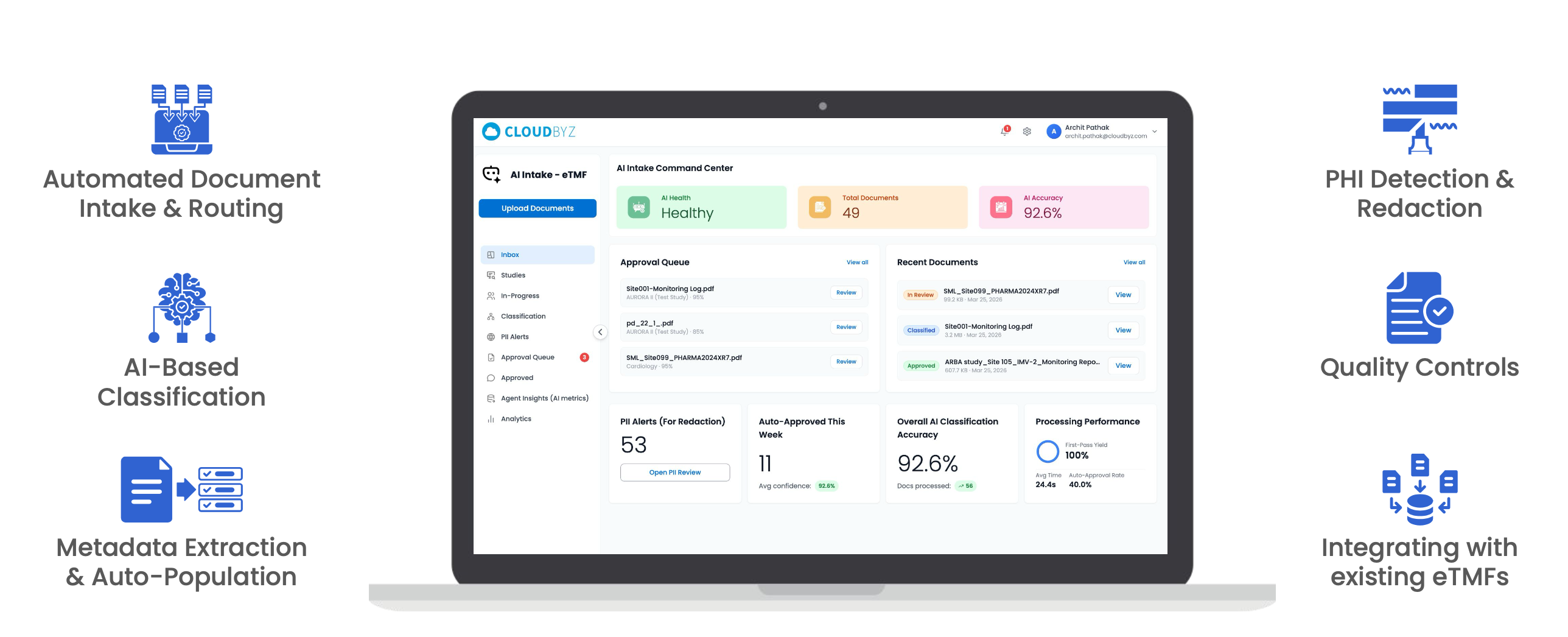
Unlike traditional eTMF models that depend on manual intake and repeated downstream QC cycles, the Cloudbyz eTMF AI Agent introduces intelligence at the point of document ingestion, ensuring documents are processed as they enter the system not later in the workflow.
Aligned with industry standards such as the DIA TMF Reference Model and ALCOA+ principles, the AI Agent drives consistent classification, metadata enrichment, and traceability from the outset. It serves as an intelligent first layer in the TMF process by:
-
Automatically classifying incoming documents against standard TMF structures
-
Enriching metadata based on study, site, and regulatory context
-
Performing real-time quality checks to detect issues early
-
Learning continuously from user interactions to improve accuracy over time
In practice, this reduces repeated QC cycles, minimizes metadata rework, and keeps documents moving forward with greater consistency.
The operational impact is clear:
-
Lower manual effort across TMF activities
-
Faster document processing and availability
-
Increased confidence in ongoing inspection readiness
As trials grow in complexity with more documents, more global sites, and rising regulatory expectations manual intake models become increasingly difficult to sustain. Organizations that adopt intelligent intake will be better equipped to manage TMF operations efficiently, without adding operational burden.
What would your TMF operations look like if every document were accurately classified, fully tagged, and quality-checked the moment it entered your eTMF—without extra effort from your team?
Cloudbyz eTMF AI Agent is already helping clinical organizations cut down repeat QC cycles, surface issues earlier, and move documents through workflows with far greater consistency.
If you are curious how this would work with your actual studies, sites, and TMF structure, request a live demo with our team. We will walk you through real use cases, show how the AI Agent fits into your current processes, and quantify the potential impact on your inspection readiness and operational workload.
Subscribe to our Newsletter
