

Request a demo specialized to your need.
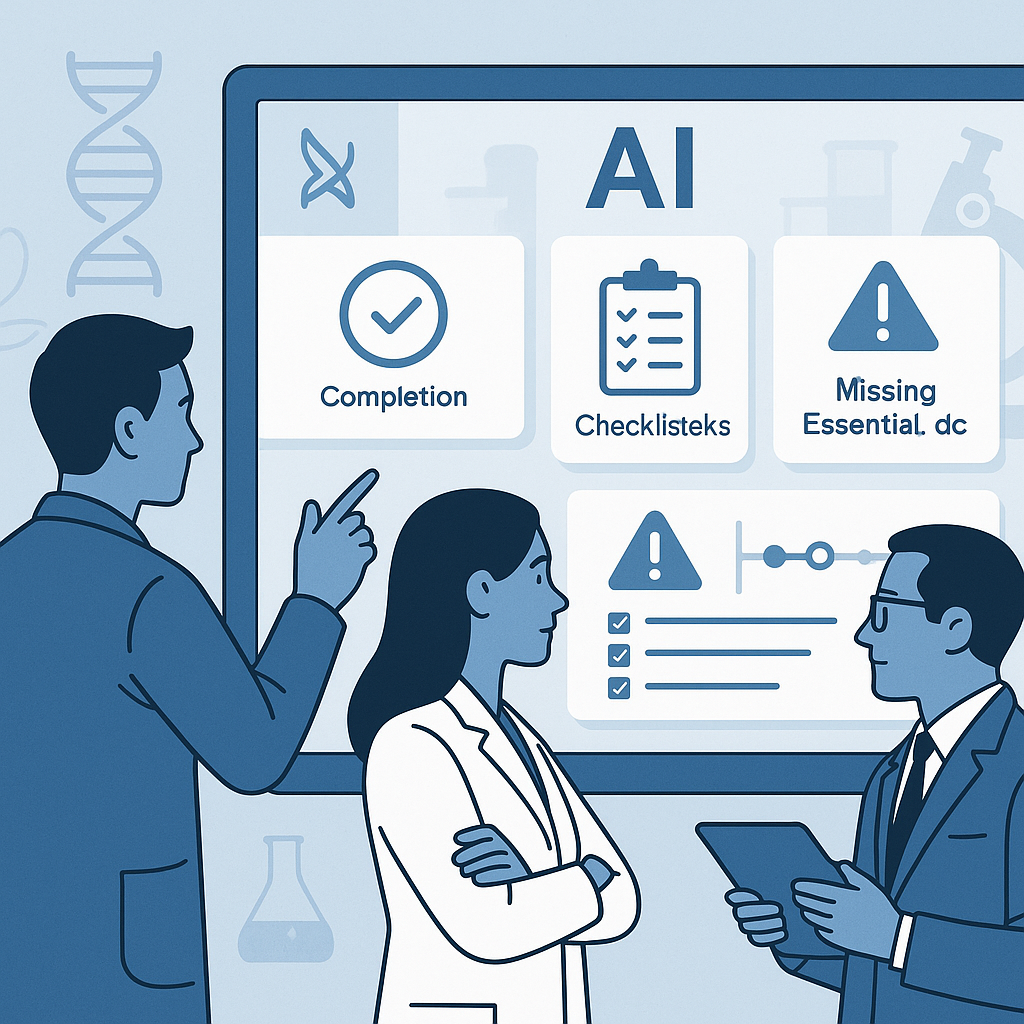
How AI hardens eTMF quality, speeds remediation, and proves readiness.
AI for eTMF Quality: From Completeness to Inspection Readiness
In clinical research, the electronic Trial Master File (eTMF) is the authoritative archive of essential documents that demonstrate trial conduct and compliance with regulatory requirements. Traditionally, ensuring eTMF quality — completeness, accuracy, and inspection readiness — has been a labor-intensive, manual endeavor. Despite significant investments in eClinical systems, many sponsors and CROs still struggle with fragmented processes, human error, and inefficient workflows.
Artificial Intelligence (AI) offers a transformative opportunity. Rather than just automating repetitive tasks, AI can elevate the quality and integrity of eTMF content by embedding intelligence across the lifecycle of document creation, classification, indexing, quality control, and regulatory inspection readiness. This shift represents a strategic inflection point — moving from reactive correction of errors to proactive assurance of quality outcomes.
Why eTMF Quality Matters More than Ever
Regulatory authorities worldwide — including FDA, EMA, MHRA, and others — have heightened scrutiny on trial documentation. Inspection readiness is no longer a future state that can be “achieved just in time”; it must be continuously demonstrated. Quality lapses in eTMF not only risk findings during inspections but can also delay submissions, increase audit costs, and expose organizations to compliance risk.
More than just completeness, eTMF quality encompasses:
-
Correctness: Documents indexed to correct trial milestones and lifecycle events
-
Consistency: Adherence to metadata standards, naming conventions, and taxonomy
-
Traceability: Clear evidence of review, approval, and provenance
-
Inspection Readiness: Confidence that any file can be retrieved and defended during regulatory scrutiny
AI helps transform these dimensions from aspirational principles into operational realities.
From Manual to Intelligent: The AI Continuum in eTMF Quality
To understand how AI elevates eTMF quality, it’s useful to view adoption in progressive stages:
-
Task Automation: Repetitive work like file uploads, notifications, and basic metadata population.
-
AI-Assisted Classification: Using natural language processing (NLP) to classify documents to the correct document types and clinical milestone.
-
Quality Assurance Overlays: Machine learning models that detect anomalies, missing documents, inconsistent indexing, and suggest corrections.
-
Predictive Quality & Risk Insights: AI-driven forecasts of document gaps, trends in quality findings, and proactive alerts.
-
Inspection Readiness Intelligence: Continuous readiness dashboards, automated audit trails, and context-aware retrieval that anticipates inspection questions.
This continuum reflects not just increasing technical sophistication, but a broader shift: AI moves from supporting users to augmenting compliance outcomes.
Key AI Capabilities Powering eTMF Quality
1. Intelligent Classification & Metadata Accuracy
One persistent challenge in eTMF management is correctly classifying documents to the right taxonomy. Manual indexing — even by expert staff — is error-prone and inconsistent across teams and geographies.
Modern AI models trained on clinical document taxonomies can analyze content context, not just keywords, accurately assigning document type, relevance, and associated trial events. The result is a dramatic reduction in misfiled items and a stronger foundation for downstream quality checks.
2. Automated Completeness Checks
Completeness isn’t simply about counting documents. True completeness means verifying that all required documents for a given phase of the trial — protocol amendments, site logs, consent forms — are present, valid, and compliant with standards.
AI can leverage historical patterns and regulatory expectations to detect missing essential documents. Rather than waiting for a compliance manager to manually reconcile lists, AI systems can surface missing items, prioritize them by risk, and even recommend corrective actions.
3. Anomaly Detection & Quality Oversight
Machine learning models excel at recognizing patterns. When fed historical eTMF data annotated with quality issues, AI can learn to detect anomalies such as:
-
Unusual metadata combinations
-
Incorrect lifecycle dates
-
Duplicate content
-
Inconsistent author or site fields
These insights help quality teams focus on exception handling rather than rote checking.
4. Contextual Search & Retrieval
Inspection readiness depends on retrieval confidence: the ability to respond to regulator requests quickly and accurately. AI-enhanced search — powered by semantic understanding — enables users to find documents based on meaning and context, not just filename or tags.
Imagine an inspector asking for “all protocol deviation communications from Site X in Q2.” AI systems can interpret intent, map context across document types, and deliver precise results.
5. Predictive Insights & Quality Forecasting
Beyond retrospective QA, AI can anticipate where quality issues are likely to occur — based on patterns such as delayed uploads, recurring indexing errors by specific sites, or document types frequently amended late in the trial.
Predictive insights allow clinical operations teams to act before quality issues crystallize.
AI in Practice: Transforming Quality Workflows
Consider these real-world eTMF quality scenarios:
-
A global study with multiple sites shows an unusual drop-off in consent form uploads. AI flags missing trends and correlates them to specific site personnel changes.
-
Near a planned submission, the AI system identifies critical regulatory documents missing for a key milestone and notifies responsible owners with suggested next steps.
-
During a mock inspection, QA managers use AI-powered search to retrieve relevant correspondence rapidly, demonstrating continuous inspection readiness.
These aren’t futuristic cases — they are achievable today with modern AI and eTMF platforms.
Governance, Trust & Human-AI Collaboration
AI doesn’t replace quality professionals; it amplifies them. Human oversight remains essential, especially where judgment, context, or regulatory interpretation is involved.
To foster trust, organizations should:
-
Maintain transparent AI traceability logs
-
Establish validation and monitoring of AI suggestions
-
Enable user feedback loops to refine models
-
Align AI outputs with SOPs and governance frameworks
For life sciences, where regulatory accountability is paramount, explainability and auditability of AI actions are non-negotiable.
Regulatory Alignment & Inspection Confidence
Regulators are increasingly receptive to intelligent tools that improve compliance. Inspection authorities expect robust documentation and reliable audit trails — areas where AI adds measurable value.
Continuous inspection readiness means eTMF quality is no longer a periodic milestone but an ongoing state. AI makes this sustainable by reducing manual load and raising the baseline quality.
The Road Ahead: AI as a Strategic Enabler of eTMF Excellence
As the industry accelerates digital transformation, AI for eTMF quality will evolve from niche automation to strategic enabler:
-
Standardized AI Taxonomies: Cross-industry standards will improve interoperability and quality consistency.
-
AI-Assisted Regulatory Intelligence: Systems that align eTMF with evolving global requirements.
-
Connected Quality Ecosystems: Integrating eTMF AI with broader clinical and safety systems to unify quality metrics enterprise-wide.
Organizations that embrace AI for quality — not just productivity — will differentiate themselves by reducing risk, accelerating timelines, and consistently demonstrating inspection readiness.
Conclusion: From Completeness to Confidence
Completeness is a starting point; quality is the destination, and inspection readiness is proof of success. AI provides the intelligent lens that shifts eTMF from error-correction to quality assurance.
For sponsors and CROs committed to operational excellence, AI isn’t an optional add-on — it’s an essential capability for the next generation of clinical execution. With thoughtful implementation, governance, and continuous refinement, AI makes inspection readiness not just achievable but sustainable.
Subscribe to our Newsletter
