

Request a demo specialized to your need.
Introduction
The pharmaceutical and clinical research industry has long grappled with one of its most persistent operational challenges: managing the massive, complex documentation that underpins every clinical trial. The Electronic Trial Master File (eTMF) - the definitive repository of all documents that allow the reconstruction and evaluation of a clinical trial - has historically been a labor-intensive, error-prone process requiring armies of clinical operations staff.
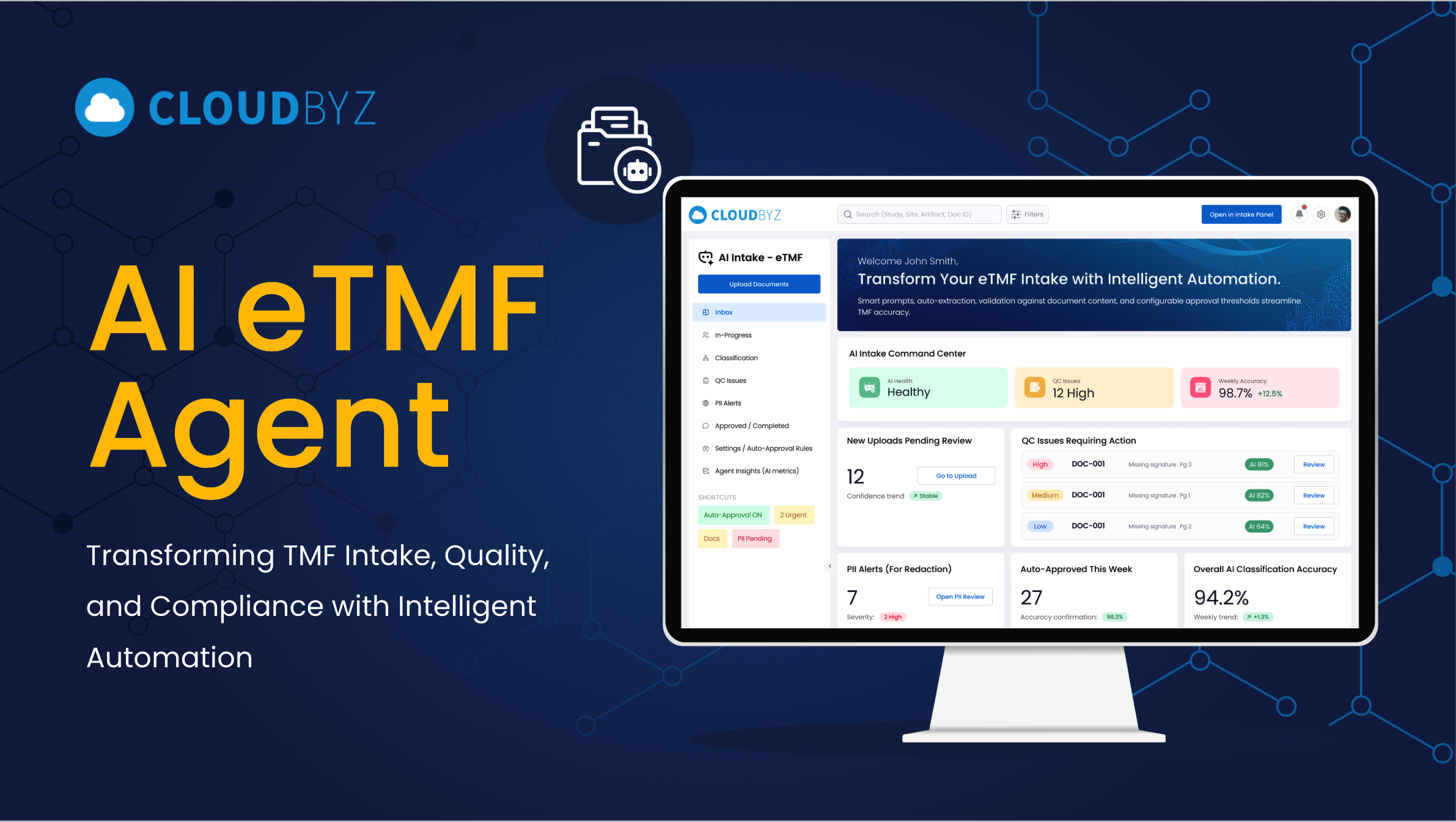
Enter the AI eTMF Agent: an intelligent, autonomous system that is fundamentally reimagining how sponsors, CROs (Contract Research Organizations), and sites manage trial documentation. By combining large language models (LLMs), intelligent document processing, and clinical trial domain expertise, AI eTMF Agents are poised to slash timelines, reduce compliance risk, and free clinical teams to focus on what matters most - getting safe, effective therapies to patients faster.
What Is an eTMF?
A Trial Master File (TMF) is the collection of essential documents that individually and collectively permits the evaluation of the conduct of a trial and the quality of the data produced. Regulatory authorities - including the FDA, EMA, and MHRA - require that sponsors maintain a complete, accurate, and inspection-ready TMF at all times throughout and after a clinical trial.
The eTMF is the electronic version of this file, typically managed within a dedicated platform. Modern eTMFs are structured around the TMF Reference Model, a widely adopted industry standard that organizes thousands of document types across zones, sections, and artifacts, spanning the full trial lifecycle from study startup to close-out and archival.
A well-maintained eTMF must be:
- Complete - all required documents are present
- Accurate - documents reflect the true conduct of the trial
- Current - documents are filed in a timely manner
- Inspection-ready - available for regulatory review at any time
Despite this clarity of purpose, maintaining a compliant eTMF is notoriously difficult. Trials can generate hundreds of thousands of documents across dozens of sites, time zones, and functional teams.
The Problem with Traditional eTMF Management
Traditional eTMF management is characterized by:
1. Manual Document Classification
Clinical operations staff must manually review incoming documents and determine their correct TMF artifact type - a process that is time-consuming and highly dependent on individual expertise. Misclassification is common and costly.
2. Completeness Gaps
Identifying missing documents requires painstaking cross-referencing of what has been received against what is expected - a task that is often reactive rather than proactive.
3. Quality Issues at Filing
Documents frequently arrive with missing metadata, incorrect dates, wrong study references, or out-of-date versions. Catching and resolving these issues manually creates significant bottlenecks.
4. Delayed Filing
Regulatory guidance generally expects documents to be filed within a defined timeframe after they are generated or received. Manual workflows consistently struggle to meet these timelines, especially during peak trial periods.
5. Inspection Readiness
Preparing for a regulatory inspection requires intensive remediation efforts - often undertaken under time pressure - to address completeness gaps, metadata errors, and filing backlogs that have accumulated over months or years.
6. Siloed Communication
eTMF health issues that require action from sites, vendors, or internal functional teams often languish in email chains, with no systematic tracking or escalation.
These challenges translate directly into risk: delayed trial timelines, regulatory findings during inspections, and increased operational costs.
What Is an AI eTMF Agent?
An AI eTMF Agent is an intelligent software system that autonomously performs the core cognitive and operational tasks of eTMF management. Unlike traditional eTMF platforms - which are passive repositories requiring human users to classify, file, and quality-check documents - an AI eTMF Agent actively monitors, processes, classifies, validates, and communicates on behalf of the clinical operations team.
The key distinction is agency: the system does not just surface information for humans to act on; it takes action, makes decisions, and manages workflows with minimal human intervention.
Core Capabilities of an AI eTMF Agent
Intelligent Document Classification
Using natural language processing and document understanding models trained on clinical trial documentation, the AI agent automatically reads incoming documents and maps them to the correct TMF Reference Model artifact. It can handle a vast array of document types - protocols, amendments, informed consent forms, investigator CVs, monitoring visit reports, laboratory certifications, regulatory correspondence, and many more - with accuracy that meets or exceeds human performance.
The agent understands context: it recognizes that a document titled "Amendment 3" belongs to a different artifact than the original protocol, and that a "Site Qualification Visit Report" differs from a "Site Initiation Visit Report" even when they look superficially similar.
Metadata Extraction and Validation
For every document processed, the AI agent extracts key metadata - study identifier, site number, visit date, document version, author, effective date, and more - directly from the document content. It then validates this metadata for accuracy, completeness, and consistency with known trial data. Discrepancies are flagged before filing rather than after.
Completeness Tracking and Gap Detection
The AI agent maintains a real-time, dynamic expected document list based on the trial's phase, therapeutic area, geography, and current status. It proactively identifies missing or overdue artifacts and generates actionable gap reports - not just what is missing, but who is responsible for providing it and how overdue it is.
Automated Quality Review
Before a document is filed in the eTMF, the agent performs a multi-point quality check: Is this the correct version? Does it bear the required signatures? Is it within the required filing window? Does its content align with the metadata? Documents that pass are filed automatically; those that fail are routed for human review with a clear explanation of the issue.
Proactive Communication and Escalation
When documents are missing or overdue, the AI agent automatically generates and sends targeted requests to the responsible party - a site coordinator, a vendor, or an internal team - with the appropriate level of urgency. It tracks responses, sends reminders, and escalates unresolved issues through defined workflows. This creates a closed-loop system that eliminates the need for manual follow-up.
Real-Time eTMF Health Dashboards
The AI agent continuously calculates and displays eTMF health metrics across the portfolio, study, and site levels. Sponsors and CROs can see, at a glance, their completeness rates, filing timeliness, outstanding queries, and inspection readiness scores - enabling data-driven prioritization of remediation efforts.
Inspection Readiness Management
The agent continuously monitors the eTMF against regulatory expectations and industry benchmarks, providing an ongoing, objective assessment of inspection readiness. When an inspection is imminent, it generates a prioritized remediation plan - identifying the highest-risk gaps and recommending the sequence of actions most likely to resolve them efficiently.
How AI eTMF Agents Work: The Technology
Modern AI eTMF Agents are built on a stack of complementary AI and automation technologies:
Large Language Models (LLMs)
Foundation models with hundreds of billions of parameters, fine-tuned on clinical trial documentation and regulatory guidance, power the core document understanding capabilities. These models can read a complex regulatory correspondence letter and correctly identify it as a "Health Authority Correspondence" artifact within the appropriate TMF zone.
Optical Character Recognition (OCR) and Document AI
For scanned PDFs and legacy documents, advanced OCR and document AI pipelines extract text, tables, and key-value pairs with high fidelity, enabling the LLM layer to process documents regardless of their original format.
Knowledge Graphs and Ontologies
Clinical trial knowledge graphs encode the relationships between trial entities - sponsors, sites, investigators, vendors, protocols, amendments - and the TMF Reference Model. This structured knowledge enables the agent to reason about document completeness in context: understanding, for example, that a new country requires a different set of regulatory approval documents than existing countries.
Retrieval-Augmented Generation (RAG)
RAG techniques allow the agent to ground its reasoning in up-to-date regulatory guidance, SOPs, and company-specific filing conventions - ensuring that its actions remain compliant with evolving requirements.
Agentic Workflow Orchestration
The "agent" architecture means the system can autonomously plan and execute multi-step workflows: receive a document, extract metadata, classify, validate, file or reject, notify stakeholders, and update dashboards - all without human initiation at each step.
Key Benefits
For Sponsors and CROs
| Benefit | Impact |
|---|---|
| Reduced manual effort | 60-80% reduction in document handling time |
| Faster filing | Near-real-time filing vs. days or weeks manually |
| Improved completeness | Proactive gap detection vs. reactive identification |
| Inspection readiness | Continuous monitoring vs. point-in-time audits |
| Cost reduction | Significant savings in clinical operations headcount |
| Scalability | Handle trial portfolio growth without proportional headcount growth |
For Sites
- Fewer data queries and requests due to upfront quality checks
- Faster turnaround on document acknowledgments
- Clearer guidance on outstanding documentation requirements
For Regulatory Agencies
- Higher-quality TMFs submitted for inspection
- Fewer findings related to documentation gaps
- More reliable reconstruction of trial conduct
Compliance and Regulatory Alignment
AI eTMF Agents are designed with regulatory compliance at their core. Key alignments include:
- ICH E6(R3) Good Clinical Practice: The revised GCP guideline emphasizes risk-based quality management and the use of technology to enhance trial oversight - principles that AI eTMF Agents directly support.
- TMF Reference Model: The industry-standard taxonomy for eTMF organization is embedded in the agent's classification logic.
- 21 CFR Part 11 / Annex 11: Electronic record and electronic signature requirements are addressed through audit trails, access controls, and validation of the underlying platforms.
- FDA eCTD guidance and EMA inspection expectations inform the completeness and quality checks performed by the agent.
All agent actions are logged in a comprehensive, immutable audit trail - a prerequisite for regulatory credibility.
Integration with eTMF Platforms
AI eTMF Agents are designed to work alongside existing eTMF platforms rather than replace them. Via APIs and native connectors, they integrate with leading platforms such as:
- Cloudbyz eTMF
- Veeva Vault eTMF
- Wingspan
- OpenText eDOCS
- Florence eBinders
- Ennov eTMF
Documents can be received from any source - email, SFTP, sponsor portals, or direct site submissions - processed by the AI agent, and filed into the target eTMF system with full metadata and classification applied.
Use Cases in Practice
Study Startup Acceleration
During the high-volume document period of study startup, AI eTMF Agents can process and file documents from dozens of sites simultaneously - a task that would require significant manual resources to accomplish within regulatory filing windows.
Ongoing Trial Management
Throughout the active phase of a trial, the agent continuously monitors the TMF for emerging gaps, validates incoming documents, and manages the communication loops needed to keep all required documentation current.
Pre-Inspection Remediation
When a regulatory inspection is announced, the AI agent rapidly generates a comprehensive gap assessment and prioritized remediation plan, enabling the clinical operations team to focus on the highest-risk items first.
TMF Migration
When organizations migrate historical TMF data from legacy systems or paper files, AI eTMF Agents can classify and validate hundreds of thousands of legacy documents at scale - a task that would take years to complete manually.
Close-Out and Archival
At trial close-out, the agent performs a final completeness review and prepares the TMF for archival in accordance with retention requirements.
Challenges and Considerations
While AI eTMF Agents offer transformative potential, organizations should approach deployment thoughtfully:
Validation Requirements
As with any GxP software, AI eTMF Agents must be validated for their intended use. This requires documented performance testing against representative document sets, with acceptance criteria tied to regulatory expectations.
Model Accuracy and Edge Cases
AI classification models, while highly accurate on common document types, may perform less well on rare or highly unusual documents. Robust human-in-the-loop workflows for low-confidence classifications are essential.
Change Management
Adoption of AI-driven workflows requires investment in training, process redesign, and cultural change. Clinical operations staff must understand how to work effectively alongside AI agents - leveraging AI for scale while applying human judgment where it matters most.
Data Privacy
Documents in the eTMF frequently contain personal data of trial participants and investigators. AI eTMF solutions must be deployed in compliance with GDPR, HIPAA, and other applicable data protection regulations.
The Future of AI eTMF
The evolution of AI eTMF technology is rapidly advancing. Emerging capabilities on the horizon include:
- Predictive analytics: Forecasting which sites or countries are at highest risk of TMF deficiencies based on historical patterns
- Natural language querying: Allowing clinical operations staff to ask questions like "Which sites are missing current CVs?" in plain English
- Cross-document reasoning: Identifying inconsistencies across multiple documents (e.g., a protocol amendment not reflected in an updated informed consent form)
- Autonomous regulatory intelligence: Automatically updating filing requirements in response to new or revised regulatory guidance
- Multimodal document understanding: Processing not just text but charts, tables, signatures, and complex layouts with greater precision
As generative AI matures and trust in autonomous systems grows, AI eTMF Agents will take on progressively more complex tasks - eventually managing the full eTMF lifecycle with minimal human oversight, while maintaining the audit trails and quality controls that regulators require.
Conclusion
The AI eTMF Agent represents one of the most significant advances in clinical operations technology in recent years. By automating the classification, validation, filing, and quality management of trial documentation, these systems address one of the most persistent pain points in drug development - and do so at a scale and speed that human teams simply cannot match.
For sponsors and CROs looking to accelerate trial timelines, reduce inspection risk, and do more with constrained resources, AI eTMF Agents are rapidly moving from a competitive differentiator to a table-stakes capability. Organizations that invest in this technology today will be better positioned to deliver life-saving therapies to patients faster and with greater confidence in the quality of their evidence.
The future of the Trial Master File is intelligent, autonomous, and inspection-ready - and it is arriving now.
This article provides a general overview of AI eTMF Agent technology and its applications in clinical trial document management. Specific product capabilities may vary by vendor and implementation.
Subscribe to our Newsletter
