

Request a demo specialized to your need.
Executive Summary
Despite years of digitization, the electronic Trial Master File (eTMF) remains one of the most fragile and resource-intensive areas in clinical operations. While paper binders have been replaced by digital repositories, the underlying operating model has not fundamentally changed. Document intake, classification, metadata entry, quality checks, and completeness reviews are still largely manual, sequential, and dependent on individual effort. As a result, eTMF quality is achieved through heroic human intervention rather than by system design.
This manual model no longer scales. Document volumes continue to grow rapidly due to decentralized trials, expanding global footprints, and increased vendor participation. Metadata inconsistencies, delayed filings, and limited real-time visibility make it difficult for teams to assess true TMF health. Gaps are often discovered weeks or months after they occur—frequently during audits or inspections—when remediation is costly, stressful, and difficult to defend. Inspection readiness remains reactive and episodic rather than continuous.
At the same time, the regulatory landscape is shifting. Regulators increasingly expect sponsors and CROs to demonstrate continuous control, risk-based quality oversight, and real-time awareness of documentation status. Checklist-driven completeness reviews and end-of-study cleanups are no longer sufficient. Traditional eTMF platforms, designed primarily as document repositories, are misaligned with both modern trial complexity and evolving regulatory expectations.
The core challenge is structural, not human. No amount of additional effort, headcount, or training can sustainably compensate for an operating model that relies on people to manage exponential scale. To meet today’s demands, eTMF must evolve from a passive document store into an intelligent, continuously monitored quality system.
This is the role of the AI eTMF Agent embedded within Cloudbyz eTMF. Unlike bolt-on tools or post-processing solutions, the AI eTMF Agent operates natively inside the system of record, sharing full study, site, country, and milestone context. It engages documents at the point of intake—automatically classifying artifacts, extracting and validating metadata, performing first-pass quality checks, and continuously monitoring completeness and timeliness against regulatory and operational expectations.
Human oversight remains central. The AI operates with configurable confidence thresholds, full audit trails, and human-in-the-loop governance, ensuring every decision is explainable, traceable, and inspection-ready. Reviewers focus on exceptions, judgment-based decisions, and high-risk artifacts, while AI absorbs repetitive, rule-based work at scale.
The impact is immediate and measurable. Intake and QC cycle times compress from days or weeks to minutes or hours. Throughput increases without linear headcount growth. TMF teams move from reactive document handling to proactive quality ownership. Quality becomes predictable, measurable, and repeatable across studies and partners. Most importantly, inspection readiness shifts from a last-minute project to a continuous operational state.
For sponsors, this means faster inspection readiness, lower audit risk, and consistent TMF quality across the portfolio. For CROs, it enables scalable delivery, stronger SLA performance, and meaningful differentiation through transparency and quality. Together, these outcomes point toward a future of autonomous quality—self-monitoring TMFs, predictive risk signals, AI-driven prioritization, and zero-panic inspections.
The conclusion is clear: the future of eTMF is not more effort or more checklists. It is intelligence embedded into everyday workflows, making quality inevitable and inspection readiness a daily reality.
Why eTMF Still Feels Broken
Despite years of digitization, eTMF remains one of the most painful areas in clinical operations.
eTMF is “electronic” — but still manual at its core
Most eTMF systems successfully replaced paper binders with digital folders — but the underlying work never changed. Documents are still uploaded manually, classified by hand, and reviewed one by one. Metadata entry, artifact placement, and completeness checks depend heavily on human interpretation. The result is an electronic filing cabinet, not an intelligent system that understands what a document is, where it belongs, or why it matters.
Quality depends on heroic human effort
TMF quality today is driven by individual vigilance rather than system design. Experienced TMF managers and reviewers compensate for system limitations through late nights, manual checklists, and constant follow-ups with sites and CROs. Quality is achieved through effort, not consistency — and when key people are overloaded or unavailable, quality predictably suffers.
Inspection readiness is reactive, not continuous
Most organizations only assess TMF health at predefined checkpoints — study milestones, internal audits, or just before inspections. Gaps accumulate quietly between reviews, creating a false sense of readiness. When inspections are announced, teams scramble to identify missing documents, reconcile metadata, and explain inconsistencies that should have been prevented earlier.
Teams discover gaps too late
Missing, misfiled, or incomplete documents are often discovered weeks or months after they should have been addressed. By then, site staff have moved on, vendors are harder to engage, and context is lost. What could have been a simple correction becomes a time-consuming escalation — increasing risk, cost, and stress across the organization.
The problem isn’t lack of systems — it’s lack of intelligence.
Traditional eTMF platforms store documents, but they don’t understand them. Without intelligence embedded at the point of intake, quality, completeness, and inspection readiness will always remain reactive — no matter how modern the UI looks.
Today’s eTMF Challenges - What Teams Are Really Facing
Operational Challenges
Manual document intake & classification
Despite digital platforms, most documents still arrive via email, portals, or shared drives and require manual uploading, naming, and filing. Classification into the correct TMF zone and artifact relies on individual judgment, leading to variability and rework. As volume increases, backlogs form quickly and silently.
Inconsistent metadata across studies, countries, and sites
Metadata standards are often defined on paper but applied inconsistently in practice. The same document type may carry different names, dates, or attributes depending on who uploaded it or where the study is running. This inconsistency breaks downstream reporting, completeness checks, and inspection confidence.
Delayed filing from sites and vendors
Sites and vendors operate on different timelines and priorities. Documents arrive late, out of sequence, or in batches long after the triggering milestone has passed. By the time issues are identified, follow-up becomes difficult and context is often lost.
Poor visibility into real TMF health
Dashboards may show document counts, but they rarely reflect true readiness. Teams struggle to answer basic questions in real time: What’s missing? What’s late? What’s high risk? Visibility is fragmented, static, and often retrospective.
Quality & Compliance Challenges
Missing or late documents
Essential documents frequently lag behind study milestones. Teams may believe a site or country is “complete” until a deeper review reveals gaps — often during internal audits or inspection prep, when remediation windows are narrow.
Incomplete or incorrect metadata
Documents may be present, but critical attributes — effective dates, approvals, versions, signatures — are missing or wrong. These issues undermine document validity and force time-consuming reconciliation just to prove compliance.
No objective measure of inspection readiness
Inspection readiness is often based on subjective judgment or manual spot checks. Without continuous, system-driven indicators, organizations lack a defensible, real-time view of readiness across studies and regions.
Last-minute QC before audits
Quality checks are compressed into high-pressure audit windows. Teams scramble to re-review documents that should have been validated at intake, increasing risk of errors and inconsistent explanations to inspectors.
Human Impact
TMF teams overwhelmed by volume
Document volumes have exploded with decentralized trials, more vendors, and more regions. TMF teams spend disproportionate time managing inflow instead of ensuring quality and oversight.
Reviewers stuck in repetitive checks
Highly skilled reviewers are consumed by repetitive, rule-based tasks — checking filenames, metadata fields, and placement — rather than focusing on true quality and risk.
High burnout, low productivity
Sustained manual effort, constant firefighting, and inspection anxiety lead to burnout. Productivity declines not because teams lack capability, but because systems don’t scale with modern trial complexity.
These challenges are not isolated problems — they’re symptoms of a manual operating model trying to survive in a high-volume, high-risk environment.
The eTMF Landscape Is Changing - Key Industry Trends
Trend 1 — Inspection readiness is now continuous
Regulators increasingly expect sponsors and CROs to demonstrate control over trial documentation at any point in time, not just during formal audit windows. Inspection readiness is no longer an end-of-study activity — it is an ongoing state. Inspectors expect organizations to know what is missing, late, or at risk in real time, and to explain how issues are detected and corrected proactively. Periodic clean-ups and retrospective reconciliations are no longer sufficient or defensible.
Trend 2 — Risk-based quality is becoming mandatory
Modern GCP emphasizes focusing oversight on what truly matters to subject safety and data integrity. This means shifting away from checkbox completeness toward prioritization of critical documents, milestones, and processes. Not all documents carry equal risk, and regulators increasingly expect organizations to demonstrate how they identify, monitor, and act on high-risk TMF areas rather than treating every artifact the same.
Trend 3 — Volume and complexity are exploding
Clinical trials are generating far more documentation than ever before. Decentralized and hybrid trials introduce new document types, workflows, and stakeholders. Studies span more countries, more vendors, and more regulatory nuances — each with different timelines, formats, and expectations. Manual eTMF processes that may have worked a decade ago simply cannot scale to this level of volume and operational complexity.
Trend 4 — AI is moving from “nice to have” to “must have”
AI adoption in clinical operations is accelerating, particularly in document-heavy, rules-based domains like eTMF. Organizations are recognizing that automation alone is not enough — systems must understand documents, detect risk, and surface issues early. AI is increasingly viewed as essential infrastructure for maintaining quality, speed, and compliance at scale, not an experimental add-on.
These trends are converging on a single reality:
Traditional, manual eTMF operating models are no longer aligned with regulatory expectations or trial complexity.
To survive this shift, eTMF must evolve from a document repository into an intelligent, continuously monitored quality system.
Why Traditional eTMF Models Can’t Scale Anymore
The traditional eTMF operating model
Humans upload → humans classify → humans QC → humans chase gaps
Most eTMF processes still rely on sequential, human-driven steps. Documents arrive in batches, are manually uploaded, interpreted, filed, reviewed, and then repeatedly revisited to resolve issues discovered later. Each step depends on individual judgment, availability, and experience — creating natural bottlenecks as volume grows.
What breaks as trials scale
Speed slows as volume increases
Manual workflows do not degrade gradually — they hit tipping points. As document volumes grow, backlogs form quickly, intake and QC cycles stretch from days into weeks, and teams fall permanently behind. More documents don’t just mean more work; they fundamentally slow the system.
Quality becomes inconsistent
When quality depends on people rather than design, outcomes vary. Different reviewers interpret artifact types, metadata rules, and completeness standards differently across studies and regions. Even within the same trial, quality fluctuates over time as workloads and personnel change.
Costs grow linearly with headcount
The only way to handle more volume in a manual model is to add more people. This creates a linear cost curve that is unsustainable for large or global portfolios. Worse, knowledge remains tribal — productivity drops when experienced staff leave or rotate.
Compliance risk rises silently
The most dangerous failures are invisible. Missing or misfiled documents often go unnoticed until an audit, inspection, or milestone review. By then, remediation windows are narrow, explanations are harder to defend, and organizational risk increases — even though no explicit “failure” was visible earlier.
You cannot manage modern eTMF complexity with manual workflows alone.
Digitizing documents without changing the operating model simply moves bottlenecks from paper to screens. To scale speed, quality, and compliance together, eTMF must shift from human-dependent execution to intelligence-driven orchestration.
If manual workflows are the constraint, the solution isn’t more effort — it’s a fundamentally different operating model.
Introducing the AI eTMF Agent - What’s Different?
Embedded by design — not bolted on
The AI eTMF Agent is natively embedded within Cloudbyz eTMF, sharing the same study structure, milestones, roles, and workflows. This is not an external AI tool or post-processing engine. Because it operates inside the system of record, the agent understands context — what study a document belongs to, which country it applies to, which milestone triggered it, and why it matters.
An intelligent intake assistant
As documents arrive, the AI agent interprets them immediately — identifying artifact type, TMF zone, and applicable study context. It extracts key metadata such as dates, versions, site identifiers, and approvals, reducing manual handling at the very first touchpoint. This shifts document intake from a clerical task to an automated, intelligence-driven process.
A real-time QC analyst
Instead of waiting for periodic reviews, the AI agent continuously evaluates documents as they enter the TMF. It flags issues such as missing metadata, incorrect placement, inconsistent versions, or incomplete attributes. Reviewers are alerted only when attention is needed, transforming QC from a batch activity into a continuous, event-driven process.
A completeness and timeliness monitor
The agent tracks required documents against study milestones, countries, and sites in real time. It identifies what is missing, what is late, and what is becoming high risk — long before those gaps surface during audits or inspections. TMF health becomes visible, measurable, and defensible at any point in time.
A compliance guardrail
The AI agent enforces consistency and policy adherence at the point of action. It applies predefined rules, confidence thresholds, and governance controls, while maintaining full audit trails and human-in-the-loop oversight. Every AI-assisted decision is explainable, traceable, and inspection-ready.
Key Shift
From people chasing documents → to AI orchestrating quality by design
Instead of relying on human vigilance to find problems after the fact, quality, completeness, and compliance are embedded directly into the eTMF workflow — at scale, and in real time.
When intelligence is embedded at intake, everything downstream — speed, efficiency, quality, and inspection readiness — changes.
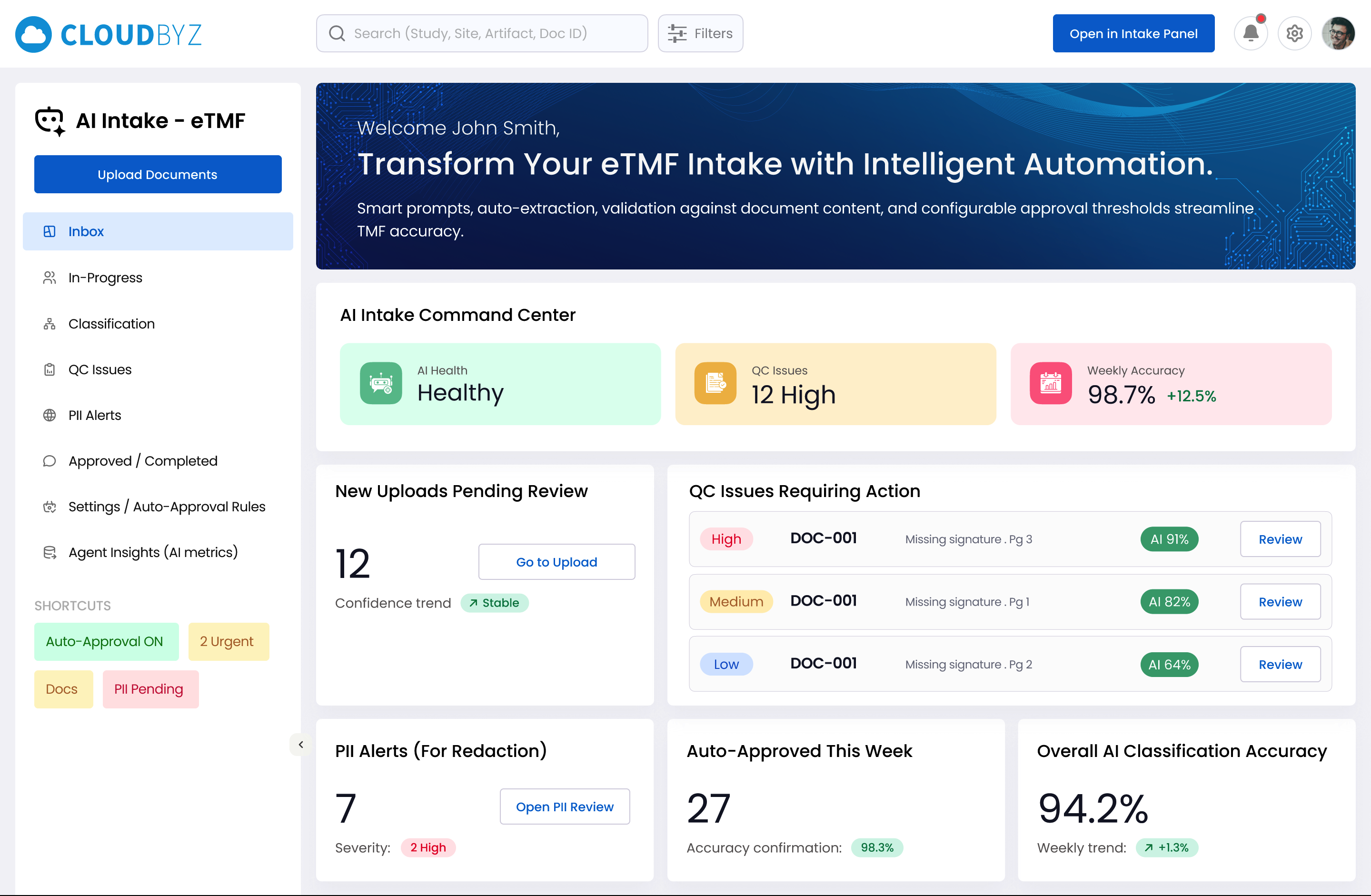
Solving Core eTMF Challenges with AI
Challenge: Manual document classification
AI auto-classifies with confidence scoring
Manual classification is slow and inconsistent, especially across large, global studies. The AI eTMF Agent analyzes document content and context at intake to determine the correct artifact type, TMF zone, and section. Confidence scores ensure that high-certainty classifications proceed automatically, while ambiguous cases are flagged for human review — eliminating misfiling without removing oversight.
Challenge: Incomplete or inconsistent metadata
AI extracts and validates metadata at ingestion
Metadata errors are one of the most common root causes of TMF findings. The AI agent extracts required attributes directly from the document — such as dates, versions, site identifiers, approvals, and signatures — and validates them against predefined standards. Issues are detected immediately, before documents are considered complete or ready.
Challenge: Late discovery of gaps
AI monitors completeness in real time
Instead of periodic completeness checks, the AI agent continuously tracks required documents against study milestones, countries, and sites. Missing or overdue artifacts are identified early, while remediation is still simple and defensible — preventing last-minute surprises.
Challenge: Reviewer overload
AI prioritizes what actually needs human review
Highly skilled reviewers should not spend their time on routine checks. The AI agent filters volume and surfaces only exceptions, low-confidence classifications, or high-risk documents. Human expertise is applied where judgment matters most, increasing throughput without sacrificing control.
Challenge: Audit panic
Continuous inspection readiness by design
Because quality, completeness, and timeliness are monitored continuously, inspection readiness becomes a steady operational state rather than a crisis event. When audits occur, teams can demonstrate real-time control, objective metrics, and clear audit trails — without scrambling to clean up historical gaps.
AI shifts eTMF from reactive problem-finding to proactive quality orchestration.
When these challenges are addressed systematically, the business impact shows up immediately in speed, efficiency, productivity, and compliance.
Speed: Compressing eTMF Cycle Times
Before AI
Days or weeks to classify and QC documents
In traditional eTMF workflows, documents often sit unprocessed in queues waiting for manual intake, classification, and review. As volume increases, turnaround times stretch unpredictably from days into weeks — even for routine artifacts.
Backlogs grow silently
Because most systems lack real-time intake intelligence, backlogs accumulate without visibility. Teams often discover delays only when milestones slip or audits approach, making recovery difficult and costly.
With the AI eTMF Agent
Near-instant classification and metadata extraction
The AI eTMF Agent evaluates documents the moment they arrive. Classification, filing, and metadata population happen automatically, eliminating wait time between upload and readiness.
QC issues flagged immediately
Instead of batching QC at later stages, the agent detects missing information, mismatches, or filing errors at intake. Issues are addressed while context is fresh and remediation is simple.
Faster filing → faster readiness
When documents are filed correctly and validated immediately, they contribute to TMF completeness in real time. Readiness improves continuously rather than in delayed bursts.
Outcome
Intake and QC timelines reduced dramatically
What previously took days or weeks becomes minutes or hours — consistently, across studies and regions. Speed is no longer dependent on team availability or heroic effort; it is built into the operating model.
Speed isn’t just about moving faster — it’s about removing waiting entirely.
When speed is engineered into intake, efficiency and productivity naturally follow.
Efficiency: Doing More Without Adding Headcount
AI takes over
Repetitive checks
The AI eTMF Agent handles repetitive, high-volume checks such as artifact placement, required metadata presence, naming consistency, and version alignment. These are necessary for compliance but do not require human judgment — making them ideal candidates for automation.
Rule-based validations
Predefined rules for completeness, timeliness, and consistency are enforced automatically at intake. The agent applies the same logic every time, across all studies and regions, eliminating variability and rework.
First-pass QC
The AI performs an initial quality review as documents arrive, identifying issues immediately instead of allowing errors to propagate. This prevents downstream clean-ups and reduces the overall QC burden.
Humans focus on
Exceptions
Only documents that fail validation rules or fall below confidence thresholds are routed to human reviewers. This drastically reduces the number of items requiring manual attention.
Judgment-based decisions
Reviewers spend their time interpreting context, assessing risk, and making informed decisions — not checking boxes or correcting avoidable errors.
High-risk artifacts
Critical documents and high-impact milestones receive appropriate human oversight, ensuring quality is strongest where regulatory risk is highest.
Outcome
Higher throughput with the same or smaller teams
Teams process more documents, more consistently, without adding headcount. Efficiency gains come from structural change — not longer hours or increased pressure — making them sustainable over time.
Efficiency isn’t about asking teams to work harder — it’s about removing work that never required human judgment in the first place.
When efficiency improves this dramatically, productivity and morale improve as well.
Productivity: Empowering TMF Teams
What changes for TMF managers and reviewers
Less manual sorting
With AI-driven classification and metadata extraction happening at intake, teams no longer spend hours sorting, renaming, and refiling documents. Routine administrative work disappears, freeing time for oversight and analysis.
Clear prioritization
Instead of working from long, undifferentiated task lists, teams see exactly where attention is required. The AI agent highlights exceptions, risks, and overdue items, allowing reviewers to focus on what truly matters rather than reacting to volume.
Fewer rework cycles
Issues are detected early, while documents are still fresh and easy to correct. This eliminates repeated back-and-forth between sites, CROs, and internal teams, significantly reducing rework and frustration.
Better visibility into study health
TMF managers gain a real-time view of completeness, timeliness, and quality across studies, countries, and sites. Problems are visible early, trends are identifiable, and decisions are based on facts rather than assumptions.
Net effect
Teams move from document clerks to quality owners
TMF professionals shift from reactive document handling to proactive quality management. Their expertise is applied where it delivers the most value — ensuring inspection readiness, guiding corrective actions, and partnering effectively with clinical operations and QA.
Productivity improves not because people work faster, but because they finally get to do the work they were hired to do.
When teams are empowered this way, quality and compliance naturally follow.
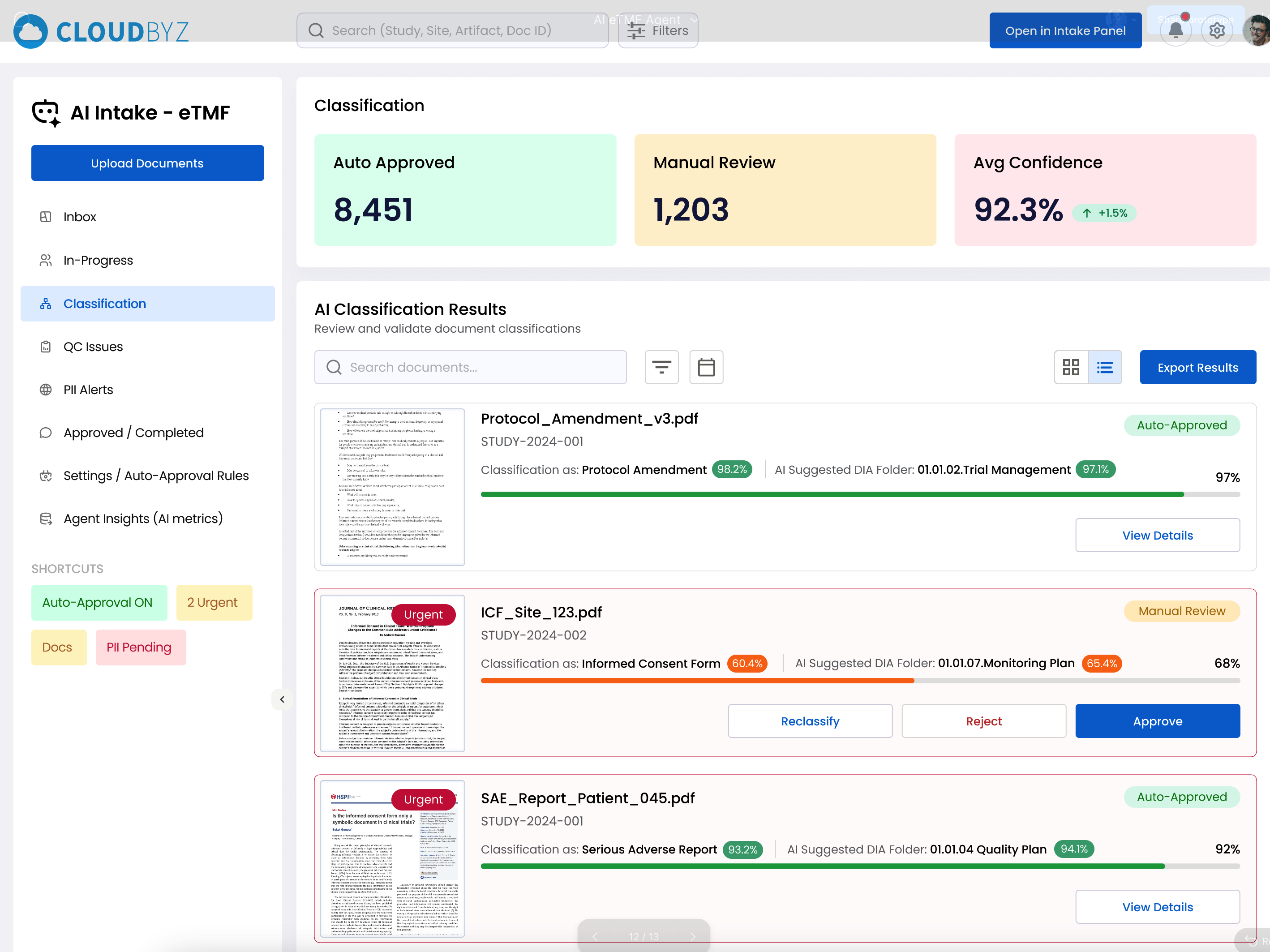
Quality: Built-In, Not Inspected In
AI enforces quality at the point of intake
Correct artifact placement
The AI eTMF Agent determines the correct TMF zone, section, and artifact type as documents arrive, preventing misfiling at the source. This eliminates downstream corrections that erode confidence and consume reviewer time.
Required metadata completeness
Mandatory metadata fields are identified, extracted, and validated automatically. Documents cannot quietly enter the TMF in an incomplete state, ensuring that quality gaps are addressed immediately rather than discovered later.
Version and date consistency
The agent checks effective dates, version numbers, and document lineage to ensure the most current and applicable version is filed. This reduces ambiguity during inspections and prevents outdated or conflicting documents from remaining active.
Signature and approval checks (where applicable)
For documents requiring approvals or signatures, the AI agent verifies presence and consistency, flagging exceptions for human review. This ensures regulatory expectations are met without requiring exhaustive manual checks.
Quality becomes
Predictable
Quality outcomes are driven by consistent system rules rather than individual interpretation. Teams know what “good” looks like — and the system enforces it every time.
Measurable
Quality is no longer subjective. Completeness, timeliness, and exception rates are tracked continuously, providing objective metrics that can be reviewed internally or presented to inspectors.
Repeatable
The same quality standards are applied across studies, countries, and vendors. As portfolios grow, quality scales with them — without relying on institutional memory or tribal knowledge.
When quality is enforced at intake, inspections confirm quality — they don’t discover it.
Built-in quality creates the foundation for continuous compliance and inspection readiness.
Compliance: Always Inspection-Ready
AI continuously monitors
Missing documents
The AI eTMF Agent continuously checks required artifacts across studies, countries, and sites. Missing documents are identified early — while remediation is still simple and defensible — instead of surfacing during audits or inspections.
Overdue artifacts
Timeliness is monitored in real time against study milestones and regulatory expectations. The agent highlights late or aging documents before they become compliance findings, enabling proactive follow-up.
Country-specific requirements
Different countries impose different documentation expectations. The AI agent applies country-aware rules, ensuring local regulatory nuances are accounted for without relying on manual tracking or institutional memory.
Study milestone alignment
Documents are evaluated in context — aligned to protocol amendments, site activation, enrollment milestones, and close-out events. This ensures the TMF accurately reflects the operational state of the trial at any point in time.
Inspection readiness shifts from
Event-based → Continuous
Readiness is no longer something teams assess periodically. It becomes a persistent operational state, demonstrable at any moment.
Manual → System-driven
Instead of relying on spreadsheets, spot checks, or subjective assessments, compliance is monitored and evidenced by the system itself.
Reactive → Proactive
Issues are identified and addressed before they escalate into findings. Inspections confirm control — they don’t expose gaps.
Inspection readiness should be your default state — not a special project triggered by an inspection notice.
Human-in-the-Loop: AI You Can Trust
Key principle: AI assists — humans decide
The AI eTMF Agent is designed to support, not replace, human judgment. It automates routine, rule-based work while ensuring that accountability for quality and compliance remains with qualified personnel. Final authority always rests with designated roles, preserving oversight and regulatory confidence.
Confidence thresholds control automation
Every AI-driven action is governed by configurable confidence thresholds. High-confidence outcomes proceed automatically, while low-confidence or ambiguous cases are routed to human reviewers. This ensures automation is applied safely and selectively — not blindly.
Clear audit trails for every AI action
Each AI interaction is fully logged: what action was taken, why it was taken, the confidence level, and whether human intervention occurred. These records are time-stamped, immutable, and inspection-ready, providing transparency for internal audits and regulatory reviews.
Full traceability for regulators
Regulators can trace every document from intake through classification, review, and approval. The system clearly shows how AI contributed, where humans intervened, and how final decisions were made — eliminating black-box concerns.
Configurable governance rules
Organizations retain full control over how AI operates. Governance rules define what the AI can automate, when human review is required, and how exceptions are handled. This allows alignment with internal SOPs, risk tolerance, and regulatory expectations across regions.
Result
AI that strengthens compliance — not compromises it
Rather than introducing risk, the AI eTMF Agent enforces consistency, transparency, and control — making compliance more predictable and defensible than purely manual processes.
The safest AI is not the one that acts alone — it’s the one that knows when to stop and ask a human.
With trust and governance in place, the business impact of AI becomes both measurable and sustainable.
Why Embedded AI Matters
Embedded inside Cloudbyz eTMF means
Shared study, site, and milestone context
Because the AI eTMF Agent operates inside Cloudbyz eTMF, it has native access to study hierarchies, country and site structures, roles, milestones, and timelines. Decisions are made with full operational context — not inferred from document text alone.
Native workflows, not integrations
Embedded AI works directly within existing eTMF workflows. There is no need to move documents between systems, synchronize metadata, or manage fragile integrations. This eliminates latency, reconciliation errors, and operational blind spots.
Unified data model
The AI agent uses the same canonical data model as the eTMF system itself. Metadata definitions, document states, and quality rules are consistent across intake, review, reporting, and inspection readiness — ensuring accuracy and repeatability.
One system of record
Documents, metadata, AI actions, human decisions, and audit trails all live in a single system of record. This simplifies oversight, accelerates audits, and eliminates disputes about which system holds the “truth.”
This enables
Better accuracy
Decisions are grounded in complete, authoritative context. Fewer assumptions, fewer mismatches, and fewer downstream corrections.
Faster decisions
Because intelligence operates where the work happens, classification, QC, and escalation occur immediately — without waiting for data movement or manual reconciliation.
Lower validation burden
Embedded AI reduces the need to validate multiple disconnected tools and integrations. Validation scope is clearer, controls are centralized, and change management becomes more manageable.
Embedded AI doesn’t just work faster — it works smarter because it understands the full clinical context.
When AI is embedded at the platform level, the business impact becomes both measurable and scalable.
What This Means for Sponsors & CROs
For Sponsors
Faster inspection readiness
With AI continuously monitoring completeness, timeliness, and quality, sponsors no longer wait for periodic reviews to understand TMF health. Inspection readiness becomes visible and defensible at any moment — across studies, regions, and partners.
Lower audit risk
Early detection of gaps and inconsistencies reduces the likelihood of inspection findings. When audits occur, sponsors can demonstrate real-time control, documented oversight, and clear governance — not reactive clean-up.
Consistent TMF quality across studies
Embedded AI applies the same standards everywhere, regardless of study size, geography, or CRO. Quality no longer varies based on individual teams or vendors, giving sponsors confidence across their entire portfolio.
For CROs
Scalable delivery without linear cost growth
AI absorbs volume growth without requiring proportional increases in headcount. CROs can support more studies and clients using the same operational backbone — improving margins while maintaining quality.
Better SLA performance
Faster intake, early issue detection, and automated QC enable CROs to meet timeliness and quality SLAs more consistently. Exceptions are identified early, making performance predictable and defensible.
Differentiation through quality and transparency
CROs can move beyond price-based competition by demonstrating continuous TMF health, proactive risk management, and audit-ready transparency — all visible to sponsors in real time.
Sponsors gain confidence and control; CROs gain scale and differentiation — from the same AI foundation.
These outcomes aren’t theoretical — they translate into measurable operational and financial impact.
Real-World Impact
Accelerated document intake during study start-up
During study start-up, document volumes surge across countries, sites, and vendors. With the AI eTMF Agent, documents are classified, filed, and validated the moment they arrive. This eliminates intake backlogs and ensures essential documents are complete and correctly filed before site activation — preventing downstream delays and rework.
Continuous completeness tracking during study conduct
As studies progress, documents are created and updated in response to protocol amendments, monitoring activities, and operational changes. The AI agent continuously tracks required artifacts against milestones, highlighting gaps early and enabling teams to address issues before they escalate into compliance risks.
Reduced audit preparation time before inspections
Instead of weeks of manual reconciliation and spot checks, teams enter inspection periods with a clear, real-time view of TMF health. Gaps, exceptions, and remediation actions are already documented and traceable — significantly reducing audit prep effort and stress.
Cleaner TMF at study close-out
Because quality and completeness are enforced throughout the trial, close-out is no longer a massive clean-up exercise. Final reconciliation is faster, documentation is defensible, and the TMF is ready for archiving without last-minute surprises.
Early indicators from pilots typically show:
- Faster intake and QC turnaround
- Reduced rework cycles
- Fewer late-stage findings
The biggest impact of AI isn’t during inspections — it’s the absence of chaos everywhere else.
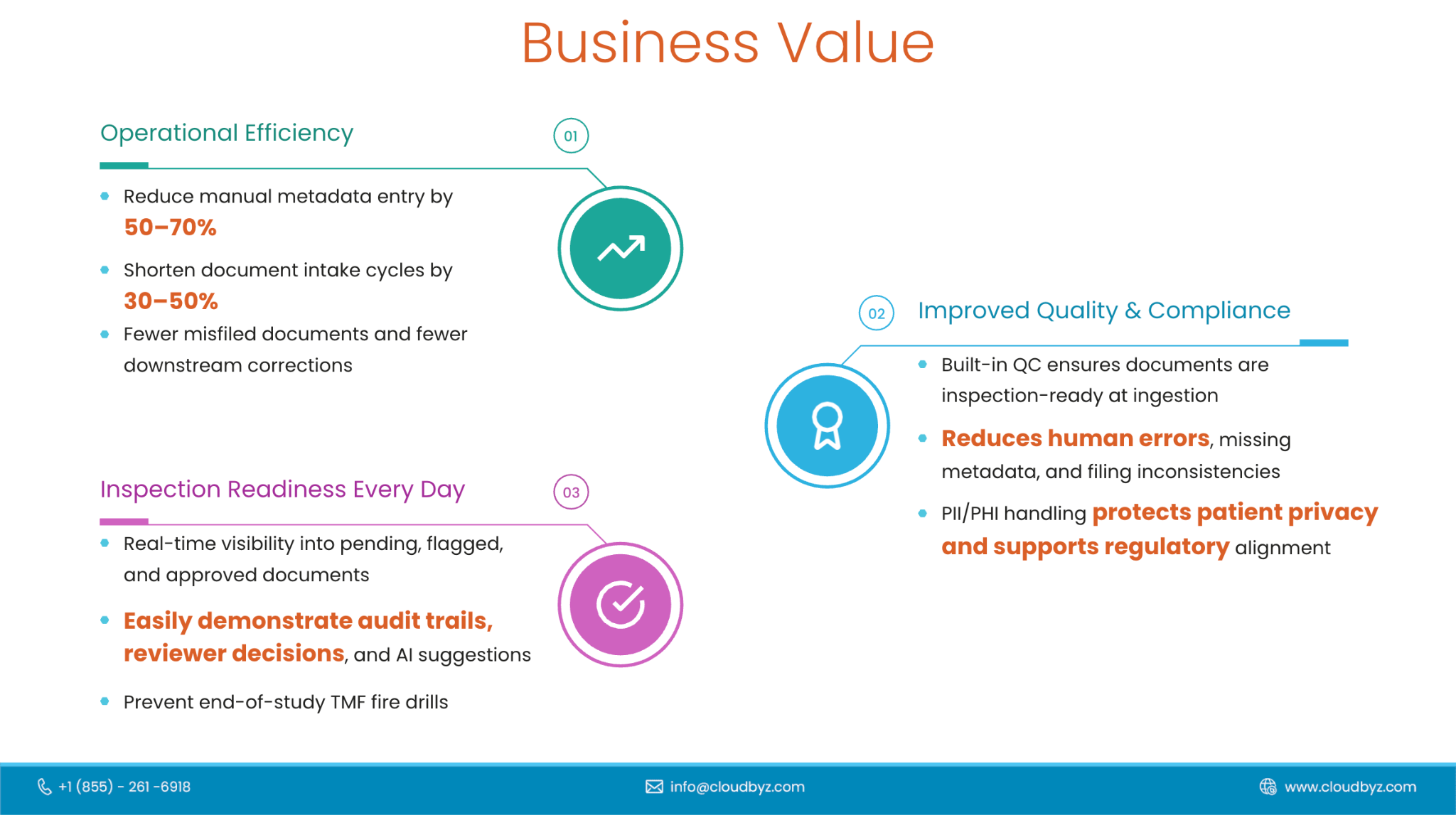
This is what happens when intelligence is embedded into the eTMF workflow — not added after the fact.
The Future of eTMF Is Autonomous Quality
Self-monitoring TMFs
The next generation of eTMF systems continuously assess their own health. Instead of waiting for humans to initiate reviews, the TMF itself detects gaps, inconsistencies, and emerging risks — and surfaces them automatically. Quality becomes a living, monitored state rather than a periodic assessment.
Predictive quality signals
Rather than reacting to missing documents or late filings, AI identifies early warning indicators — patterns that historically lead to compliance issues. This allows teams to intervene before gaps materialize, shifting quality management from corrective to preventive.
AI-driven prioritization
As volume and complexity grow, not everything deserves equal attention. AI dynamically prioritizes artifacts, sites, and studies based on risk, criticality, and inspection exposure — ensuring human effort is focused where it has the greatest impact.
Zero-panic inspections
When quality is continuously enforced and monitored, inspections lose their element of surprise. Teams enter audits confident, informed, and prepared — not scrambling to fix issues under pressure. Inspections become confirmation exercises, not crisis events.
The AI eTMF Agent is the foundation for that future
By embedding intelligence directly into the eTMF workflow today, organizations lay the groundwork for autonomous quality tomorrow. Each capability — automated intake, continuous monitoring, human-in-the-loop governance — builds toward a system that scales quality as trials scale.
Autonomous quality isn’t about removing humans — it’s about removing uncertainty.
The future of eTMF isn’t more dashboards or more checklists — it’s intelligence working quietly in the background, every day.
Key Takeaways
eTMF challenges are structural — not human failures
The persistent pain in eTMF isn’t caused by lack of effort, experience, or discipline. It’s the result of manual operating models trying to manage exponential growth in documents, complexity, and regulatory expectations. When systems don’t scale, even the best teams struggle.
AI changes eTMF from manual oversight to continuous control
By embedding intelligence at the point of intake and throughout the lifecycle, AI transforms eTMF from a reactive, inspection-driven process into a continuously monitored, risk-aware control system. Quality and readiness are enforced every day — not just reviewed occasionally.
Embedded AI delivers speed, efficiency, productivity, quality, and compliance
When AI operates inside the eTMF platform — sharing context, workflows, and data — it removes waiting, reduces rework, focuses human expertise, and enforces consistency. The result is not incremental improvement, but a fundamentally better way to run TMF operations at scale.
Cloudbyz AI eTMF Agent makes inspection readiness a daily reality
Inspection readiness is no longer a special project or last-minute scramble. With the AI eTMF Agent embedded in Cloudbyz eTMF, readiness becomes the default state — visible, defensible, and sustainable across studies and partners.
The future of eTMF isn’t more effort — it’s smarter systems that make quality inevitable.
Conclusion
The challenges facing eTMF today are not the result of inadequate teams or insufficient systems—they are the natural consequence of manual operating models struggling to keep pace with modern clinical trial complexity. As document volumes grow, trials globalize, and regulatory expectations shift toward continuous oversight and risk-based quality, the limitations of traditional eTMF approaches become increasingly visible.
The future of eTMF demands more than digitization. It requires intelligence embedded directly into the workflow—intelligence that understands documents in context, enforces quality at the point of action, and continuously monitors readiness without relying on periodic clean-ups or heroic human effort. This is the transition from document management to quality orchestration.
With the AI eTMF Agent embedded inside Cloudbyz eTMF, inspection readiness becomes a sustained operational state rather than a reactive event. Speed, efficiency, productivity, quality, and compliance are no longer competing priorities—they are outcomes of a single, intelligent operating model. Human expertise is preserved and elevated, while AI absorbs scale, variability, and repetition.
As the industry moves toward autonomous quality and continuous compliance, organizations that modernize their eTMF operating model today will be better positioned to scale confidently, reduce risk, and meet regulatory expectations tomorrow. The question is no longer whether AI belongs in eTMF—but whether eTMF can remain viable without it.
The future of eTMF is not more effort. It is smarter systems that make quality inevitable.
Subscribe to our Newsletter
