

Request a demo specialized to your need.
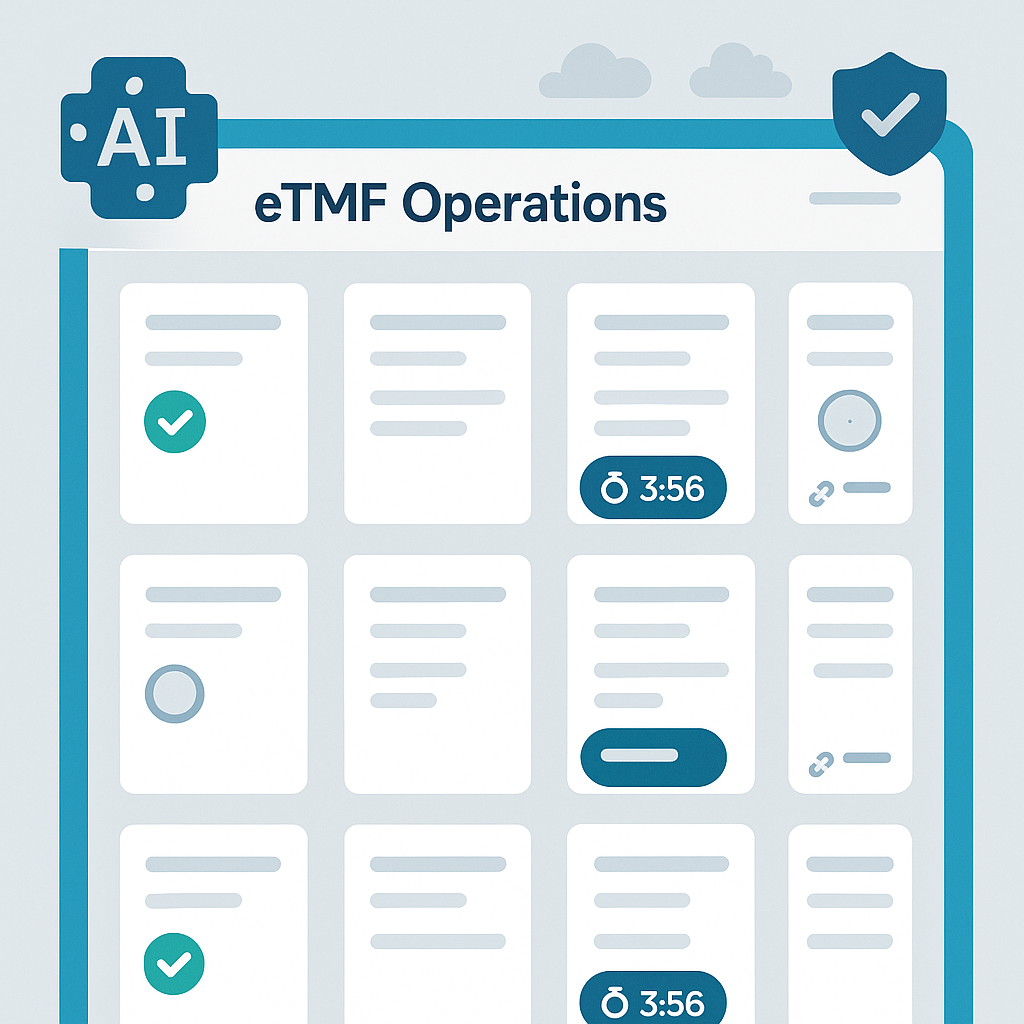
How AI raises eTMF completeness and speed without risking compliance.
For sponsors and CROs, the electronic Trial Master File (eTMF) is the single most important body of evidence demonstrating how a clinical trial was conducted. Regulators do not evaluate the eTMF in isolation; they assess it as a reflection of trial quality, oversight, and control. Two dimensions dominate every inspection conversation: completeness (is everything there?) and timeliness (was it there when it should have been?).
Historically, organizations have treated these as end-of-study or pre-inspection problems—addressed through periodic QC cycles, manual reconciliation, and last-minute remediation. AI-assisted eTMF completeness and timeliness fundamentally changes this model. It transforms TMF management from a reactive exercise into a continuous, risk-aware, and defensible process embedded into day-to-day operations.
Why Completeness and Timeliness Still Fail in Practice
Despite modern eTMF systems, completeness and timeliness remain persistent pain points. The reasons are structural, not technological.
Most eTMF processes rely on static expectations tables, manual document chasing, and binary metrics (present vs missing, on-time vs late). These approaches struggle to account for real-world trial complexity: staggered country start-ups, rolling submissions, protocol amendments, vendor handoffs, and decentralized trial models. As a result, TMF teams spend disproportionate effort managing noise rather than addressing true inspection risk.
More importantly, traditional approaches answer what is missing or late—but not why, how risky it is, or what to do next.
Reframing Completeness and Timeliness Through an AI Lens
AI-assisted eTMF management reframes completeness and timeliness as dynamic risk signals, not static checklist outcomes.
Instead of asking, “Is this document filed?”, AI asks:
-
Is this document expected now, given how the trial is actually progressing?
-
Is its absence a low-risk timing issue or a high-risk compliance gap?
-
Is this a one-off delay or part of a systemic pattern?
This shift moves TMF oversight from rule enforcement to intelligent quality governance.
AI-Assisted Completeness: Beyond the Checklist
Context-Aware Expectations
AI evaluates document expectations based on real trial signals such as:
-
Site activation and close-out status
-
Enrollment milestones
-
Monitoring visit completion
-
Country-specific regulatory requirements
A document is not simply “missing.” It is classified as not yet applicable, expected soon, overdue with low risk, or overdue with inspection-critical risk. This contextual awareness dramatically reduces false alarms and focuses attention where it matters most.
Pattern Recognition Across the TMF
AI looks across studies, sites, countries, and artifact types to detect patterns humans miss. Repeated gaps tied to a specific vendor, country, or process indicate systemic quality risk—not isolated oversights.
This enables TMF leaders to address root causes rather than chasing individual documents, improving both completeness and operational efficiency.
AI-Assisted Timeliness: From Deadlines to Risk Windows
Intelligent Timeliness Windows
Timeliness in inspections is rarely about a single date—it is about reasonable, justifiable timelines aligned with trial conduct. AI models timeliness windows dynamically, adjusting expectations based on trial phase, site activity, and document type.
This allows organizations to demonstrate that documents were filed in line with SOPs and risk-based principles, even when timelines flex due to operational realities.
Early Warning and Escalation
Instead of discovering lateness during QC reviews, AI flags emerging delays early. Escalation playbooks trigger targeted actions—reminders, reassignment, or management review—before lateness becomes an inspection finding.
Every intervention is logged, creating evidence of proactive oversight rather than reactive cleanup.
Human-in-the-Loop: Intelligence With Accountability
A critical principle for buyers: AI does not replace TMF judgment—it sharpens it.
AI surfaces risk, prioritizes action, and recommends next steps. TMF professionals validate decisions, handle edge cases, and apply clinical and regulatory context. This human-in-the-loop model ensures:
-
Trust in AI outputs
-
Clear accountability
-
Audit-ready decision trails
Regulators do not expect automation without oversight; they expect controlled intelligence with documented governance.
Inspection Readiness as a Continuous State
AI-assisted completeness and timeliness enables a profound shift: inspection readiness becomes continuous, not episodic.
TMF health is visible in real time. High-risk gaps are addressed as they arise. Trends are monitored, not rediscovered during inspection prep. When inspectors ask how the TMF was maintained, organizations can demonstrate:
-
Ongoing risk monitoring
-
Proactive intervention
-
Consistent application of SOPs and RBQM principles
This level of transparency fundamentally changes inspection posture—from defensive to confident.
Strategic Value Beyond Compliance
While completeness and timeliness are compliance metrics, AI-assisted eTMF delivers broader business value:
-
Reduced TMF QC workload and outsourcing costs
-
Faster study close-out and submission readiness
-
Improved collaboration between clinical, vendors, and TMF teams
-
Scalable quality management for growing portfolios
AI transforms eTMF from a cost center into a quality intelligence asset.
The Future: From Measurement to Prediction
The next evolution of AI-assisted eTMF management goes beyond monitoring to prediction:
-
Identifying which studies are likely to fall out of compliance
-
Forecasting inspection risk months in advance
-
Recommending preventive actions based on historical patterns
This moves organizations from managing TMF quality to engineering it by design.
Conclusion: Proving Control, Every Day
AI-assisted eTMF completeness and timeliness represents a fundamental shift in how trial documentation quality is managed. It replaces static checklists and retrospective QC with continuous, explainable, and risk-based oversight.
For sponsors and CROs operating in an environment of increasing scrutiny and complexity, this capability is no longer optional. It is the foundation for inspection confidence, operational efficiency, and regulatory trust—where TMF quality is not assumed, but continuously proven.
Subscribe to our Newsletter
