
Request a demo specialized to your need.
Adverse event reporting is the one workflow in clinical research where a delay isn't just a metric problem it's a patient safety problem and a regulatory one. A missed 15-day window, an incomplete MedDRA code, or an ICSR that never reconciled with the case narrative can trigger an FDA Form 483, a warning letter, or worse.
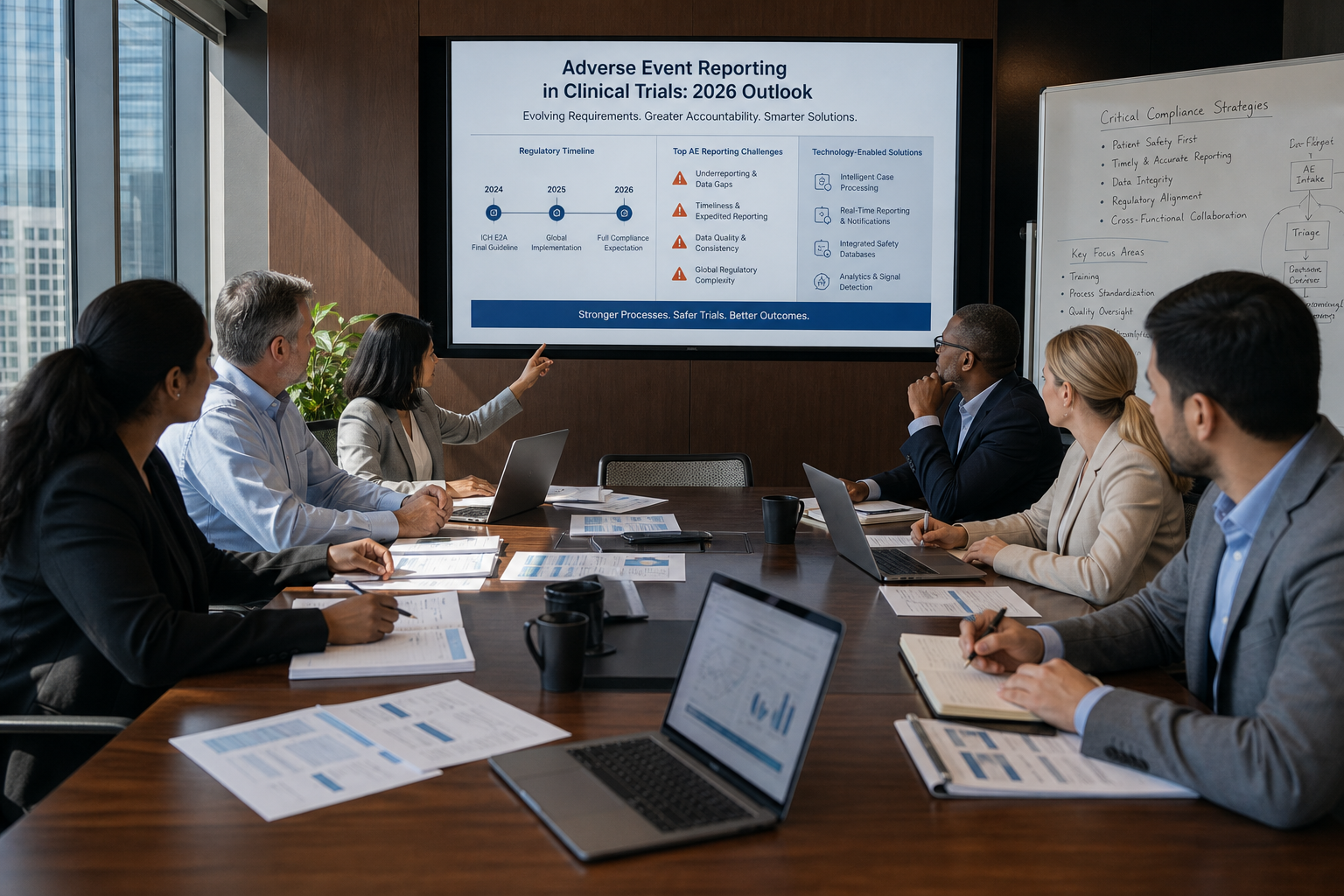
Heading into 2026, three things are converging that make this workflow harder to get wrong: the shift to ICH E2B(R3) as the default exchange format, tightening agency turnaround expectations across FDA, EMA, and PMDA, and a steady rise in trial complexity (more sites, more decentralized data streams, more adverse events flowing in from ePRO and wearables rather than a single site coordinator).
This guide breaks down what adverse event reporting actually requires in 2026, where teams lose the most time and compliance points, and what a modern, audit-ready workflow looks like.
What Is Adverse Event Reporting in Clinical Trials?
Adverse event (AE) reporting is the structured process of identifying, documenting, assessing, and submitting information about any untoward medical occurrence in a study participant — whether or not it's judged related to the investigational product. When an AE meets criteria for seriousness and unexpectedness, it becomes a Serious Adverse Event (SAE) and must be captured as an Individual Case Safety Report (ICSR) and submitted to regulators within a defined window.
The core reporting chain looks like this:
- Detection Site or patient identifies and documents the event (clinic visit, ePRO entry, phone report, lab result).
- Initial assessment Investigator determines seriousness, causality, and expectedness.
- Case creation Safety team builds the ICSR, including MedDRA coding of the event term.
- Quality and completeness check Missing narrative fields, inconsistent dates, or unmapped terms are resolved.
- Regulatory submission Case is transmitted via the appropriate gateway (FDA ESG, EMA EVWEB, or equivalent) in E2B(R3) format.
- Reconciliation Safety database is checked against the clinical database (EDC) to confirm no AEs were missed or duplicated.
Regulatory Timelines That Matter in 2026
| Event Type | Typical Reporting Window | Governing Standard |
|---|---|---|
| Fatal or life-threatening unexpected SAE | 7 calendar days (initial), 8 additional days for follow-up | ICH E2A / FDA IND Safety Reporting |
| Other serious, unexpected AE | 15 calendar days | ICH E2A |
| Serious, expected AE | Per protocol / periodic reporting | ICH E2A |
| Case data exchange format | E2B(R3) structured XML | ICH E2B(R3) |
| MedDRA coding | Current MedDRA release (v27 as of 2026) | ICH M1 |
The deadline itself hasn't moved much what's changed is the tolerance for error. Agencies increasingly reject or bounce back ICSRs that are technically late because of a field-level validation failure, not because the safety team was actually slow. That distinction matters when you're building your 2026 process: the bottleneck usually isn't clinical judgment, it's data mechanics.
Where Adverse Event Reporting Breaks Down
Across sponsor and CRO teams, the same failure points show up again and again:
- Verbatim-to-MedDRA coding delays. Investigators and site staff describe symptoms in plain language ("felt dizzy and lightheaded after infusion"). Mapping that to the correct Preferred Term, Lowest Level Term, and hierarchy takes time and manual coding is where inconsistency creeps in across a study.
- E2B(R3) field validation errors. Missing narrative sections, malformed dates, or incorrect causality codes get caught at the gateway, not before submission meaning the "15-day" case actually took 17 or 18 days once the resubmission cycle is included.
- Reconciliation gaps between EDC and safety databases. An AE logged in the EDC that never made it into the safety system (or vice versa) is one of the most common inspection findings, and it's almost always a process gap, not a willful omission.
- Case quality inconsistency across sites and CROs. When ten sites report the same event ten different ways, aggregate signal detection later in the trial gets noisy.
- No real-time visibility into case status. Safety leads often can't see, at a glance, which cases are approaching their deadline versus which are stuck in query.
Building an Audit-Ready AE Reporting Process for 2026
A few practices consistently separate teams that pass inspections cleanly from teams that get 483 observations on safety reporting:
- Validate at entry, not at submission. Field-level E2B(R3) checks should happen as data is entered, not after the case is "complete" catching errors when they're cheap to fix.
- Score case quality before it reaches the gateway. A completeness score (narrative present, MedDRA term mapped, causality assessed, dates consistent) gives safety leads a go/no-go signal instead of a surprise.
- Keep MedDRA coding tied to the live dictionary, not a static lookup table. Codes should be pulled and validated against the current MedDRA release, not typed in from memory or an outdated spreadsheet.
- Reconcile EDC and safety data on a fixed cadence, not just before database lock. Monthly (or more frequent) reconciliation catches gaps while they're still fixable.
- Keep an immutable, 21 CFR Part 11–compliant audit trail on every case. Every change, e-signature, and status transition should be traceable inspectors will ask.
How Cloudbyz Supports Compliant AE Reporting
Cloudbyz's Safety and Pharmacovigilance solution, built natively on Salesforce, gives sponsors and CROs a single system for case intake, MedDRA coding, and E2B(R3) submission with 21 CFR Part 11 audit trails built in rather than bolted on.
Two AI agents inside the platform target the exact failure points above:
- AI VigiCheck runs real-time, field-level E2B(R3) validation as data is entered, checks cases against 200+ ICH and agency rules (EMA EVWEB, FDA ESG, WHO-ICTRP), validates MedDRA PT/LLT/HLT codes automatically, and assigns each case a completeness and quality score before it ever reaches the gateway — with reported accuracy up to 99.4% and per-case review times under 2 seconds.
- The Medical Coding Assistant turns verbatim symptom text into standardized MedDRA terminology, pulling the full hierarchy directly from the database — so it cannot invent a code — and only saves a final code once a human confirms it.
Both keep a human in control of every judgment call; the AI's job is to remove the manual lookup, formatting, and validation work that eats safety teams' time and creates avoidable delays.
If your team is still reconciling AE cases by hand or catching E2B(R3) errors at the gateway instead of at entry, it's worth seeing what a validated, audit-ready workflow looks like end to end.
Request a live demo with your team's own cases.
Subscribe to our Newsletter
