
Request a demo specialized to your need.
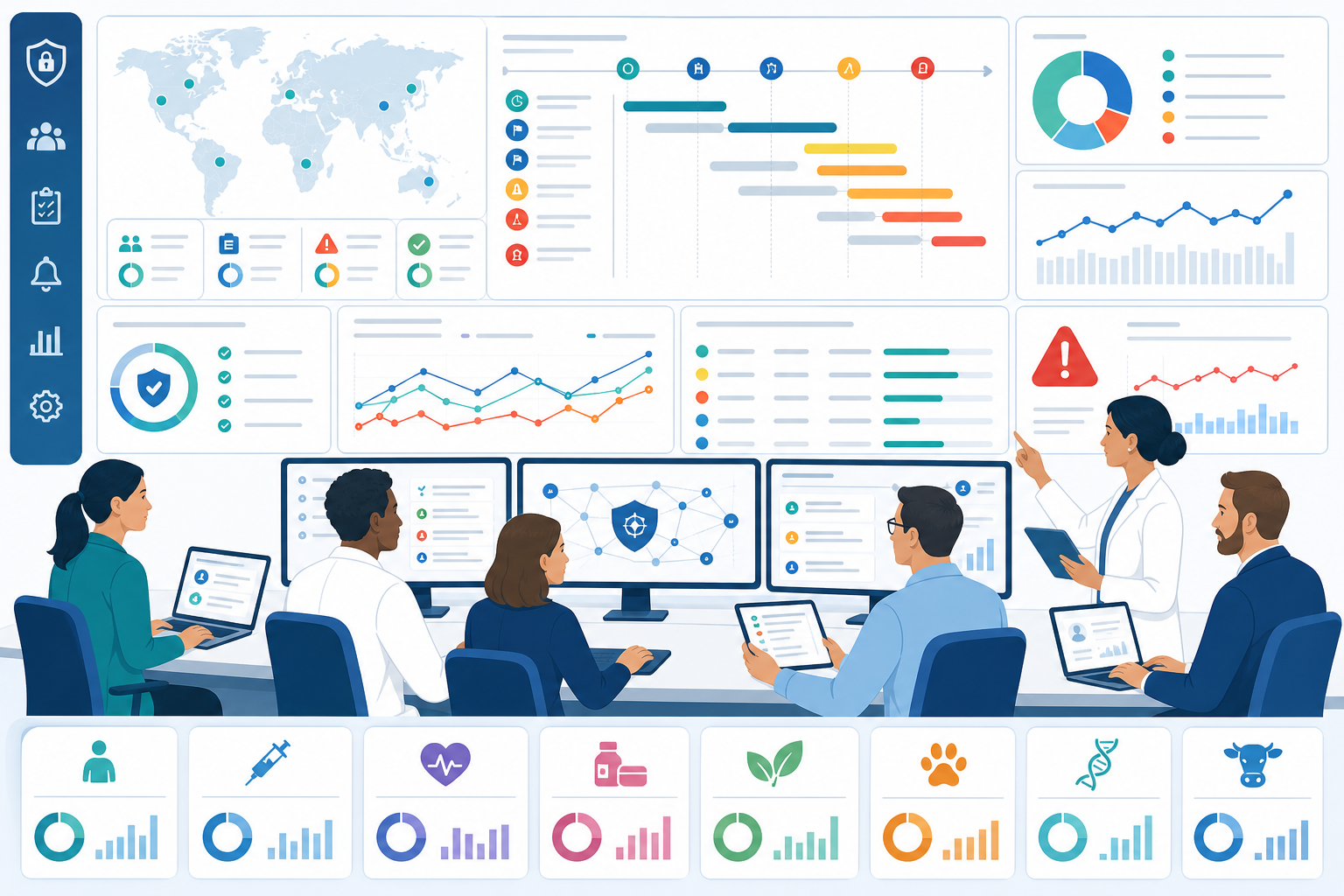
Every sponsor and CRO knows that clinical trial safety is non-negotiable. Yet a surprising number of teams still run drug safety management on a patchwork of spreadsheets, shared inboxes, and generic document repositories—systems never designed to carry the weight of regulated pharmacovigilance. It works, until it doesn't. And when it fails, it usually fails at the worst possible moment: during an inspection, a signal escalation, or a reporting deadline that can't be moved.
Dedicated pharmacovigilance software exists precisely because safety data behaves differently from other clinical data. It arrives unpredictably, it is time-bound by regulation, and a single mishandled case can trigger consequences that ripple across a program. Below are seven risks that clinical operations and pharmacovigilance leaders take on when they try to manage safety without a purpose-built platform—and why each one tends to grow quietly until it becomes expensive.
1. Missed and Late Adverse Event Reporting
The most immediate risk is also the most consequential: blowing a regulatory reporting clock. Expedited timelines for serious adverse events and SUSARs—7 days for fatal or life-threatening cases, 15 days for other serious events—leave no room for a case that sits in an inbox over a weekend or gets routed to the wrong reviewer.
Manual workflows have no built-in sense of urgency. There is no clock counting down, no automatic escalation when a case ages, no alert when an intake form lands. When adverse event reporting depends on someone remembering to check a folder, timeliness becomes a matter of individual diligence rather than system design. Purpose-built pharmacovigilance platforms treat the reporting deadline as a first-class object: the clock starts at intake, escalations fire automatically, and nothing quietly ages past its due date.
2. Fragmented Safety Data With No Single Source of Truth
In a manual environment, a single adverse event can live in five places at once—the site's email, a case-tracking spreadsheet, the medical monitor's notes, a narrative document, and the EDC. Each copy drifts from the others. Someone updates one and forgets the rest. By the time a case is submitted, reconciling those versions becomes a manual detective exercise.
This fragmentation is more than an annoyance. It undermines the integrity of the entire safety database. Aggregate reports pull from inconsistent source data, reconciliation between clinical and safety systems becomes error-prone, and no one can confidently answer the simple question: what is the current, authoritative status of this case? Consolidated pharmacovigilance platforms collapse those scattered copies into one governed record, so the case a reviewer sees is the case that gets reported.
3. Case Processing Bottlenecks That Don't Scale
Manual case management is deceptively manageable at low volume. Ten cases a month feel controllable. But clinical trial safety workloads are not linear—they spike with enrollment surges, protocol amendments, and the addition of new studies or indications. A process that depended on two experienced people copying data between systems suddenly becomes the bottleneck that everything else waits on.
Without automation for intake, duplicate detection, coding, and workflow routing, every additional case adds proportional manual effort. Teams respond by working longer hours, which increases the very transcription and data-entry errors that safety work can least afford. Pharmacovigilance software absorbs volume through automation and configurable workflows, letting a team of the same size handle far more cases without a corresponding drop in quality.
4. Signal Detection Blind Spots
Individual case processing is only half of pharmacovigilance. The other half is seeing the pattern across cases—the subtle uptick in a particular event, the clustering that suggests something the individual reports don't reveal in isolation. This is where manual systems are most quietly dangerous, because the failure is invisible. Nothing looks broken. You simply never see the trend.
Spreadsheets don't surface aggregate signals. Disconnected documents can't be queried for emerging patterns across a program. When your view of safety is a stack of individual cases rather than a queryable dataset, signal detection becomes retrospective at best and accidental at worst. Modern pharmacovigilance platforms structure safety data so that aggregate analysis, trending, and signal detection are continuous capabilities rather than manual, periodic scrambles.
5. Audit and Inspection Exposure
Regulators expect to see not just the right outcome but a defensible process behind it: who touched a case, when, what changed, and why. Regulatory compliance in clinical trials hinges on this kind of traceability, and manual systems rarely produce it. A shared spreadsheet has no reliable audit trail. Email chains get deleted. Version history is whatever someone happened to save.
Under 21 CFR Part 11 and equivalent expectations, an electronic system managing safety data needs validated controls, secure and time-stamped audit trails, and defined access permissions. Cobbling that together from general-purpose office tools is nearly impossible to defend during an inspection. A validated pharmacovigilance platform generates the audit trail as a byproduct of normal work, so inspection readiness is the default state rather than a fire drill triggered by an FDA or EMA notice.
6. Poor Cross-Functional Visibility
Safety does not operate in a vacuum. Medical monitors, clinical operations, data management, and regulatory affairs all need visibility into what's happening with safety in a study—often in real time. When safety data is trapped in a standalone spreadsheet or a system disconnected from the rest of the clinical stack, that visibility depends on someone manually exporting, formatting, and emailing status updates.
The result is a lag between what the safety team knows and what everyone else knows. Decisions about enrollment holds, protocol changes, or benefit-risk assessments get made on stale information. Drug safety management works best when it's woven into the broader clinical operations fabric rather than siloed off to the side. Pharmacovigilance platforms that connect to the wider eClinical environment give every stakeholder a shared, current view without the manual reporting overhead.
7. Scalability and Business-Continuity Failure
The final risk is strategic rather than operational, and it's the one that keeps executives up at night. A manual safety process is often held together by a small number of experienced people who know where everything lives and how every workaround functions. That institutional knowledge is a single point of failure. When those individuals leave, go on leave, or are simply overwhelmed, the process degrades—and there's no system to catch what falls through.
For organizations preparing to expand their pipeline, enter new markets with different reporting requirements, or position themselves for partnership or acquisition, a manual safety operation is a liability that surfaces immediately in due diligence. Investors and partners want to see infrastructure that scales, not heroics that don't. Investing in pharmacovigilance software early is as much about building a durable, transferable operation as it is about processing today's cases correctly.
The Bottom Line
None of these seven risks announces itself loudly. Each one grows quietly in the background of a busy safety operation—until an inspection, a missed deadline, or a scaling event brings it into sharp relief. The teams that avoid these failures are rarely the ones with more headcount or longer hours. They're the ones that recognized safety data deserves purpose-built infrastructure and moved to dedicated pharmacovigilance platforms before the manual approach broke under its own weight.
Clinical trial safety is ultimately about protecting patients and preserving the credibility of the science. Both deserve better than a spreadsheet. For clinical operations and pharmacovigilance leaders weighing whether now is the time to modernize, the more honest question is usually not can we keep managing without it?—it's how much longer can we afford to?
Subscribe to our Newsletter
