

Request a demo specialized to your need.
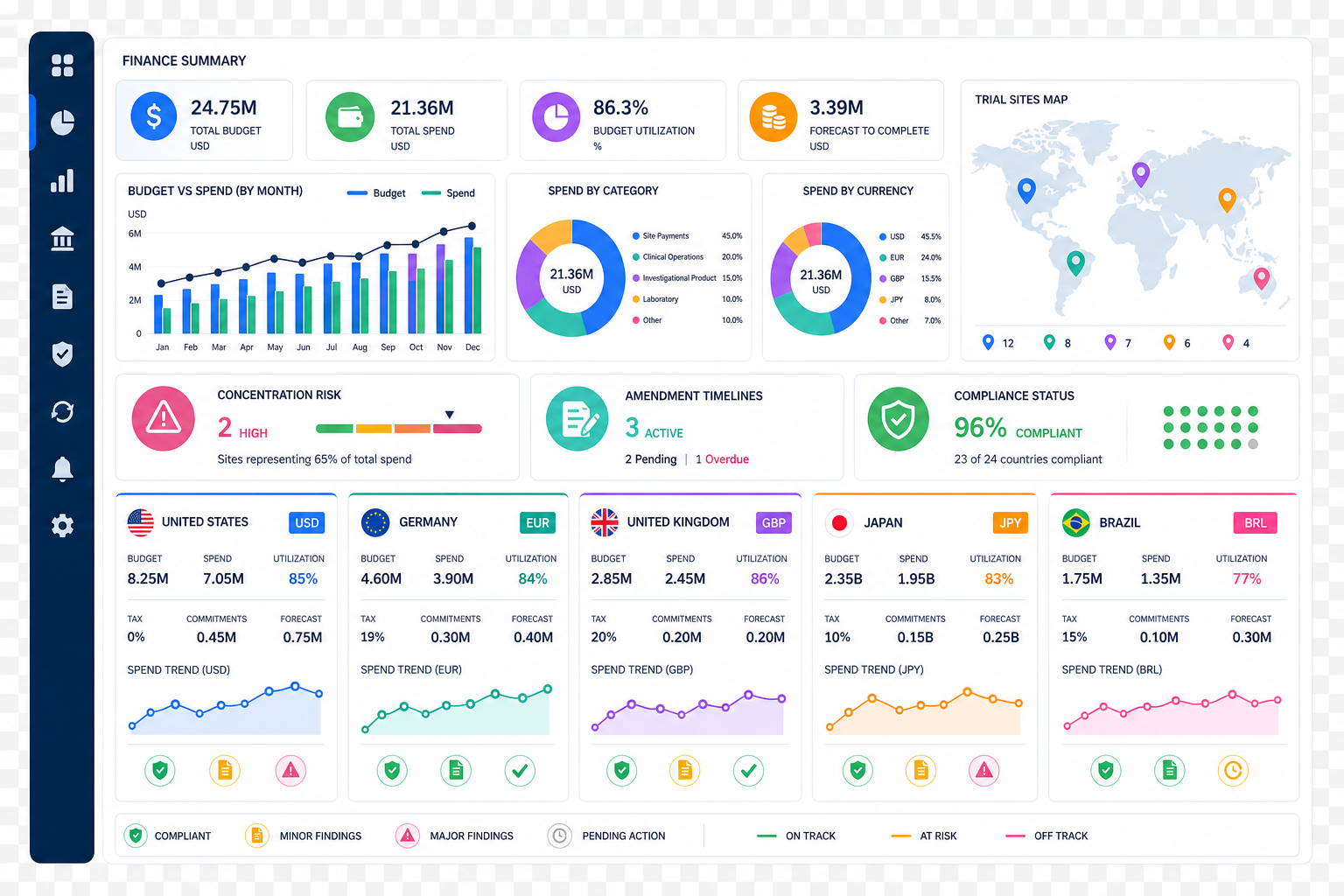
A multi-country trial doesn't have one budget. It has one budget per country, in different currencies, under different tax and disclosure rules, with payment terms and withholding requirements that vary by jurisdiction. Treating that as a single number that just needs converting at month-end is where a lot of global study budgets start to lose accuracy not because anyone made an error, but because the underlying complexity was never really designed for.
Here are six specific things a genuinely global trial budget needs to account for, beyond what a spreadsheet or a single-currency system was built to handle.
1. Multi-currency tracking that doesn't rely on manual conversion
Site payments in local currency, sponsor budgets often set centrally in a reporting currency the exchange rate used at the time of budgeting is rarely the rate in effect when a payment actually happens. Tracking this manually across dozens of sites introduces both effort and error. A platform built for global studies needs to hold both the local transaction currency and the reporting currency simultaneously, with conversion handled systematically rather than recalculated by hand each cycle.
2. Country-specific tax and withholding rules applied consistently
Withholding tax treatment on site payments varies by country, and getting it wrong creates real financial and compliance exposure for the sponsor and for the site. This isn't a detail that can be handled with a single global formula; it needs to be configurable per country while still rolling up into one consistent view.
3. Region-specific disclosure and transparency reporting
Payments to investigators and institutions are often subject to disclosure requirements that differ significantly by country and region. A global budget process needs to support these region-specific reporting obligations without requiring an entirely separate, manually maintained process for each jurisdiction.
4. Consolidated visibility without losing country-level detail
Finance leadership needs a rolled-up view of total study spend across all countries. Country-level teams need the specific detail relevant to their sites. A platform built for global complexity needs to support both views from the same underlying data, rather than forcing a choice between high-level summary and operational detail.
5. Amendment timelines that don't move in sync across countries
A protocol amendment doesn't get approved on the same timeline in every country ethics committee cycles, contract renegotiation, and local regulatory review all move at different speeds.
Budget tracking needs to reflect that a single amendment can be "in effect" in one country and "still pending" in another, without treating the whole study as uniformly updated or uniformly behind.
6. Site concentration risk viewed across, not just within, countries
A handful of high-enrolling sites can create concentration risk within a single country's budget, but that risk can also compound across countries if the same pattern repeats in several regions simultaneously. Genuinely global budget visibility needs to surface concentration risk at both the country level and the portfolio level.
What single-currency tools miss versus what global complexity requires
| Requirement | Single-Currency / Spreadsheet Approach | What Complex Global Studies Need |
|---|---|---|
| Currency handling | Manual conversion at reporting time | Local and reporting currency tracked simultaneously |
| Tax and withholding | One formula applied everywhere | Configurable per country, rolled up consistently |
| Disclosure reporting | Separate manual process per region | Built-in support for region-specific requirements |
| Visibility | Either summary or detail, not both | Consolidated and country-level views from the same data |
| Amendment tracking | Treated as uniform across the study | Reflects country-by-country approval timelines |
| Concentration risk | Reviewed within a single country | Visible across the full country portfolio |
Why this matters under ICH E6(R3)
Sponsor oversight under ICH E6(R3) doesn't scale down in complexity just because a study spans multiple countries if anything, the oversight burden increases.
A sponsor needs to be able to demonstrate financial oversight across every country in a study, not just the ones with the largest budgets or the most familiar regulatory environment. A budget process that only really works cleanly for single-currency, single-jurisdiction studies puts that broader oversight responsibility on manual reconciliation rather than the system itself.
How Cloudbyz CTFM approaches this
Cloudbyz Clinical Trial Financial Management (CTFM) is built to handle multi-currency and multi-country budget complexity as a core capability, not an add-on. Budgets can reflect country-specific configurations while still rolling up into a consolidated view for finance leadership, and the Financial Navigator can be asked plain-English questions about payment and budget status at either the country or portfolio level.
Because budget versions are tracked with full history, amendment timelines that move at different speeds across countries remain traceable, rather than forcing the whole study into an artificial single "current" state.
What this means by role
- Clinical Trial Finance Teams and Study Finance Leads get currency and tax handling built into the platform rather than managed through parallel country-specific spreadsheets.
- Clinical Operations Directors overseeing multi-country studies get concentration risk visibility that spans the full country portfolio, not just individual regions.
- QA and Compliance Directors get a defensible record of financial oversight that reflects the real complexity of a global study, supporting sponsor oversight expectations under ICH E6(R3).
A global trial budget was never really one number. Treating it that way is where visibility gaps, tax exposure, and concentration risk tend to hide usually until a specific country's numbers stop reconciling with everyone else's.
Book a demo with Cloudbyz.
Subscribe to our Newsletter
