

Request a demo specialized to your need.
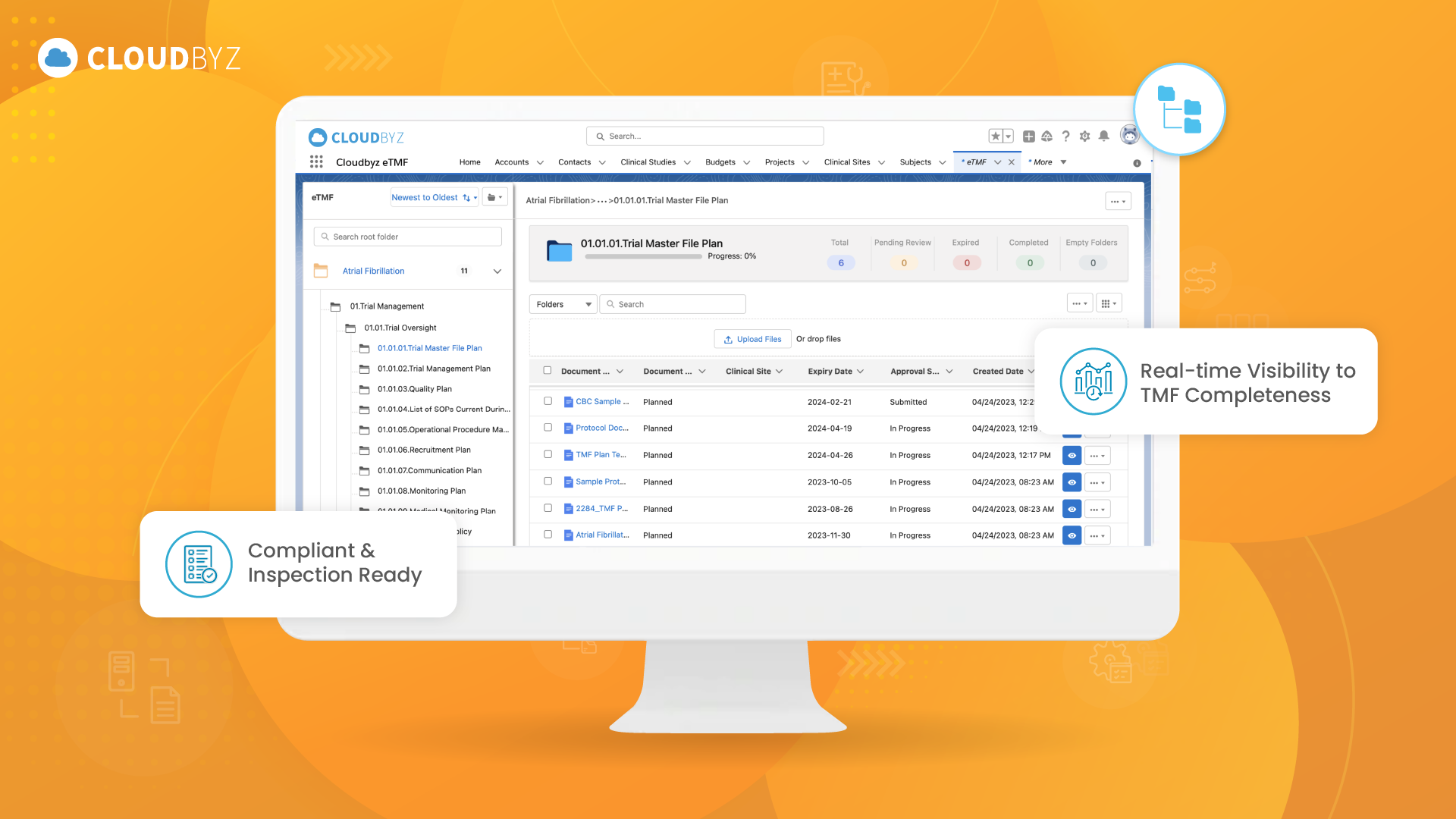
The sponsor-focused electronic trial master file systems capabilities that strengthen inspection readiness and clinical trial documentation quality across modern trial operations.
Inspection readiness has quietly become one of the clearest tests of a sponsor’s operating maturity. For years, many teams treated the trial master file as an artifact to be assembled near database lock, a reconstruction exercise carried out under time pressure and often after the people who created the records had moved on. That model no longer holds. Regulators now expect the file to be inspection ready at any moment, and the guidance underpinning that expectation has moved decisively in their favor.
ICH E6(R3), finalized in January 2025, took legal effect across the European Union on 23 July 2025, and the FDA published its final guidance in September 2025. The revision reframes Good Clinical Practice around risk-based quality, data governance, and one principle that lands directly on the sponsor: accountability cannot be delegated. A sponsor may outsource execution to a contract research organization, but it retains responsibility for oversight, for the integrity of essential records, and for the ability to demonstrate both on demand. Notably, TMF and essential-records management sits high on the list of processes regulators expect sponsors to have re-examined against the new framework.
That shift places new weight on the electronic trial master file systems that sponsors rely on. The eTMF is no longer a document repository. It is the evidence layer for the entire trial, and its capabilities determine whether a sponsor walks into an inspection confident or exposed. Below are ten capabilities that separate a system that merely stores clinical trial documentation from one that actively strengthens readiness.
1. Real-time completeness, timeliness, and quality metrics
Readiness is a continuous state, not a milestone. The single most important eTMF capability is the ability to see, at any moment, how complete, current, and clean the file is across every study, country, and site. Health dashboards that measure completeness against expected content, timeliness against filing targets, and quality against QC pass rates convert readiness from a periodic audit into a standing operational metric. When a clinical operations leader can answer "are we inspection ready today" with data rather than a promise, the organization has crossed an important line.
2. Milestone-driven expected document management
A file cannot be judged complete without a definition of what complete means. Expected Document Lists tied to trial phase, country, and site let the system know which documents should exist at each stage of the trial. When a site activates, the expected set is triggered automatically, and gaps surface as they occur rather than months later during reconciliation. This proactive model is what allows a sponsor to close findings before an inspector ever names them, and it is the foundation for every completeness metric that sits above it.
3. DIA TMF Reference Model alignment and structured taxonomy
Consistency is the quiet engine of readiness. Structuring the file around the DIA TMF Reference Model, with its standardized zones, sections, and artifacts, gives every study the same navigable shape. Inspectors move through a familiar structure, benchmarking becomes possible across the portfolio, and content is far less likely to be misfiled or lost. A reference-model-aligned taxonomy is not a cosmetic choice. It is what makes clinical trial documentation legible to an outside reviewer working under time pressure.
4. Automated quality control and AI-assisted classification
Manual filing and review are where quality quietly erodes. Modern electronic trial master file systems now apply machine classification to route documents to the correct artifact, extract and validate metadata, detect duplicates and blank pages, and flag expiring documents before they lapse. AI-assisted QC does not replace human judgment, but it removes the mechanical burden that causes fatigue-driven errors and lets reviewers concentrate on the exceptions that matter. The result is a file that is cleaner at the point of filing rather than corrected at the end.
5. Contemporaneous filing and timeliness enforcement
Regulators expect the TMF to be maintained contemporaneously, not assembled retrospectively. A capable system tracks the lag between when a document is created and when it is filed, enforces filing service levels, and surfaces overdue records before they accumulate into what many teams now call TMF debt. Timeliness is one of the first things an inspector tests, because a file that is chronically behind signals an oversight process that is not functioning. Enforcing contemporaneous filing is therefore as much a governance control as a documentation one.
6. Sponsor oversight of CRO-managed files
This is the capability that ICH E6(R3) has pushed to the center. Most emerging and mid-size sponsors outsource clinical execution to CROs, yet accountability for the file remains with the sponsor. An eTMF that gives the sponsor real-time, read-level visibility into CRO-held documents, supports contemporaneous transfer rather than end-of-study handover, and reconciles filed content against the oversight plan is what turns delegated execution into demonstrable oversight. Without it, a sponsor is trusting a partner’s word. With it, the sponsor can evidence control. This unified oversight layer is increasingly the difference between passing and struggling in an inspection of an outsourced trial.
7. Audit trails, version control, and data integrity
Every essential record must be attributable, legible, contemporaneous, original, and accurate, the ALCOA principles that underpin data integrity, along with the extended set that follows them. Immutable audit trails, controlled versioning, electronic signatures, and granular access controls compliant with 21 CFR Part 11 and EU Annex 11 are non-negotiable. E6(R3) sharpens expectations here, calling for validated computerized systems and complete traceability across the data lifecycle. An eTMF that cannot show who did what, when, and why is not inspection ready regardless of how complete it appears on the surface.
8. Integration with CTMS and the broader clinical stack
A file that lives apart from operations drifts out of sync with reality. Integrating the eTMF with CTMS software so that operational milestones, site status, and monitoring activity flow directly into expected-document logic eliminates the reconciliation gaps that plague disconnected systems. When clinical trial management and the document layer share a single source of truth, a site activation in the CTMS automatically shapes the eTMF’s expectations, and a completed monitoring visit generates its expected report without manual tracking. Integration is what keeps the file honest.
9. Inspection mode and secure inspector access
When an inspection begins, speed and control both matter. Purpose-built inspection capabilities, including read-only inspector portals, saved search views, secure remote access, and controlled document production, let a sponsor present the file cleanly without exposing the wider system or scrambling to compile binders. The ability to produce a requested document in seconds, with its full audit trail intact, projects exactly the operational maturity inspectors are trained to look for. Inspection mode turns a stressful event into a controlled demonstration.
10. Analytics, benchmarking, and predictive risk signals
The most advanced capability looks forward rather than back. Portfolio-level analytics that benchmark TMF health across studies, identify trends, and surface predictive signals of degradation let leaders intervene before a file slips out of readiness. Risk-based indicators, such as a rising filing lag in one region or a falling QC pass rate at one CRO, give clinical operations the same early-warning discipline that risk-based monitoring brought to data. This is where the eTMF stops being a system of record and becomes a genuine sponsor oversight tool.
Bringing the capabilities together
No single capability delivers readiness on its own. They compound. Expected-document logic gives completeness metrics something to measure against. CTMS integration keeps those expectations tied to operational reality. AI-assisted QC and contemporaneous filing keep quality high at the point of entry, and audit trails make every record defensible. Sponsor oversight of CRO-held content extends all of it across organizational boundaries, and analytics turn the whole picture into foresight. A sponsor evaluating electronic trial master file systems should assess them not as feature checklists but as an integrated readiness capability, because that is precisely how an inspector will experience the result.
The organizations that will navigate the E6(R3) era with confidence are those that treat the eTMF as the connective evidence layer of the trial rather than a filing obligation. In an operating model where clinical trial management, safety, and documentation increasingly draw on the same underlying data, regulatory compliance stops being a downstream cleanup task and becomes a property of the system itself. Readiness, in the end, is not something a sponsor achieves in the weeks before an inspection. It is something the right sponsor tools sustain every day.
Cloudbyz delivers a Salesforce-native, unified eClinical platform spanning CTMS, eTMF, EDC, CTFM, and Safety, giving sponsors a single oversight layer across in-house and CRO-executed trials in the ICH E6(R3) era.
Subscribe to our Newsletter
