
Request a demo specialized to your need.
The Trial Master File has always carried an outsized burden. It is simultaneously the legal record of a clinical trial, the evidence base for a regulatory inspection, and the operational nerve center that tells a study team whether the trial is actually being run the way the protocol says it should be. And for decades, keeping that record complete, current, and inspection-ready has been one of the most labor-intensive, least-loved jobs in clinical operations.
The shift from paper to electronic TMF solved the storage problem. It did not solve the work problem. Documents still have to be classified, indexed, quality-checked, cross-referenced against an expected-document list, and monitored for gaps — and in most organizations, a large share of that still happens through human effort, spreadsheets, and periodic "TMF review" fire drills before an audit.
The AI eTMF Agent is the response to that gap. Rather than treating the eTMF as a smarter filing cabinet, agentic AI treats it as a living system that can classify, reason, monitor, and act. This article unpacks what an AI eTMF Agent actually is, what it does, why it matters for regulatory readiness, and what to consider before you deploy one.
What We Mean by "AI eTMF Agent"
It's worth being precise, because "AI" gets attached to a lot of features that are really just rules engines with a marketing budget.
A traditional eTMF system automates storage and workflow: it holds documents, routes them for review, applies a version history, and enforces permissions. Some add rule-based automation — auto-naming a file based on the folder it lands in, or flagging a document type as overdue.
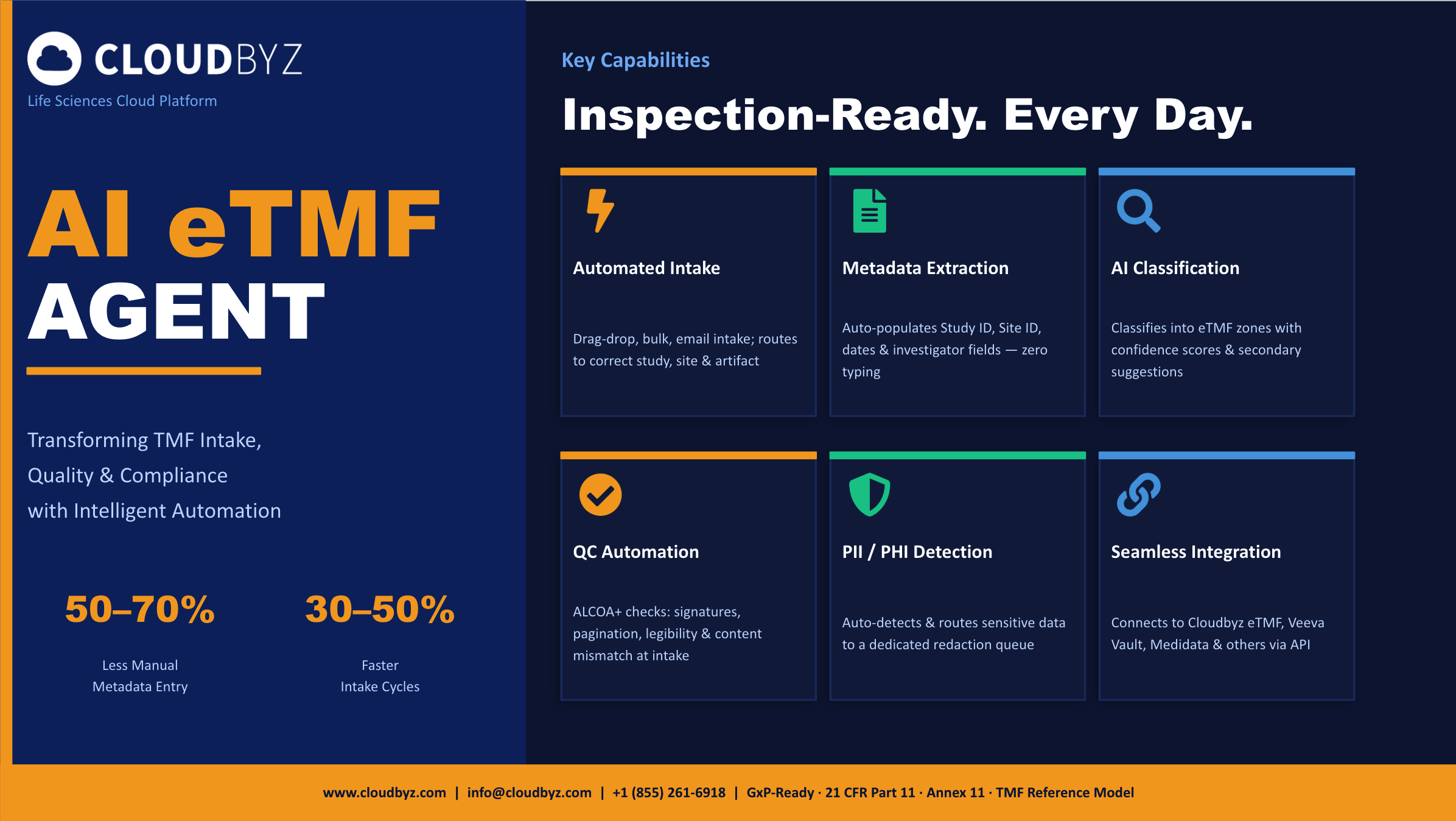
An AI eTMF Agent goes further in three specific ways. First, it understands content — it reads the actual document, not just its filename, using optical character recognition and natural language processing to determine what the document is and what it contains. Second, it reasons about state — it compares what exists against what should exist for a given study, country, and site, and forms a judgment about completeness, timeliness, and quality. Third, and most importantly, it acts — it classifies, extracts metadata, files documents to the right artifact, raises specific gaps, drafts remediation tasks, and answers questions in natural language, escalating to a human only where judgment or accountability requires it.
That last property is what makes it "agentic" rather than merely "automated." An automation executes a fixed rule. An agent pursues a goal — an inspection-ready TMF — and orchestrates the steps needed to get there, adapting as the trial's document landscape changes.
The Problem It Solves
To appreciate why this matters, look at the three dimensions that regulators and sponsors actually care about in a TMF: completeness, timeliness, and quality. TMF findings in inspections almost always trace back to failures in one of these three.
Completeness is the question of whether every document that should exist actually does. The challenge is that the expected set is not fixed — it depends on trial phase, therapeutic area, geography, regulatory framework, number of sites, and dozens of protocol-specific factors. Manually maintaining an accurate expected-document list across a multi-country study is enormous work, and the moment the protocol is amended, the list shifts underneath you.
Timeliness is the question of whether documents are filed contemporaneously rather than reconstructed in a panic before an inspection. ICH E6(R3) sharpens the expectation that the TMF be maintained throughout the trial in a way that allows effective management and reconstruction of the conduct of the study — not assembled retroactively. A document that shows up in the file six months late tells an inspector a story, and it isn't a flattering one.
Quality is the question of whether each document is the right version, legible, correctly signed and dated, complete, and free of the small defects — a missing signature, a wrong date, a superseded version left active — that individually seem trivial and collectively signal a control failure.
The reason these three are hard is not that any single check is difficult. It's the volume. A mid-sized study generates tens of thousands of documents; a large program, hundreds of thousands. Human QC of that volume is slow, expensive, inconsistent between reviewers, and — because it's usually sampled rather than exhaustive — incomplete by design. The AI eTMF Agent's core value proposition is exhaustive review at machine speed, applied continuously rather than at audit time.
What an AI eTMF Agent Actually Does
The capabilities cluster into a handful of concrete jobs.
Auto-classification and filing. When a document enters the system, the agent reads it and determines its artifact type according to the TMF Reference Model — distinguishing, for example, a signed informed consent form from a protocol amendment from a monitoring visit report — and files it to the correct zone, section, and artifact without a human choosing from a dropdown. Because it reads content rather than trusting the filename, it catches the mislabeled and the miscategorized.
Metadata extraction. From the document body, the agent pulls the structured attributes the eTMF needs: site number, investigator name, document date, version, country, expiration date, and so on. This is the step that historically drives the most manual keystrokes and the most transcription errors, and it's where extraction models deliver an immediate, measurable reduction in effort.
Quality and duplicate detection. The agent flags the defects that undermine document quality — missing signatures or dates, illegible scans, wrong-language versions, and superseded documents that should have been archived — and identifies duplicates and near-duplicates that inflate the file and confuse reviewers.
Completeness monitoring against a dynamic expected-document list. This is where reasoning matters most. The agent maintains a live model of what documents should exist for each study, country, and site given the current protocol and regulatory context, continuously compares it against what does exist, and surfaces the specific, named gaps — not "the site file looks thin," but "Form FDA 1572 is missing for Site 104" or "the IRB approval on file predates the current protocol amendment."
Inspection-readiness scoring and alerting. Rolling those signals up, the agent produces a real-time readiness picture — completeness percentages, aging of open items, quality-defect counts — by study, country, and site, and pushes alerts when a metric drifts out of tolerance, so that readiness is a standing state rather than a project you spin up before an audit.
Natural-language query. Instead of navigating folder trees, a study team member can ask a question — "Which sites are missing current CVs for their sub-investigators?" or "Show me every document filed late in Germany this quarter" — and get an answer grounded in the actual file, with links to the underlying documents.
How It Works Under the Hood
The pipeline is less mysterious than it sounds. A document arrives and is rendered readable through OCR where needed. NLP and document-understanding models identify the artifact type and extract entities and metadata. A classification layer maps the result to the TMF Reference Model. A reasoning layer — increasingly powered by large language models — compares the extracted state against the expected-document model and the quality ruleset, and decides what, if anything, needs to happen. An orchestration layer then acts: filing the document, writing the metadata, creating a remediation task, raising an alert, or routing an ambiguous case to a human reviewer.
The architectural choice that separates a serious deployment from a demo is where this runs and how it's governed. In a regulated environment, the agent cannot be a black box bolted onto the side of the system of record. It has to operate inside the validated eTMF, respect the same permissions and audit trail, and produce actions that are themselves auditable. Platforms that embed the agent natively — where the AI reasoning and the document repository share one governed environment rather than passing data across integrations — have a structural advantage in validation, security, and traceability.
The Regulatory Frame: Why "Agentic" Doesn't Mean "Unsupervised"
This is the part that separates a credible AI eTMF strategy from a risky one.
Everything an AI eTMF Agent touches sits inside a GxP environment, which means it inherits the full weight of good clinical practice, ALCOA+ data-integrity principles, and, for systems used in FDA-regulated work, 21 CFR Part 11 expectations around electronic records and signatures. ICH E6(R3), with its explicit emphasis on quality by design, risk-based thinking, and the sponsor's accountability for oversight, is the governing backdrop — and nothing in it lets you outsource judgment to a model.
The practical implication is human-in-the-loop by design. The agent should be trusted to do the high-volume, high-consistency work — reading, classifying, extracting, comparing, flagging — and should be explicit about its confidence. High-confidence, low-risk actions can proceed automatically with a full audit trail. Lower-confidence or higher-consequence decisions get routed to a qualified human, whose decision is captured. The goal is not to remove the human; it's to spend human attention where it actually adds value — on judgment and exceptions — instead of on the mechanical bulk of the work.
Two more governance points matter. Validation: the agent is part of a computerized system and must be validated for its intended use, with its performance monitored over time, not assumed to be static. And explainability: when the agent classifies a document or raises a gap, a reviewer needs to be able to see why, both to trust the output and to defend it to an inspector. An agent that can't show its reasoning is a liability in an audit, no matter how accurate it is on average.
The Payoff
When it's done well, the benefits are concrete rather than aspirational.
The most immediate is the collapse of manual effort on classification, indexing, and metadata entry — the work that consumes the most hours and generates the most errors. The second is a shift from periodic, sampled, retrospective QC to continuous, exhaustive, real-time monitoring, which changes inspection readiness from a recurring project into a maintained state. The third is earlier detection: because completeness is monitored continuously against a live expected-document model, gaps surface while they're still cheap to fix, rather than at the moment an inspector finds them. And the fourth, easy to overlook, is that freeing skilled clinical operations staff from document-wrangling lets them do the oversight and risk work that ICH E6(R3) actually wants them doing.
What to Look for — and Watch Out For
If you're evaluating an AI eTMF Agent, a few questions cut to the substance.
Ask whether the AI is native to the eTMF or bolted onto it, because that determines how clean the validation, security, and audit story is. Ask how the expected-document model is built and maintained, and whether it adapts to protocol amendments automatically. Ask how the system handles low-confidence cases — a mature agent is candid about uncertainty and routes accordingly, rather than guessing confidently. Ask to see the audit trail for an AI-driven action end to end. And ask how the models are validated and monitored over time, since a model that was accurate at go-live can drift as document types and formats evolve.
The failure modes to avoid are the mirror image of these: an opaque agent that can't explain a classification, an over-automated one that acts on low-confidence guesses without oversight, an integration-heavy architecture that fragments the audit trail across systems, and a static expected-document list that quietly goes stale the first time the protocol changes.
Where This Is Heading
The near-term trajectory is toward agents that don't just monitor the TMF but actively help close it — drafting the missing-document requests to sites, pre-populating remediation tasks, and reconciling the TMF against adjacent systems like the CTMS and EDC so that a milestone recorded in one system automatically raises the expectation of a corresponding document in another. The longer-term direction is a TMF that is continuously and provably inspection-ready as a default condition of running the trial, with human experts supervising a system that does the mechanical work — a genuine inversion of how the job has been structured for the last thirty years.
The Trial Master File will always be a record of accountability, and accountability will always rest with people. What the AI eTMF Agent changes is the ratio: less human time spent proving the file is complete, more spent on the judgment and oversight that only people can provide. For clinical operations teams that have spent years treating TMF completeness as a permanent background anxiety, that's not a small shift. It's the difference between chasing the file and running the trial.
Interested in how an AI eTMF Agent fits into a unified, Salesforce-native eClinical platform — with CTMS, eTMF, EDC, and safety operating on one governed data model? That's exactly the kind of integrated, audit-ready foundation where agentic AI delivers the most, because the agent reasons across the whole trial rather than a single silo.
Subscribe to our Newsletter
