

Request a demo specialized to your need.
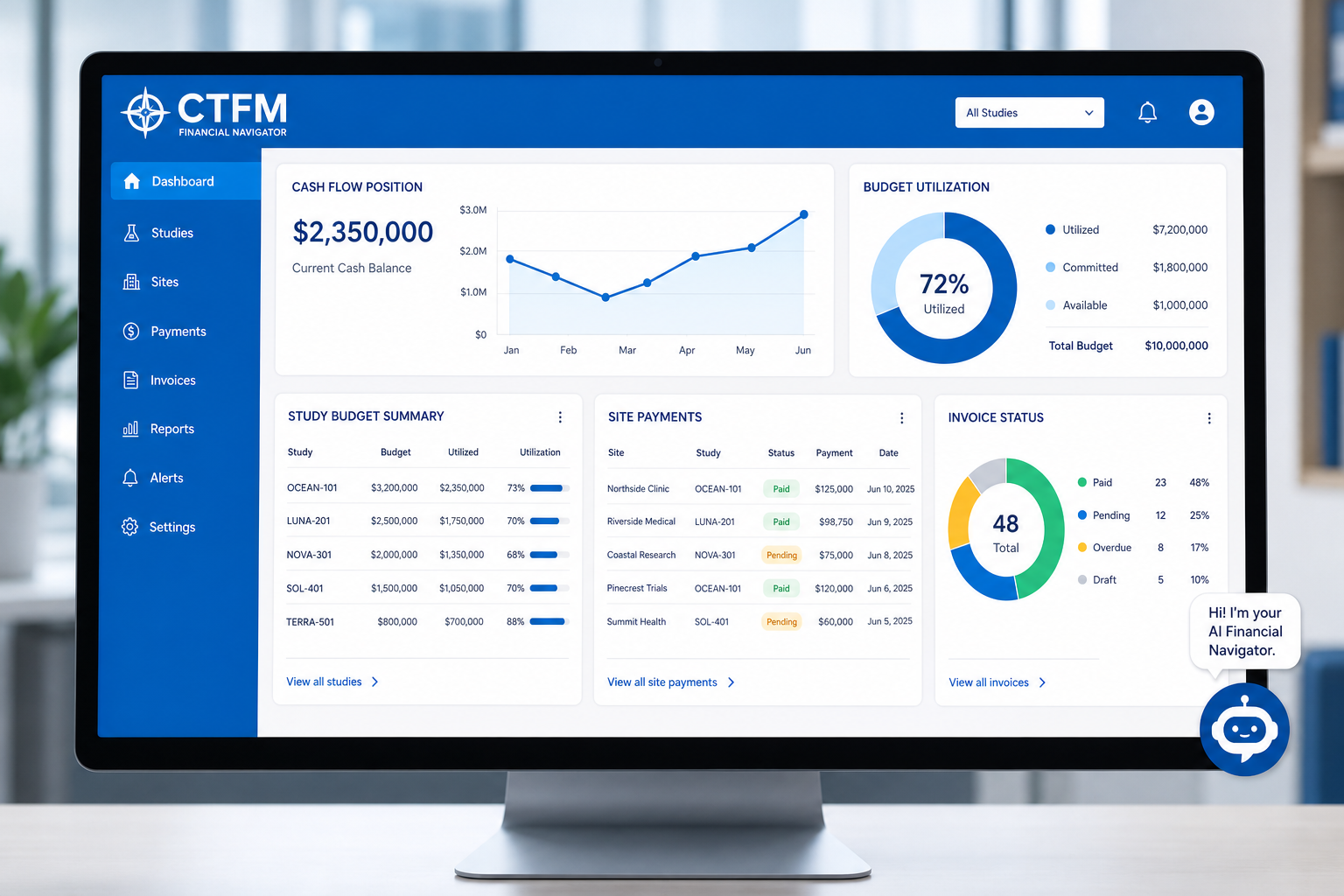
Cloudbyz eClinical, built natively on Salesforce Agentforce, adds a read-only AI agent to Clinical Trial Financial Management (CTFM) that answers payment, budget, and cash flow questions in real time — without ever touching a record.
The Problem: Financial Answers Live Behind Ten Minutes of Clicking
Ask a study manager whether a site has been paid, and the honest answer is usually "give me a few minutes." Clinical trial finance data is inherently fragmented — payables sit in one view, invoices in another, budget versions in a third, and the sponsor receivables picture somewhere else entirely. Answering a single question like "has Site 104 been paid for the visits completed last month?" often means opening multiple screens, cross-referencing payment and invoice records, and manually reconciling what was earned against what was billed and what was actually paid.
Multiply that by every site, every study, and every finance stakeholder who asks a version of the same question — study managers checking on a site payment, site coordinators following up on an invoice, finance leads reviewing budget utilization before a sponsor call — and the cumulative time cost becomes significant. Worse, because the review is manual, the things that matter most — an invoice quietly aging past 90 days, a budget dangerously concentrated in one site, a growing gap between what's been paid out and what's been collected — are exactly the things most likely to be missed until they become a problem.
This is the gap the CTFM Financial Navigator is built to close.
What the CTFM Financial Navigator Is
The CTFM Financial Navigator is a read-only conversational analyst built into Cloudbyz eClinical's Clinical Trial Financial Management module, powered by Salesforce Agentforce. It answers financial questions in real time and, on request, assembles a complete financial picture for a study or site — pulling together payables, invoices, budgets, and payment status into a single, plain-English answer.
The design principle behind the agent is deliberate and important: it queries and returns answers, and never creates, updates, or deletes records. It is not a workflow automation tool and it does not touch the underlying financial data. Every number it surfaces is a live read of the system of record, which means finance teams get speed and visibility without introducing any new risk to data integrity or audit trail.
Who It's Built For
The CTFM Financial Navigator serves two distinct usage patterns:
- Clinical trial finance teams and study finance leads, who use it for deeper financial analysis — budget utilization, version comparisons, concentration risk, and cash flow position across studies.
- Study managers and site coordinators, who get day-to-day value from something much simpler: a fast, reliable answer to "has this site been paid?" or "what's the status of this invoice?" — without needing to understand the underlying financial system at all.
Core Features
1. Plain English Answers on Payments, Budgets, and Financial Summaries
Users can ask direct questions — "What's the invoice status for Site 212?", "How much of the study budget has been utilized?", "What's the financial summary for this study this quarter?" — and get an immediate answer drawn directly from live CTFM data, no report-building or screen-hopping required.
2. Full Payable-to-Invoice Lifecycle Tracing
The agent can trace an individual payable through its entire lifecycle — from earned, to billed, to paid — giving finance teams and site coordinators a single, coherent answer to what is normally a multi-system reconciliation exercise.
3. Proactive Flagging of Aging, Stalled, and Cleanup Items
The Navigator flags invoices aging past 90 days, stalled drafts that never progressed, and zero-amount records that need cleanup — the kind of housekeeping issues that are individually minor but collectively erode financial control when left unaddressed.
4. Budget Version Comparison and Concentration Risk Detection
The agent compares budget versions over time and flags concentration risk — for example, when a single site holds a disproportionate share of a study's total budget. This surfaces a structural financial risk that is difficult to see without deliberately comparing budget allocations across every site in a study.
5. Cash Flow Gap Visibility
The Navigator surfaces the cash flow gap between what has been paid out to sites and what has been received from the sponsor — giving finance leads real-time visibility into the study's net cash position rather than requiring a manual reconciliation between two separate ledgers.
6. Explains Financial Mechanics, Not Just Numbers
Beyond reporting figures, the agent explains why they are what they are — for instance, why a payment amount is smaller than the corresponding invoice once withholding and indirect costs are applied. This turns the agent into a financial explainer as much as a financial reporter, reducing the back-and-forth that normally happens when a site or study team questions a payment amount.
Why It Matters: The Value Proposition
Minutes, not lookups. A question that used to take 10 to 15 minutes of multi-screen lookup and manual reconciliation is answered in seconds through a single conversational query.
Finance teams get their time back. By absorbing routine payment and status questions, the Navigator frees finance staff to focus on approvals, exception handling, and higher-value strategic financial oversight rather than repetitive lookups.
It catches what manual review tends to miss. Cash flow gaps, budget concentration, and invoice aging are exactly the categories of risk that fall through the cracks in period-based manual reviews. Continuous, conversational access means these risks surface as they emerge, not at quarter-end.
It keeps payment questions from becoming site friction. When a site coordinator can get an immediate, accurate answer about payment status, a routine question never has the chance to escalate into a relationship or trust issue between sponsor, CRO, and site.
Built Natively on Salesforce Agentforce
As part of the Cloudbyz eClinical platform, the CTFM Financial Navigator runs directly against live CTFM data within the same native Salesforce architecture used across Cloudbyz's CTMS, eTMF, and pharmacovigilance products. There is no separate financial data warehouse to maintain, no export-and-reconcile step, and no lag between what happened financially and what the agent can answer — because it is reading the same system of record finance teams already work in.
The Bottom Line
Clinical trial finance has never suffered from a lack of data — payables, invoices, budgets, and payment histories all exist, just scattered across systems and screens that take time to reconcile. The CTFM Financial Navigator gives finance teams, study managers, and site coordinators a single conversational entry point to all of it: fast, accurate, explainable, and strictly read-only, so speed never comes at the cost of financial control.
To see the CTFM Financial Navigator in action on Cloudbyz eClinical, reach out to the Cloudbyz team for a demo.
Subscribe to our Newsletter
