
Request a demo specialized to your need.
There is a particular kind of silence that falls over a regulatory affairs team when the FDA issues a Refuse-to-File. Months of work — clinical data, manufacturing records, labeling, thousands of pages assembled across five modules — bounced back not because the science was wrong, but because a document was missing, mis-slotted, or failed to conform to a structural rule that everyone assumed had been checked.
The cruelty of the Refuse-to-File is that it is almost always preventable. The problems that trigger it are rarely scientific. They are clerical, structural, and procedural: an incomplete Module 1, a form that doesn't match the eCTD backbone, a cross-reference that points to a document that was revised three versions ago. These are exactly the kinds of errors that human reviewers, working under deadline pressure across thousands of pages, are least equipped to catch reliably — and exactly the kind of work that a well-designed AI agent is built to do.
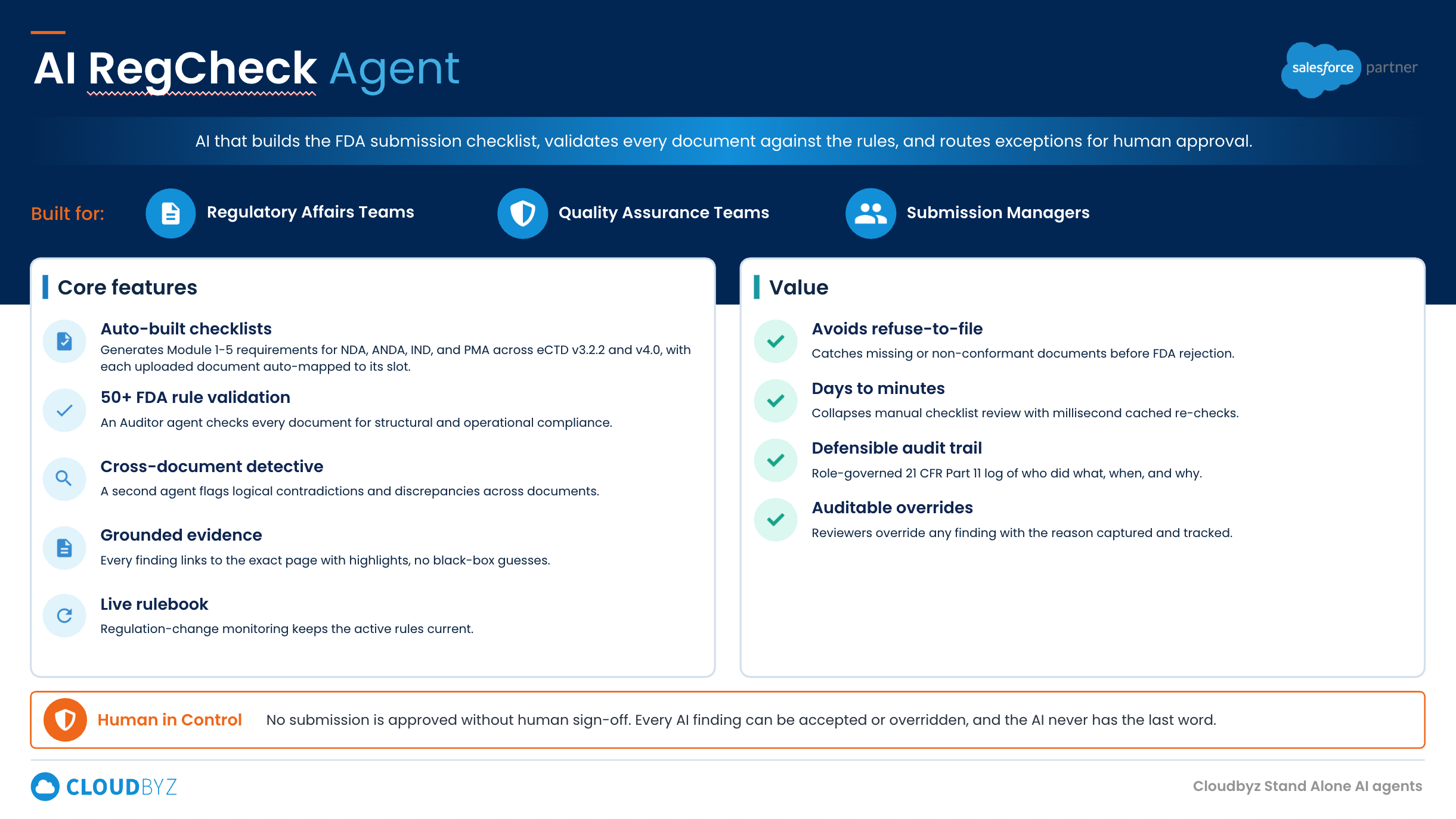
That is the problem the Cloudbyz AI RegCheck Agent was designed to solve: AI that builds the FDA submission checklist, validates every document against the rules, and routes exceptions for human approval.
The hidden cost of manual submission review
Ask any submission manager how they verify readiness today and you'll hear a version of the same story. A senior regulatory professional sits down with the applicable guidance, the eCTD specification, and a spreadsheet, and works through the submission document by document. Is Module 3 complete? Does the labeling in Module 1 match the clinical narrative in Module 5? Are the forms current? Is anything contradicting anything else?
It is painstaking, expensive, and — because it depends on human attention holding steady across an enormous volume of material — inconsistent. The same submission reviewed twice can produce two different lists of findings. And when a regulation changes, every checklist built against the old rules quietly becomes wrong until someone remembers to update it.
The manual model doesn't fail because regulatory teams aren't good at their jobs. It fails because the task has outgrown what manual review can guarantee. Submissions have gotten larger, timelines have gotten tighter, and the cost of a single missed detail has gotten higher.
What the AI RegCheck Agent actually does
The AI RegCheck Agent is a standalone AI agent in the Cloudbyz portfolio, built for the three roles that live and die by submission quality: regulatory affairs teams, quality assurance teams, and submission managers. Rather than replacing their judgment, it does the exhaustive, repeatable, high-volume verification work that human review can never do perfectly at scale — and then hands the decisions back to the people accountable for them.
Here is how it works.
It builds the checklist for you
Most submission-readiness work starts with a question that shouldn't require a senior person to answer: what, exactly, does this submission need to contain? The AI RegCheck Agent answers it automatically. It generates the Module 1 through Module 5 requirements for NDA, ANDA, IND, and PMA filings, across both eCTD v3.2.2 and the newer v4.0 standard. As documents are uploaded, each one is auto-mapped to its correct slot in the structure.
The result is that the checklist is no longer something a person assembles from memory and a PDF of the guidance. It is generated correctly, every time, for the submission type at hand — and the moment a document arrives, the agent knows where it belongs.
It validates every document against the rules
Behind the checklist sits an Auditor agent that runs each document through more than 50 FDA rules, checking for both structural and operational compliance. This is the layer that catches the conformance failures — the ones that trigger Refuse-to-File — before the submission ever leaves the building. It is the difference between finding out a document is non-conformant during your own internal review and finding out from a rejection letter weeks later.
It reads across documents, not just within them
Some of the most damaging submission errors aren't errors in any single document — they're contradictions between documents. A dosage stated one way in the label and another way in a clinical summary. A study reference that doesn't reconcile with the data it points to. These are nearly invisible to a reviewer working through files one at a time.
The AI RegCheck Agent runs a second agent — a cross-document detective — whose entire job is to flag logical contradictions and discrepancies across the submission. It holds the whole package in view at once and surfaces the inconsistencies that page-by-page review structurally cannot see.
It shows its work
The fastest way to lose a regulatory team's trust is to hand them a finding they can't verify. The AI RegCheck Agent is built to avoid the black box entirely. Every finding it produces links directly to the exact page it came from, with the relevant text highlighted. There are no unexplained verdicts and no "trust me" outputs — a reviewer can see precisely what the agent saw, evaluate it in seconds, and decide.
Grounded evidence isn't a nice-to-have in a regulated context. It is what makes an AI finding usable at all.
It keeps the rulebook current
The rules do not stand still. Guidance is revised, eCTD standards evolve, and requirements shift. The AI RegCheck Agent includes a live rulebook with regulation-change monitoring, so the active rule set stays current without a person having to notice, interpret, and manually rebuild the checks. The submission you validate today is validated against today's rules — not last year's.
The business case: what this changes
The features are the mechanism. The value is what regulatory and quality leaders actually care about.
It avoids the Refuse-to-File. By catching missing or non-conformant documents before the FDA ever sees them, the agent addresses the single most expensive, most demoralizing, and most avoidable outcome in the submission process. Every RTF it prevents is months of timeline and a significant slice of cost preserved.
It turns days into minutes. Manual checklist review that consumes days of senior time collapses into a process that runs in minutes — and because results are cached, re-checks after a document update return in milliseconds rather than requiring the whole review to start over.
It produces a defensible audit trail. Every action is captured in a role-governed, 21 CFR Part 11-compliant log of who did what, when, and why. When an inspector or a partner asks how a submission was verified, the answer is documented, complete, and defensible — not reconstructed from memory and email threads.
It makes overrides auditable. Reviewers can override any finding the agent produces, and when they do, the reason is captured and tracked. Disagreement with the AI is not a gap in the record; it becomes part of it.
Human in control, by design
This last point deserves its own emphasis, because it is the design principle the entire agent is built around: no submission is approved without human sign-off. Every AI finding can be accepted or overridden, and the AI never has the last word.
This matters for more than compliance optics. In a regulated environment, accountability cannot be delegated to a model — it belongs to a named, qualified person. The AI RegCheck Agent is structured to honor that reality. It does the tireless, exhaustive verification work that humans do poorly at scale, and it reserves every consequential decision for the humans who are accountable for it. The agent makes the reviewer faster, more thorough, and better-armed. It does not make the reviewer optional.
That balance — machine-scale rigor with human-held authority — is what makes an AI agent trustworthy enough to sit inside a regulatory workflow in the first place.
Built on the platform your quality system already lives on
The AI RegCheck Agent is part of Cloudbyz's portfolio of standalone AI agents, and it inherits the advantages of being built by a Salesforce-native eClinical company. Role-based governance, 21 CFR Part 11-grade audit logging, and secure record-keeping aren't features bolted on after the fact — they are the foundation the platform is built on. For teams that already need their regulatory operations to be inspection-ready and enterprise-governed, that foundation is not a detail. It is the whole point.
The takeaway
Submission review has quietly become a task that manual effort can no longer guarantee. The volumes are too large, the rules change too often, and the cost of a single missed detail is too high. The AI RegCheck Agent doesn't ask regulatory teams to work harder against that reality — it changes the math. It builds the checklist automatically, validates every document against more than 50 FDA rules, reads across the entire submission for contradictions, grounds every finding in the source page, and keeps the rulebook current — all while leaving every final decision exactly where it belongs: with a human.
The Refuse-to-File was always preventable. Now there's an agent whose entire job is to prevent it.
The Cloudbyz AI RegCheck Agent is part of Cloudbyz's portfolio of standalone AI agents for life sciences. To see it applied to your submission workflow, connect with the Cloudbyz team.
Subscribe to our Newsletter
